

Once lines like these are drawn, they rarely get erased.
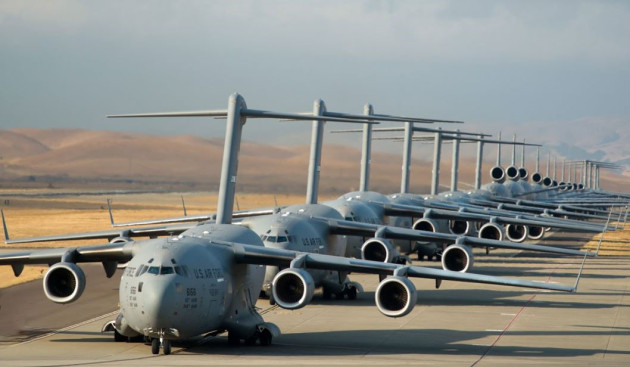
The Airlift That Never Retires
The U.S. Air Force is about to give its workhorse a second life, and it’s doing it at the same time Washington is pushing harder than ever to sell American steel overseas.
This week, the Air Force awarded contracts to modernize the C-17 Globemaster III fleet, a platform that has been hauling tanks, troops, and everything in between since the early 1990s. The plan is simple: keep the jet relevant well into the 2070s. That is not a typo. The new avionics and flight-deck modernization effort is designed to replace aging systems, add modular open-architecture computing, and make it easier to bolt on future upgrades without tearing the airplane apart.
Boeing and its partners will update mission computers, cockpit displays, and core avionics to deal with obsolescence and keep the aircraft flying for decades. The Air Force wants a plug-and-play architecture that allows new tech to slide in as threats evolve. In plain English, the C-17 is getting a digital nervous system transplant so it can keep doing what it does best: move the war.
We’ve been awarded a new contract with the @usairforce to modernize flight decks for its C-17 aircraft.
This collaboration—which covers the design, manufacturing, integration, and qualification of the upgraded flight decks—will extend the life and capabilities of the USAF’s… pic.twitter.com/dXNpIxPmfQ
— Boeing Defense (@BoeingDefense) February 9, 2026
The timing matters. Strategic airlift is not glamorous, but it wins wars. Every deployment, every humanitarian mission, every armored brigade crossing an ocean starts with cargo in a C-17. Keeping that fleet viable into the 2070s signals that the United States intends to maintain global mobility even as the fight shifts toward the Pacific and high-end competition.
Now add the second half of the equation: a new executive order aimed at speeding up foreign arms sales and boosting domestic production. The White House rolled out what it calls an “America First Arms Transfer Strategy,” which directs agencies to cut red tape, accelerate approvals, and prioritize sales to allies that matter strategically. The idea is to use foreign demand to expand U.S. manufacturing capacity while getting weapons into allied hands faster.
In practical terms, that means fewer bureaucratic delays, more coordination with industry, and a stronger push to turn U.S. defense exports into a tool of industrial and strategic leverage. Officials say the policy is meant to strengthen supply chains, speed deliveries, and ensure allies can field American equipment before adversaries close the gap.
Put those two moves together, and a pattern emerges. The Pentagon is investing in the muscle that moves forces around the globe while Washington works to arm partners who can hold ground in their own regions. One keeps the pipeline open. The other fills it.
The C-17 will keep flying for another half-century. And if the export push works the way planners hope, it won’t be flying alone.
China’s “Secret Test” Problem, and Why It Matters Now
The United States just lobbed a very specific accusation at Beijing, and it landed in the worst possible moment for nuclear stability.
On February 6, at the Conference on Disarmament in Geneva, U.S. Under Secretary of State Thomas DiNanno said Washington believes China conducted a “yield-producing” nuclear test on June 22, 2020, and prepared for additional tests with yields in the “hundreds of tons.” He also claimed China used “decoupling,” a technique meant to muffle a blast’s seismic signature by detonating in an underground cavity, basically trying to make a nuclear test look like background noise.
China’s response was not subtle. Beijing called the allegation “outright lies,” said it was “completely groundless,” and accused Washington of manufacturing an excuse to restart U.S. nuclear testing.
Then the referee stepped onto the field. The Comprehensive Nuclear-Test-Ban Treaty Organization, the Vienna-based body that runs the global monitoring network for nuclear explosions, said its system did not detect anything consistent with a nuclear test at the time Washington cited, and that further analysis did not change that conclusion.
🚨🇺🇸🇨🇳🇷🇺 The era of nuclear arms control is ending. With the New START treaty set to expire on February 5, 2026, and China rapidly expanding its nuclear arsenal, the world is entering a far more dangerous phase, a three power nuclear arms race involving the U.S., Russia, and… pic.twitter.com/5bDCSPvD3H
— Defence Index (@Defence_Index) February 1, 2026
So who’s right? Publicly, we do not have the underlying U.S. intelligence. We do have the CTBTO saying, in plain language, it did not see a signature that looks like a nuclear blast. That gap is the whole story.
This flare-up is not happening in a vacuum. New START, the last treaty limiting U.S. and Russian strategic deployments, expired on February 5, leaving the two biggest arsenals without binding caps for the first time since the early 1970s. The Comprehensive Nuclear-Test-Ban Treaty still is not in force, and key countries including the United States and China have signed but not ratified it.
The timing also matters because the U.S. President in October ordered the military to resume the process for nuclear weapons testing, pointing to alleged foreign activity without providing details at the time. Now the administration is naming a date, a method, and a target.
If this is a bluff, it is a dangerous one. If it is true, it is worse. Either way, we are watching the old arms-control scaffolding come apart while three nuclear superpowers glare at each other over the rubble.








COMMENTS