

U.S. European Command said the two sides agreed to reestablish the mechanism after talks in Abu Dhabi that involved U.S., Russian, and Ukrainian officials, with Gen. Alexus Grynkewich representing the U.S. side. The stated purpose is simple and painfully practical: reduce the risk of miscalculation and escalation.
Here’s the easiest way to understand it. Imagine two heavily armed men in a dark house, moving room to room with their fingers on the trigger. You do not need them to be friends. You need them to yell “I’m on the stairs” before somebody panics and empties a magazine into the drywall. That’s what military-to-military dialogue is in a high-tension environment, not diplomacy, not trust, just basic fire prevention.
Kari contended that if the 3 countries came to the negotiating table in the near future, the U.S. doesn’t have that much it could give up without sacrificing security. pic.twitter.com/5of6hBvGd0
— CSIS Missile Defense (@Missile_Defense) February 9, 2026
It is also not the same thing as an emergency hotline, which never fully disappeared. Even after the broader dialogue froze, reporting notes an emergency deconfliction line remained available, the kind of last-ditch phone you pray you never have to use. The difference now is intent and frequency, a return to regular, structured contact instead of a break-glass option.
Timing matters. This restart lands as Washington keeps trying to shape an off-ramp to the Ukraine war, and it coincides with a brutal reality: the guardrails of arms control are thinner than they have been in decades. The Washington Post reported the announcement came the same day New START expired without a replacement, and officials see renewed military dialogue as one tool to improve transparency and dampen worst-case assumptions.
The takeaway is not “America trusts Russia again.” It does not. This is the Department of War recognizing that even hostile powers need a way to talk shop when the consequences of a misunderstanding are measured in wreckage, not press releases.
A line of communication does not make peace. It just lowers the odds that a bad night turns into an irreversible one.
U.S. Warships Off Haiti: A Show of Presence as the Floor Drops Out
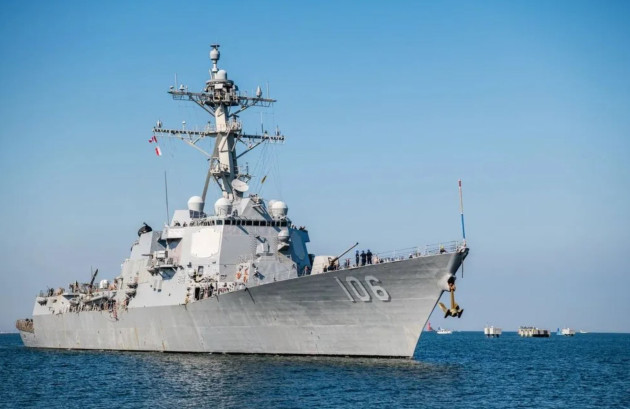
Three American cutters and gray hull muscle have slid into the Bay of Port-au-Prince as Haiti’s political transition hits a hard stop and the security situation keeps bleeding. The ships are the U.S. Navy guided-missile destroyer USS Stockdale and two Coast Guard cutters, USCGC Stone and USCGC Diligence, according to the U.S. Embassy statement cited by regional reporting.
The timing is not subtle. Haiti’s nine-member Transitional Presidential Council was installed in April 2024 to help steer the country toward elections and stabilize the state after years of collapse. Its mandate ended on February 7, 2026, and it ended with no agreed succession plan. Reuters described the moment plainly: political limbo, worsening insecurity, and no consensus on what replaces the council.
Washington’s public line is risk management. The U.S. Embassy said the warships’ presence reflects an “unwavering commitment” to Haiti’s security and stability. The wider picture is that the Department of War is trying to keep Haiti from slipping into a vacuum that gangs can fill completely, while also protecting U.S. interests in the approaches to the Caribbean.
At the direction of @SecWar, USS Stockdale (DDG 106), USCGC Stone (WMSL 758) and USCGC Diligence (WMEC 616) have arrived in the Bay of Port-au-Prince. Their presence reflects the United States’ unwavering commitment to Haiti’s security, stability, and brighter future. The… pic.twitter.com/DAQLeIpVIG
— U.S. Southern Command (@Southcom) February 4, 2026
Think of this like a fire engine pulling up to a neighborhood where the hydrants are broken, and arsonists run the block. The engine cannot rebuild the city, but its presence changes behavior. Maybe.It gives locals a little room to breathe, and it gives bad actors something to think about.
There is also a second lane here that matters. The embassy statement tied the deployment to Operation Southern Spear, the Trump administration’s regional campaign aimed at countering narcotics trafficking networks across the Caribbean and Eastern Pacific. That matters because Haiti’s instability is not isolated. When governance collapses, trafficking routes thicken, weapons flow faster, and the region gets uglier for everyone.
Meanwhile, the international security effort meant to help Haitian police is still underweight. Reuters reported that fewer than 1,000 troops, mostly Kenyan police, were deployed as part of the U.N.-backed force, far short of the 5,500 envisioned, with the U.N. aiming for full strength by summer.
So this naval move is not an invasion and it is not a rescue mission.
It is a signal and a pressure point.
Haiti’s political crisis is deepening, and the Department of War is placing a visible thumb on the scale, hoping the next stumble does not become a fall.








COMMENTS