The U.S. has transferred over 2,200 ISIS detainees from Syria to Iraq to alleviate overcrowding and enhance security, while also engaging in ongoing strikes against ISIS. Concurrently, talks between the Syrian government and Kurdish forces are underway to integrate security operations in northeast Syria, aiming for a unified approach against ISIS.
Key points from this article:
The U.S. moved 2,200+ ISIS detainees from the al-Sina’a prison complex in Hasakah, Syria, to Iraq to reduce pressure on local forces.
How the transfer of detainees to Iraq allows Baghdad to utilize its established counterterrorism infrastructure to manage ISIS fighters more effectively.
Why the ongoing U.S. strikes against ISIS in Syria indicate that the detainee transfers are part of a broader strategy to maintain pressure on ISIS during a transitional period in the region.
Updating summary...
Evening Brief: U.S. Transfers ISIS Detainees, SDF Integrates With Damascus, Floods Hit Idlib, Violence Spreads in Nigeria
Galen Fries
Speed
1x
Listen
COMMENTS
U.S. forces are transferring ISIS detainees from Syria to Iraq as Damascus and the SDF begin security integration talks, while deadly floods hit Idlib displacement camps and coordinated militant raids escalate violence in Nigeria’s northwest.
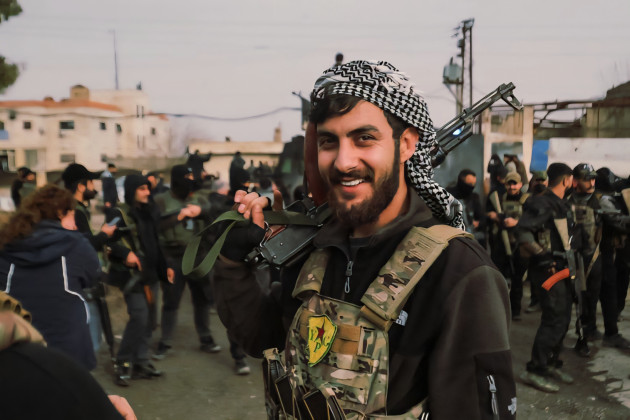
A Kurdish forces soldier reacts as Syrian government soldiers enter the northeastern Syrian city of Hasakah. Image Credit: Delil Souleiman/AFP
U.S. Moves 2,200+ ISIS Detainees From Syria to Iraq as Hasakah Transfers Accelerate
U.S. forces have moved more than 2,200 ISIS detainees from northeast Syria into Iraq in recent weeks, according to Iraqi officials tracking the transfers. The latest reported convoy left the Hasakah area on February 7, pulling detainees from the al-Sina’a prison complex in the Ghwayran neighborhood, a facility long treated as a pressure point in the fight against ISIS.
Advertisement
This is a logistics operation with strategic weight. The detainee system in northeast Syria has always been a fracture line: overcrowded facilities, limited manpower, and a running fear of another coordinated break attempt. Moving detainees out reduces the load on local forces and shifts the detention problem onto a state that has courts, prisons, and a standing counterterrorism apparatus built for this kind of fight.
CENTCOM has framed the mission as a security move designed to keep ISIS members in hardened detention and prevent escapes during a period of political and security transition in Syria’s northeast.
Iraq takes custody on arrival, and Baghdad has a direct interest in locking down fighters who still anchor networks on both sides of the border.
Advertisement
The transfers are also running alongside continued U.S. strike activity against ISIS targets in Syria. CENTCOM recently reported multiple strikes aimed at ISIS infrastructure and logistics nodes, signaling that detention moves are not replacing kinetic pressure.
No escapes have been reported during the convoys. The bigger question is what comes next for the wider detention ecosystem, especially the camps holding ISIS-linked families, which remain a separate problem with its own ignition points.
Advertisement
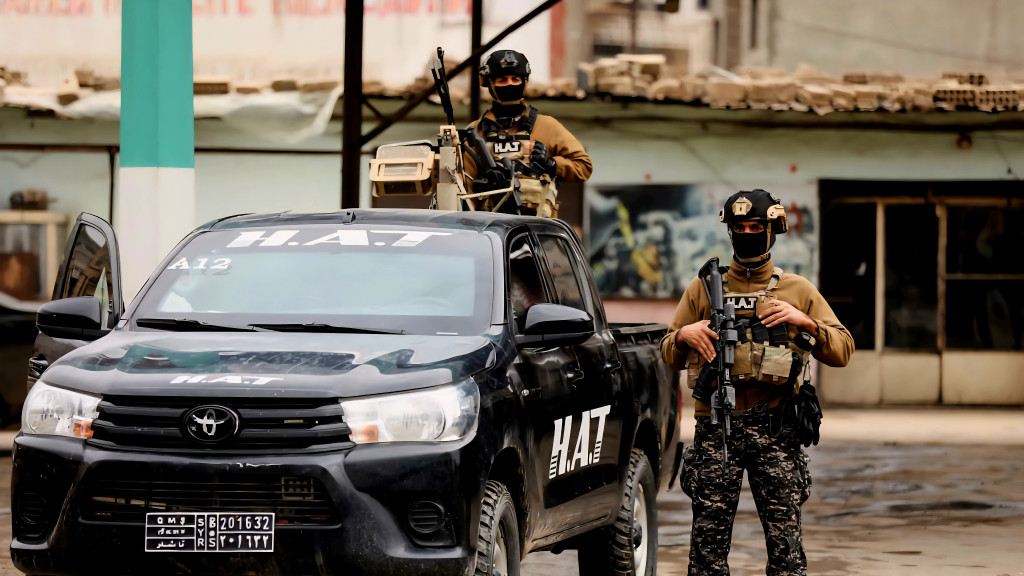
Members of the Kurdish Internal Security Forces – another group working to take over world with a Toyota. Image credit: REUTERS/Orhan Qereman
Syrian Government, SDF Begin Phased Integration Talks in Northeast Syria
Hasakah and Qamishli, Syria – Syrian Defense Ministry delegations led by Brig. Gen. Hamza al-Hmaidi met with representatives of the Kurdish-led Syrian Democratic Forces in Hasakah and Qamishli on February 7, kicking off implementation of a phased integration agreement announced January 30.
The meetings focused on moving the deal from theory to execution. According to official statements, both sides coordinated timelines for withdrawing armed units from civilian areas, reopening key roads, removing checkpoints, and beginning demining operations around strategic infrastructure, including airports and energy facilities. Field visits followed the talks to map out handovers and security responsibilities.
Advertisement
The agreement also lays the groundwork for incorporating SDF personnel into Syrian Army and Interior Ministry structures. Interior Ministry forces are expected to assume responsibility for civil institutions and internal security, while locally recruited personnel transition into state-run units during the process. Participants from both sides described the meetings as constructive and operationally focused.
The talks come after months of pressure on the SDF position in eastern Syria, where Damascus has steadily expanded its reach with support from tribal forces and negotiated arrangements rather than large-scale combat. The government’s objective is unified territorial control and continuity of security operations, particularly against ISIS cells that remain active in rural areas.
There have been no reported clashes linked to the integration effort so far. Security coordination and counter-ISIS missions remain a shared priority during the transition.
While implementation is still early, the talks mark a significant shift in northeast Syria’s power balance. The outcome will determine whether this process produces a stable security framework or simply reshuffles forces under a new flag while deeper tensions remain unresolved.
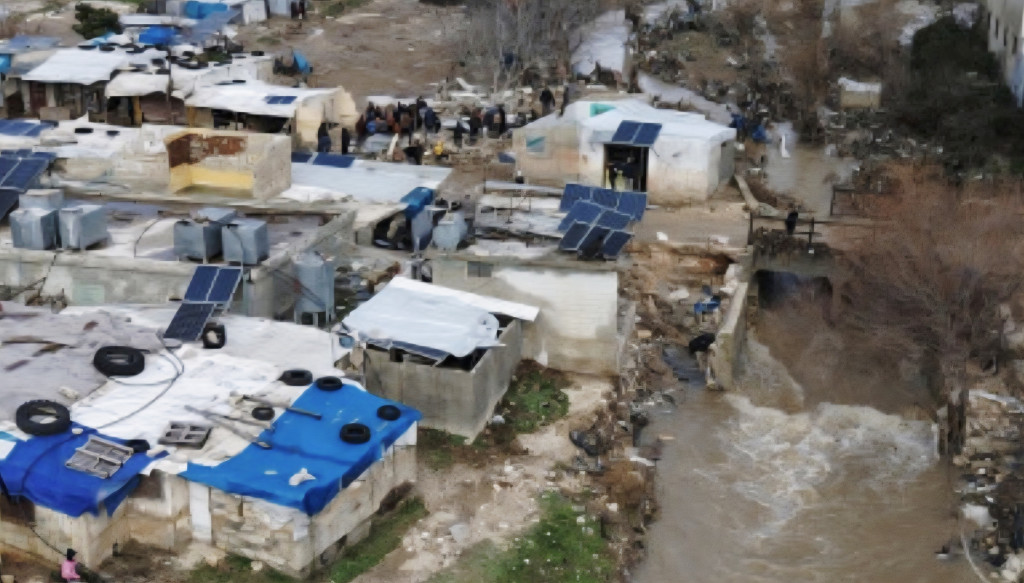
Tents and makeshift shelters damaged from floodwater in Khirbet al-Joz in Idlib, Syria. Image Credit: Getty
Flash Floods Hit Idlib Displacement Camps, Kill Two Children
Jisr al-Shughur, Syria — Heavy winter rain tore through northwest Syria this weekend, flooding low-lying towns and overwhelming displacement camps across Idlib’s western countryside.
Around Khirbet al-Jawz, floodwater ripped through tent settlements overnight, forcing families to flee as seasonal waterways spilled into living areas. By early Saturday, streets were submerged, vehicles stranded, and shops packed with mud and debris as residents waded through chest-deep water trying to salvage what they could.
Local reports say evacuation teams moved families away from flood zones and cleared drainage channels as water levels continued to rise. Schools and mosques were opened as emergency shelters, housing more than 500 displaced families.
The flooding also forced the evacuation of Ain al-Bayda Hospital after water inundated parts of the facility, sending patients and staff to hospitals in Jisr al-Shughur and Idlib city.
Further west, the town of Darkush was hit after the Orontes River rose sharply, pushing floodwater into homes and commercial areas.
The storm turned deadly in northern Latakia countryside, where flash flooding killed two children and another was rescued after being swept from a tent. A Syrian Arab Red Crescent team responding to the floods was also involved in a traffic accident in the Jabal al-Turkmen area, killing one volunteer and injuring several others.
Aid groups warn that standing water and damaged sanitation systems raise the risk of disease as temperatures drop. For families already displaced by years of war, the floods follow a familiar pattern: tents pitched on bad ground, limited drainage, and winter systems that hit fast and hard.
Reverend Father Nathaniel Asuwaye. Image Credit: Channelstv
Kaduna Violence Escalates as Gunmen Abduct Clergy in Parallel Raids
Kaduna State sits in northwest Nigeria, inland and north of Abuja, with long stretches of rough terrain where armed groups can move fast and disappear faster. That geography keeps paying dividends to the bad guys.
On Saturday, February 7, gunmen hit Karku community in Kauru Local Government Area. They stormed Holy Trinity Catholic Church around 3:20 a.m. and abducted the parish priest, Rev. Fr. Nathaniel Asuwaye, along with at least ten other residents. Three locals were killed in the attack: Jacob Dan’azumi, Maitala Kaura, and Alhaji Kusari.
Parallel raids hit Kagarko Local Government Area, where attackers seized Chief Imam Bello Abdullahi and Fulani community leader Shehu Bello during assaults on Janjala and nearby settlements. The attacks unfolded within the same operational window, reinforcing the sense of coordination rather than isolated criminal acts.
Security forces responded and made contact with the attackers during pursuit, but outcomes remain unclear and official casualty figures have not been confirmed.
This is the operating pattern in Nigeria’s northwest. Rapid raids. Civilian targets. Kidnapping built around clergy and community leaders who carry leverage. The playbook hasn’t changed: overwhelm, grab bodies, fade into terrain the state does not consistently control.
Call them bandits, call them terrorists, the result is the same. Churches and mosques remain predictable targets.
Advertisement
What readers are saying
Generating a quick summary of the conversation...
This summary is AI-generated. AI can make mistakes and this summary is not a replacement for reading the comments.










COMMENTS