News

Evening Brief: US Shoots Down Iranian Drone, Unidentified Biological Agents Found in Las Vegas Home, Iranian Gunboat Approaches US Tanker

Tonight, from the Arabian Sea to a quiet Las Vegas street and back through the Strait of Hormuz, American forces and investigators navigated drones, gunboats, and thousands of mysterious vials, each a reminder that danger often hides in plain sight, and volatility waits in every corner.

US Brings Down an Iranian Drone 

Tonight’s headline from the Arabian Sea reads like a script from a Tom Clancy thriller, only it is very real. In the late afternoon of Tuesday, February 3, U.S. Central Command confirmed that a U.S. Navy F‑35C Lightning II stealth fighter shot down an Iranian drone that was closing on the aircraft carrier USS Abraham Lincoln in international waters. The action was a textbook self‑defense strike, executed to protect one of America’s most valuable and visible power‑projection assets amid simmering tensions with Tehran.

Advertisement

The unmanned aerial vehicle in question was identified by U.S. officials as a Shahed‑139, a long‑endurance Iranian design capable of carrying a modest payload and, crucially, of being used in armed or reconnaissance roles. According to the Pentagon, the drone continued to press toward the Lincoln, roughly 500 miles off Iran’s southern coast, despite repeated warnings and de‑escalation efforts by U.S. forces. With the carrier and its strike group in the drone’s path and its intent unresolved, commanders elected to neutralize the threat.

An F‑35C, deployed with Carrier Air Wing Nine aboard the Abraham Lincoln, intercepted the aircraft and fired a missile that brought the drone down without damage to the carrier, its escorts, or any U.S. personnel. Central Command emphasized that no Americans were injured and no U.S. equipment was damaged in the encounter.

Advertisement

This shootdown did not happen in a vacuum. It unfolded on a day marked by multiple confrontations between U.S. forces and Iranian‑aligned units. In the Strait of Hormuz, Iranian Islamic Revolutionary Guard Corps boats, supported by at least one Mohajer drone, approached and attempted to harass the U.S.‑flagged tanker Stena Imperative. The guided‑missile destroyer USS McFaul, with air support, intervened and escorted the vessel out of harm’s way.

Diplomatically, Washington and Tehran are threading a needle. Talks between U.S. envoy Steve Witkoff and Iranian officials remain scheduled this week even as President Trump continues to push for substantive concessions, particularly on Iran’s nuclear program. Iran’s leadership, for its part, has indicated a willingness in private statements to engage in what it calls “fair and equitable negotiations,” though mistrust runs deep.

The shootdown underscores a broader truth: deterrence at sea remains a dangerous, delicate game. Every flight profile, every radar lock, every intercept carries the risk of miscalculation, especially when both sides measure resolve as keenly as they do distance. For now, this encounter was contained, but the region’s volatility remains undiminished.

Advertisement

Biomaterials of Questionable Origin Found in Las Vegas Home

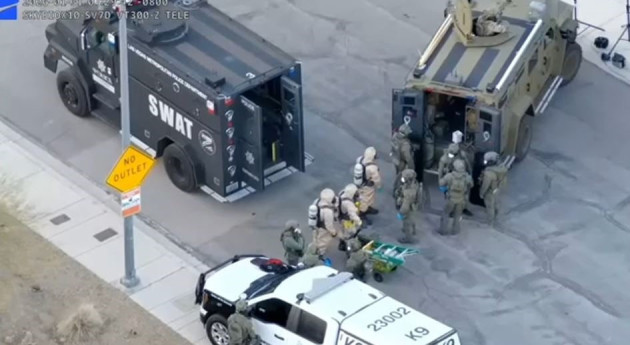
Las Vegas law enforcement stumbled onto a potentially hazardous situation over the weekend, hidden in plain sight on a quiet suburban street. Police and FBI agents executed a search warrant at a home on Sugar Springs Drive after a tip suggested unlicensed biological activity. Inside, HazMat teams found refrigerators and freezers holding more than 1,000 vials and containers of unknown liquids and biological materials. All samples were secured and transported to federal labs for testing.

Authorities were clear: there is no known threat to the public. No one was harmed, and HazMat and law enforcement teams handled everything under strict safety protocols. The FBI and Las Vegas police continue their investigation, combing through the property and analyzing the materials.

The property is linked to Jia Bei Zhu, also known as David He, a Chinese national previously arrested in 2023 in California after an unauthorized bio‑lab was discovered in Reedley. That prior case involved unregulated biological materials and misbranded diagnostic kits. Nevada authorities have noted only visual similarities between the materials in the two locations. There is no firm evidence at this time that the Las Vegas samples are hazardous, linked to biological weapons, or connected to any foreign government program, but time will tell the final tale.

One person tied to the property was taken into custody on unrelated charges, and no further arrests have been announced. Investigators are treating every lead seriously as the analysis continues.

The incident highlights a persistent risk: unregulated biological work can appear in residential areas, and even when no immediate danger exists, authorities respond with full force. For now, the public remains safe, but the investigation is ongoing. Over 1,000 samples, secure in federal custody, stand at the center of a federal probe that could have wider implications.

Las Vegas remains quiet tonight, but inside that home, law enforcement and scientists are working through every vial.

Gunboats Shadow a U.S. Tanker in the Strait of Hormuz

A U.S.-flagged oil tanker came under a tense maritime challenge today in the Strait of Hormuz, a narrow corridor that channels roughly a third of the world’s seaborne oil. The Stena Imperative, traveling north of Oman, was approached by six Iranian Revolutionary Guard Corps boats, which radioed the vessel ordering it to stop and prepare for boarding. The tanker maintained course in international waters and did not enter Iranian territory.

A U.S. naval warship escorted the tanker, ensuring it continued safely along its route. No shots were fired, no boarding occurred, and the tanker was unharmed. Iranian state media, however, claimed a vessel entered Iranian waters and was warned before leaving. That claim has not been independently verified, and maritime sources confirm the Stena Imperative remained in international waters.

The encounter comes amid heightened tensions in the region. Hours earlier, a U.S. fighter jet shot down an Iranian drone near the aircraft carrier USS Abraham Lincoln. Both incidents underscore the strategic flashpoint that the Strait of Hormuz represents: a single misstep could spark far-reaching consequences for global energy flows and regional security.

 It is unclear whether the Iranian maneuvering was intended as a warning, a test of resolve, or part of a broader pattern of harassment.

For now, shipping continues, and the Stena Imperative is safely escorted. But today’s events are a reminder that even routine transits through the world’s most sensitive chokepoints carry real risk, and that the line between routine maritime patrols and potential conflict remains razor-thin.


Advertisement

What readers are saying

Generating a quick summary of the conversation...

This summary is AI-generated. AI can make mistakes and this summary is not a replacement for reading the comments.