

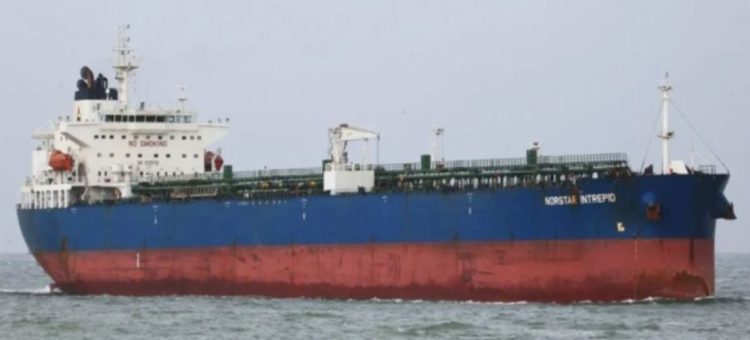
After the boarding, the Eagle S was seized and is now held in Finnish waters near Porkkala. Finnish authorities have also established a no-fly zone over the area where the vessel is being held to secure the investigation site and ensure safety.
About Russia’s Shadow Fleet
Russia operates a shadow fleet of ships using various strategies to sidestep international sanctions and continue exporting oil and other commodities. This fleet, developed with an estimated $10 billion investment, mainly consists of aging, poorly maintained vessels with unclear ownership and limited or no insurance coverage. Many of these ships are linked to Russian companies like Rosneft, which use overseas entities with obscure ownership structures to market and sell oil.
The fleet employs several tactics to avoid detection and regulation. Ships often use “flags of convenience,” registering under permissive countries like Gabon, Eswatini, Comoro Islands, and Guinea-Bissau. To evade tracking, vessels switch off their Automatic Identification System (AIS) transponders, effectively “going dark,” or use “spoofing” to transmit false location data. They also engage in ship-to-ship transfers to hide the origin of their cargo and manipulate documentation, sometimes presenting fake customs compliance papers that misrepresent the actual prices of exported goods.
By mid-2024, this shadow fleet was responsible for transporting over 70% of Russia’s oil and oil product exports, including 89% of crude oil and 38% of oil products. Estimates place the fleet size at around 435 to 591 vessels, depending on the source. Russia has even expanded its shadow fleet operations into liquefied natural gas (LNG), with approximately 50 vessels, including nine confirmed shadow ships.
These operations come with significant risks. The shadow fleet’s lack of adherence to international regulations, coupled with poor maintenance, raises concerns about environmental harm, maritime safety, and global security. Despite these challenges, the shadow fleet remains a critical component of Russia’s strategy to maintain its exports under the pressure of international sanctions.
International Reactions
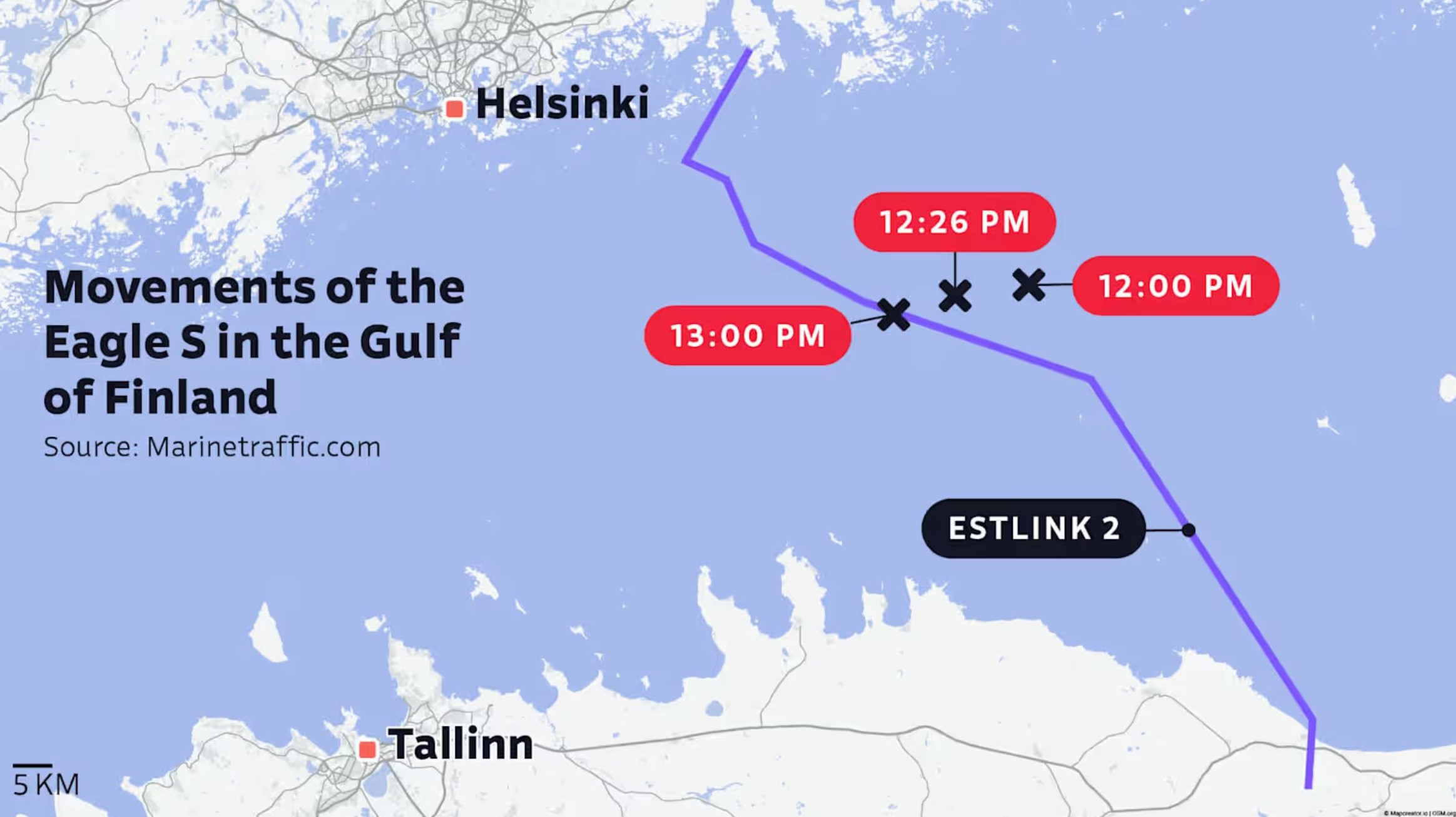
The incident involving the Eagle S tanker and the damaged EstLink 2 power cable has triggered strong reactions from international authorities and organizations. The European Union, through foreign policy chief Kaja Kallas, described the event as “the latest in a series of suspected assaults on critical infrastructure.” Kallas commended Finnish authorities for their swift response and highlighted the dangers posed by Russia’s shadow fleet. These vessels threaten security and the environment, as well as helping to finance Russia’s military. In response, the EU is considering additional sanctions and measures to address the shadow fleet’s activities.
NATO has also been involved, with Estonia, a member of the alliance, taking steps to safeguard its maritime infrastructure. Estonia deployed its patrol ship Raju to monitor the waters around the EstLink 1 cable and has called on NATO allies to assist in protecting critical undersea assets. This reflects growing concern among NATO countries about the security of undersea infrastructure in the Baltic Sea.
The incident has sparked increased cooperation among Baltic and Nordic nations. Finnish authorities are working closely with Estonian counterparts to investigate the damage, while Sweden and Poland are also evaluating the broader impact on undersea infrastructure in the region. This collaborative effort underscores the importance of regional partnerships in addressing such threats.
Internationally, the seizure of the Eagle S has drawn attention to the broader issue of maritime security in the Baltic Sea. European officials have linked this and similar incidents to Russia’s invasion of Ukraine, suggesting a pattern of sabotage targeting critical infrastructure. Finnish Prime Minister Petteri Orpo emphasized the urgency of developing strategies to counter the shadow fleet operating in the Baltic.
Although direct accusations against Russia remain limited, the incident has heightened global awareness of the vulnerabilities facing undersea infrastructure and the risks posed by vessels linked to Russia’s shadow fleet.
Broader Context
The incident involving the Eagle S tanker and the damaged EstLink2 power cable has triggered strong reactions from international authorities and organizations. The European Union, through foreign policy chief Kaja Kallas, described the event as “the latest in a series of suspected assaults on critical infrastructure.” Kallas commended Finnish authorities for their swift response and highlighted the dangers posed by Russia’s shadow fleet. These vessels not only threaten security and the environment but also help finance Russia’s military. In response, the EU is considering additional sanctions and measures to address the shadow fleet’s activities.
NATO has also been involved, with Estonia, a member of the alliance, taking steps to safeguard its maritime infrastructure. Estonia deployed its patrol ship Raju to monitor the waters around the Estlink 1 cable and has called on NATO allies to assist in protecting critical undersea assets. This reflects growing concern among NATO countries about the security of undersea infrastructure in the Baltic Sea.
The incident has sparked increased cooperation among Baltic and Nordic nations. Finnish authorities are working closely with Estonian counterparts to investigate the damage, while Sweden and Poland are also evaluating the broader impact on undersea infrastructure in the region. This collaborative effort underscores the importance of regional partnerships in addressing such threats.
Internationally, the seizure of the Eagle S has drawn attention to the broader issue of maritime security in the Baltic Sea. European officials have linked this and similar incidents to Russia’s invasion of Ukraine, suggesting a pattern of sabotage targeting critical infrastructure. Finnish Prime Minister Petteri Orpo emphasized the urgency of developing strategies to counter the shadow fleet operating in the Baltic. Although direct accusations against Russia remain limited, the incident has heightened global awareness of the vulnerabilities facing undersea infrastructure and the risks posed by vessels linked to Russia’s shadow fleet.
Implications and Future Actions
The detention of the Eagle S underscores the urgent need for enhanced surveillance and protection of undersea infrastructure in the Baltic region. The European Union and NATO have both indicated their commitment to supporting member states in safeguarding these critical assets. Additionally, there are calls for increased sanctions against Russia’s shadow fleet to deter further clandestine activities.
As investigations continue, the incident reminds us of the geopolitical tensions simmering beneath the surface of the Baltic Sea. The deliberate targeting of infrastructure disrupts essential services and poses significant risks to regional stability. It is imperative for nations bordering the Baltic to collaborate closely, share intelligence, and bolster their defensive measures to counteract these emerging threats.
Summing Up
The apprehension of the Eagle S by Finnish authorities marks a pivotal moment in the ongoing efforts to protect the Baltic Sea’s undersea infrastructure. The incident highlights the complex interplay between maritime security, energy supply, and geopolitical strategy in a region of critical importance to Europe’s stability and security.








COMMENTS