

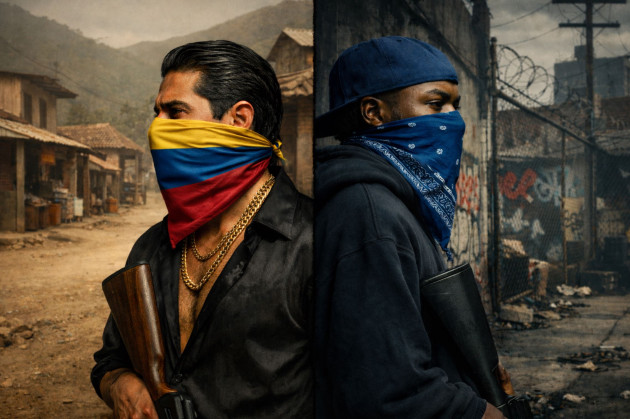
Kenny believed he was entitled to take what he took. X-Man believed he was entitled to vengeance… and not just death, but humiliation. Daeqwon and Rodney believed they were entitled to $20,000 wrapped in golden street cred. The families left behind believed they were entitled to justice that would never come.
The wound that started this? I couldn’t tell you. Nobody could. It happened before Kenny, before my undercover role, before X-Man, before the Fishbowl even had a name. Someone wronged someone. That someone retaliated. And the retaliation became the next wrong, which entitled the next response, which became the next wrong.
First blood. The original wound that entitles endless repayment.
I used to sit across from gang members and ask them to put the gun down. Sometimes, right after someone in their family was murdered. You know what that conversation sounds like? It sounds insane. It sounds like asking someone to forfeit the only thing that makes sense to them in that moment… Retaliation. And honestly, it is understandable, if not relatable to an extent.
Because in their math, they’re not starting violence. They’re finishing it. They’re collecting what they’re owed. The fact that their collection creates a new debt for someone else to collect is not their problem. That’s tomorrow’s problem.
This is why the cycle of violence, particularly, though not exclusively, thrives amongst sociopaths. Everyone’s just trying to balance the books.
So, imagine two men whose fathers ran rival cartels. Thousands dead between them. Family members murdered on both sides. These two were literally raised to hate each other with no compassion for anyone.
Sebastián Marroquín is the son of Pablo Escobar. William Rodriguez Abadía is the son of Miguel Rodríguez Orejuela, head of the Cali Cartel. Their fathers’ organizations hunted each other for years. The Cali Cartel helped fund the paramilitary group that eventually cornered Pablo. After Escobar‘s death, the Cali bosses vowed to kill his family. Sebastián had to negotiate with them and agree to leave the country with only the shirt on his back for them to spare his life.
If anyone on earth had the right to eternal vengeance, it was these two.
I’ve had the privilege of spending time with and interviewing both of them separately. Both carry the same impossible mission: prove that if they can make peace, anyone can.
When Sebastián learned his father was dead, he threatened the whole country of Colombia. Swore vengeance. Called the media and promised blood.
Ten minutes later, he called back.
“I apologized,” he told me, “and I made a promise to be a man of peace for the rest of my life.”
He’s met personally with over 150 families of his father’s 10,000+ direct victims. Not one reconciliation went badly. He and William, the son of his father’s mortal enemy, are now close friends.
“We should be the worst enemies,” Sebastián said. “Because this is how we were raised. We were raised to hate and to damage the enemy and have no compassion for anyone. But we choose a different life.”
And then he said something simple, yet profound in this context:
“It’s like a boomerang. You send the boomerang with love, the boomerang will come back with love to your life. But if you send the boomerang to cut off someone’s head… perhaps it will come back and cut yours.”
The Fishbowl‘s still there. Different players, same math. Someone’s always owed. Someone’s always collecting.
But somewhere in Colombia, two men who had every right to keep the books open decided to close them instead. Not because they forgot what happened. Not because they forgave in some soft, greeting-card way. But because they understood something Kenny and X-Man and Daeqwon never did:
The only way to stop more bloodshed is to stop cutting. The operators reading this know what I’m talking about. You’ve been sent to places where the first blood was drawn before any of us were born. Tribal feuds. Religious schisms. Colonial borders carved by men who never walked that ground. Different scale, same math. Someone’s always owed. Someone’s always collecting. And someone’s always sent to bleed for a wound they didn’t inflict.
I think about that when I remember the conversations I used to have after arresting and debriefing the 51 gang members from the Crips I’d infiltrated. Asking them to put the gun down and think differently, yet at the same time, asking them to forfeit what they were owed.
It sounded insane then.
Maybe it still does.
William laid his guns down. Sebastián used his boomerang for good. Both let go of the debt owed to them…
What are you still holding?”
—
Tegan Broadwater spent 13 years with the Fort Worth Police Department, including two years assigned to the FBI working deep undercover inside a violent Crip organization. That operation, detailed in his book Life in the Fishbowl, resulted in 51 convictions. He has since founded Tactical Systems Network, an armed security & protection firm primarily staffed by veterans, is a creative writer and musician, and hosts The Tegan Broadwater Podcast. All book profits benefit children of incarcerated parents. Learn more at TeganBroadwater.com








COMMENTS