



Samantha Jay
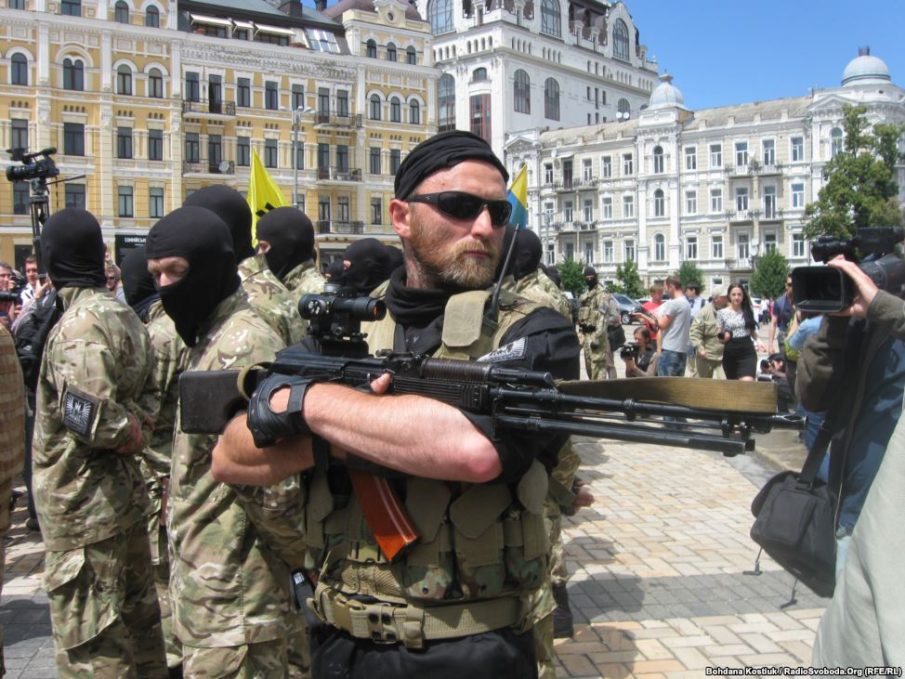
Another category of foreign volunteer is former soldiers from the Western world. Some of them are quality dudes, some are not, but one interesting quality I’ve found in many of them is that they served, but did not have the chance to deploy. One British volunteer I spoke to in Ukraine served in the British military in a EOD unit but was not deployed to Iraq because he was only 17. Then he hurt his knee and was medical discharged from the Army. Before joining up with Azov Battalion in Ukraine, he had spent some time with Karen freedom fighters in Burma.
Interestingly, this young man was caught on camera briefly on the front lines. The Russian press went ballistic. “Have you heard about the CIA-Blackwater-mercenaries in Ukraine?” the British volunteer asked during our conversation. “Well, that’s me!” he said with a laugh. The Russian press met their propaganda quota that day, accusing the UK citizen of working for MI-5, Blackwater, the CIA, and god knows who else.

A CIA-Blackwater-Mercenary!? Not Quite.
Jordan Matson is perhaps the most famous foreign volunteer in Kurdistan. Like the others, for reasons beyond his control, he never was able to deploy to Iraq or Afghanistan with the military. When I spoke to Jordan in Syria, he told me that although he is a red-blooded Republican that he completely supports the Kurds and their fight for freedom, their socialist ideology aside. He also said that he felt he had to come and fight ISIS because if the Islamists won than it meant that all of our brothers in arms in the military would have died for nothing. I would be lying if I said that I had never felt the same. Jordan has since gone on to see some heavy combat in Tal Tamir.
For many of these former soldiers I get the impression that they see Iraq, Syria, and Ukraine as an opportunity to get their war on.
Speaking of which, another interesting character I met was Peter who is from Canada and did not serve in the military. At 66-years old, he contacted the Lions of Rojava Facebook page and traveled to Syria to join the YPG. He said that he wanted to get his licks in before he had a stroke or got dementia. That said, he did believe deeply in the Kurdish cause and saw their fight against ISIS as a battle against the greatest evil to exist since the Nazis. Some months after I met him, he left the YPG and is now with the Peshmerga in Kurdistan.

Peter Douglass
Most of the foreign volunteers in these wars are guys looking for a fight and/or society’s lost children. However, there are a few outlier groups that I would like to detail. One of them is the idealists. Amongst the foreigners, I never met anyone who I would say signed up for purely ideological reasons. Sure, they support the Kurdish fight for freedom against ISIS, but none of the westerners I met were socialist ideologues. Yet, a few such people do exist.

Ivanna Hoffman
Take for instance Ivanna Hoffman. She was a German member of the Marxist-Leninist party who traveled to Rojava with several other Germans. She was killed in combat just a day after I learned of her existence. Another example of an ideological soldier is “Marcello” who is an Italian socialist that traveled from Turkey to Syria, joined the YPG, and saw action during the heavy fighting in Kobani. His real name is Karim, but he chose to use Marcello as his war name, seeing it as good luck. It was his father’s name, who served as an Italian partisan during World War 2. Maybe the name was good luck because he was one of the lucky few to walk away from the battle for Kobani. It is important not to make assumptions about people’s motivations, but in these two cases it seems pretty clear that Marcello and Hoffman saw themselves as helping the communist/socialist cause by fighting alongside the YPG.

Marcello
Another group of outliers is the lunatics. One of the foreigners fighting in Ukraine is reported to spend each morning walking around naked, and one account even has him running towards the Russian front with his twig and berries dangling in the breeze while yelling, “I’m a tourist!” after they got shelled for 12 hours.
Most of the foreign volunteers I’ve met were genuinely nice people who I felt perfectly safe around, but there are few exceptions. The most curious case is that of George Marshall Lerner. Half-Thai, half-Jewish, George went to the University of Edinburgh. From there his background gets murky as one has to pick through his web of lies. He claimed to some people to have served in the U.S. Army, even using information he got from conversations with me to claim that he served in 5th Special Forces Group. He also claimed to have gone to Oxford and was enrolled in a PhD program there. He claimed to have worked for a hedge fund in Manhattan. He claimed to have worked for the World Bank in Afghanistan…or was it the Department of Defense? He could never quite get his lies straight. He also had three or four passports (according to him).
George was a dyed in the wool lunatic, a mentally unsound individual, who was truly lost. Traveling to Iraq sometime in the summer of 2014, he joined the PKK and became a full fledged party member, something that he never hesitated to rub in the faces of the Kurds. He allegedly fought in Rabia and Jezza. After I met him in Rojava, the Kurds locked him up for a time (George was involved in weapons trafficking by his own admission) and then the YPG sent him to Kobani. They said this was to give him another chance, but personally, I think it was a way to get rid of him. Everyone knows that getting sent to Kobani is a one way trip.
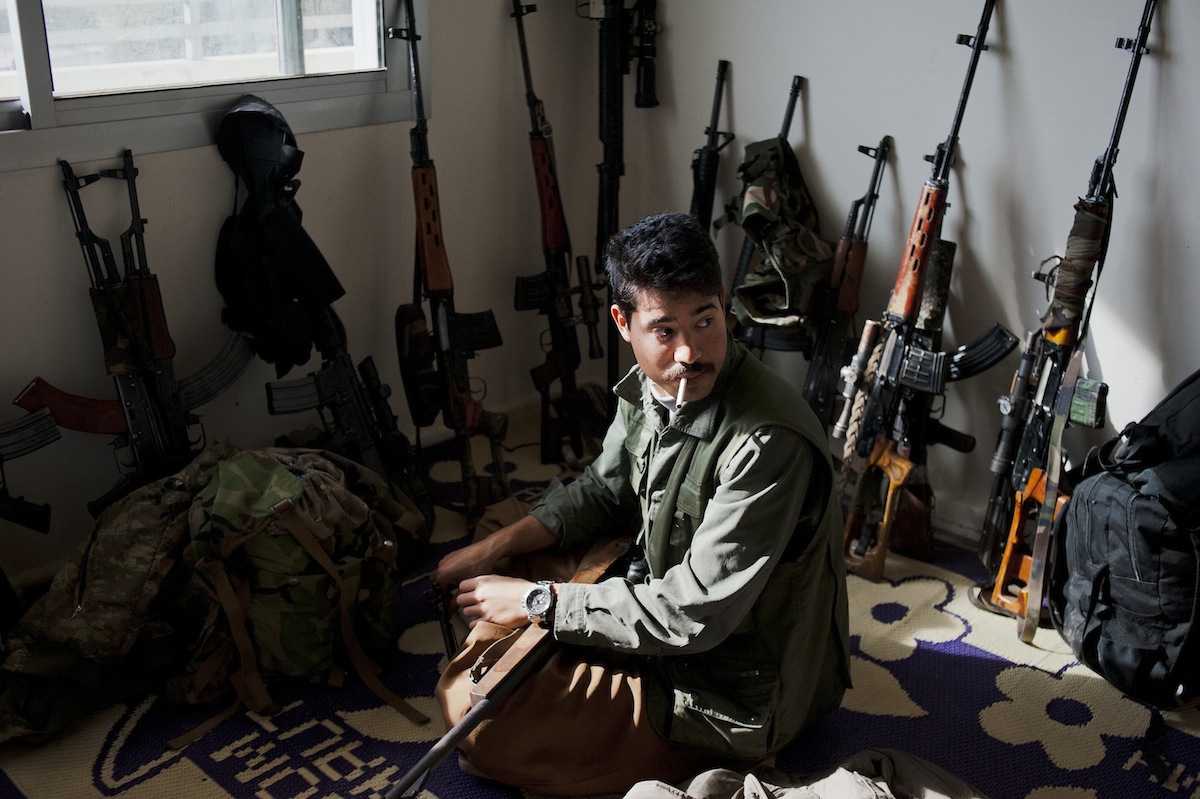
George Marshal Lerner
When I met George, he was one of the oddest people I had ever come across, war zone or not. Sometimes he seemed to be suffering from severe PTSD. Other times he had very lucid comments about the war, the region’s political structures, economics, and many other keen insights. George either had multiple personality disorder, or he was faking the funk. He was faking something for sure, exaggerating his combat record in Rojava if nothing else. But what was his end game? As far as I can tell he was simply a war profiteer. Coming from an affluent background he thought he was entitled to end running people, rail roading the Kurds, and making petty power plays like some kind of 23-year-old monopoly man. In the end, he failed to impress the Kurds (they all hated him to say the least) and he never became the big shot arms dealer or oil man that he wanted to be. Where he is today is unknown, but I’d guess he is hiding out in Dubai or Thailand.
The idea of foreigners, so-called mercenaries, is something that captures the imagination. It makes for a cool action-adventure novel if nothing else. Trust me, I’d know since I’ve written a few. However, foreigners receive a dis-proportionate amount of coverage by the press, and even on SOFREP. The media loves to focus on these characters, calling them heroes or mercenaries, depending on which headline will sell more newspapers. I also have a fascination with the personalities who show up to fight in someone else’s war. But with this fascination we can also lose focus.
The reality is that the foreign volunteers in Kurdistan, Syria, and Ukraine are strategically insignificant. Perhaps there are 25-30 foreigners in Syria at any given time as some leave and other arrive. In Ukraine, maybe we are talking about 20 foreigners. I am excluding first and second generation Ukrainians and Kurds who lived in American or European diasporas and went to join the fight from this entire article, as their strong national and cultural ties place them in a different category than the above mentioned personalities. When we look at the numbers of foreigners in these conflicts, the truth is that they are strategically decisive to nothing.
On one hand, many of these volunteers deserve respect. They put their money where their mouth is. Take Jordan Matson as an example. He joined up with the YPG and committed to the Kurds, publicly stating that he won’t come home until the war has been won. But at the end of the day, it is the Kurdish people who are fighting and dying in droves. The war will be won or lost by the Kurds, not by a handful of foreigners in the ranks.

Jordan Matson
The press reports groups like the Lions of Rojava in Kurdistan or Azov Battalion volunteers as if they are something new and unique. Of course this is far from the truth. In the 1970’s a number of foreigners joined up with the National Liberation Front of Angola (FNLA) and saw action fighting the MPLA. Again, there were maybe 30 foreigners in FNLA with backgrounds that ranged from former soldiers to street sweepers. One notable example was George Washington Bacon who served in MACV-SOG and as a CIA para-military operations officer in Laos. In the end, the Soviet backed MPLA crushed FNLA and the foreigners had to beat a hasty retreat. History is rife with such examples of foreigners signing up to fight for fun, profit, or a cause.
Some things do change though. For one, the internet has sped up communication exponentially. In the past, mercenaries were recruited by word of mouth also known as the good old boy network. Later, they might have been recruited through publications such as Soldier of Fortune magazine. Today, it is fast and easy to set up a webpage or facebook group catering to a niche volunteer in a dirty little war somewhere. The disenfranchised of society can easily find these webpages and link up with other foreign volunteers on social media. An American friend who served with the Selous Scouts in Rhodesia once told me that the Soldier of Fortune coverage of the bush war was mixed blessing. Out of that they attracted some very professional Vietnam veterans to the war, but also a lot of nutcases. The same is true of the internet today, but the rate at which individuals communicate is much faster.
Thus far, cyber-recruiting of foreign fighters does not seem to have escalated the conflict or led to the recruitment of extraordinarily large numbers of people when you compare foreigners in FNLA to foreigners in say the Peshmerga. In the future, one can see a niche hobby emerging in which foreigners bounce from war to war. Maybe they will each have an online persona, be self funded through online donations, and be traded like baseball players, who knows? The de-institutionalization of violence and rise of the modern Private Military Company also brings about the prospect of these people to bounce between jobs as actual paid contractors and unpaid foreign volunteers. This puts them in a very gray world of quasi-soldiers.

Foreigners currently serving in the Peshmerga
The next inference we should make is that each side of the conflict will engage in cyber-recruiting their own teams of volunteer soldiers who have vague ideological motivations or are incentivized by war for profit. It should also be noted that the majority of the foreigners in the YPG and Azov Battalion are strictly unpaid volunteers and so, they really don’t qualify as being mercenaries. In Ukraine, there are foreigners fighting on both sides, including one American and a few Italians on the Russian side. In Syria, the Kurds have the Lions of Rojava but ISIS has thousands of foreigners in their ranks. Amongst these players, ISIS is far the best at cyber-recruiting foreigners, even if they use most of them as suicide bombers.
As we progress into the 21st century, we are moving into a multi-polar world where America will no longer be a global hegemon acting to hold smaller weaker states together. Terrorist organizations, narco-groups, small countries, trans-national companies, and non-governmental organizations will have an increased role in international outcomes. While another global war is not yet in sight, the world will get a lot more violent as the potential for dirty little wars to break out at any given time becomes increasingly likely.
Aided by the internet and faltering western economies, these wars will attract the lunatics, the scammers, and the rare few professional soldiers looking to get their kill on in someone else’s war.








COMMENTS