

Shortly after midnight on the early morning of April 29, 1945, with Soviet troops closing in rapidly, Hitler married his longtime mistress, Eva Braun, in a small, civil ceremony inside a map room in the bunker. They had approximately 40 hours to live.
Late on the morning of April 30th, the Red Army troops were only 500 meters away from the Führerbunker. At about 2:30 PM, Adolf Hitler and his wife went into his personal study and sitting room, on the south side of the bunker, and his adjutant, SS Sturmbannführer Otto Günsche, dutifully stood guard outside the door, respecting their final privacy.
At approximately 3:25 PM, a gunshot rang out from inside the study, but no one entered the room until 3:30 PM, when Günsche and Heinz Linger, Hitler’s valet, walked in and saw Hitler and Eva sitting upright on the sofa, with Hitler to his wife’s right side, both dead. She had taken cyanide, and he had bitten a glass ampule of cyanide, and then shot himself in the right temple with a pistol.
Günsche subsequently stated that Hitler, “sat… sunken over, with blood dripping out of his right temple. He had shot himself with his own pistol, a Walther PPK 7.65,” and the gun lay at his feet, with a large bloodstain on the sofa arm to his right. A single, 7.65mm brass shell casing was found on the floor.
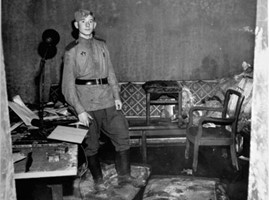
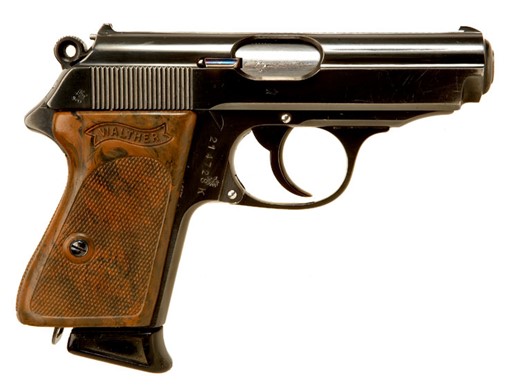
It’s quite likely that Günsche’s “PPK” description was a translational error in his later testimony, because the suicide gun was clearly a 7.65mm weapon, and the only such firearm in Hitler’s possession was his own Walther PP belt pistol.
The two bodies were burned outside the bunker from four PM to 6:30 PM that evening, soaked in some 55 gallons of gasoline, inside an artillery shell crater. In early May 1945, the Soviets recovered the charred bodies of Hitler and his wife, and positively confirmed their identities through dental records, and the sworn testimony of dental assistant Käthe Heusermann and dental technician Fritz Echtmann, both of whom had worked for Hitler’s dentist, Hugo Blaschke.
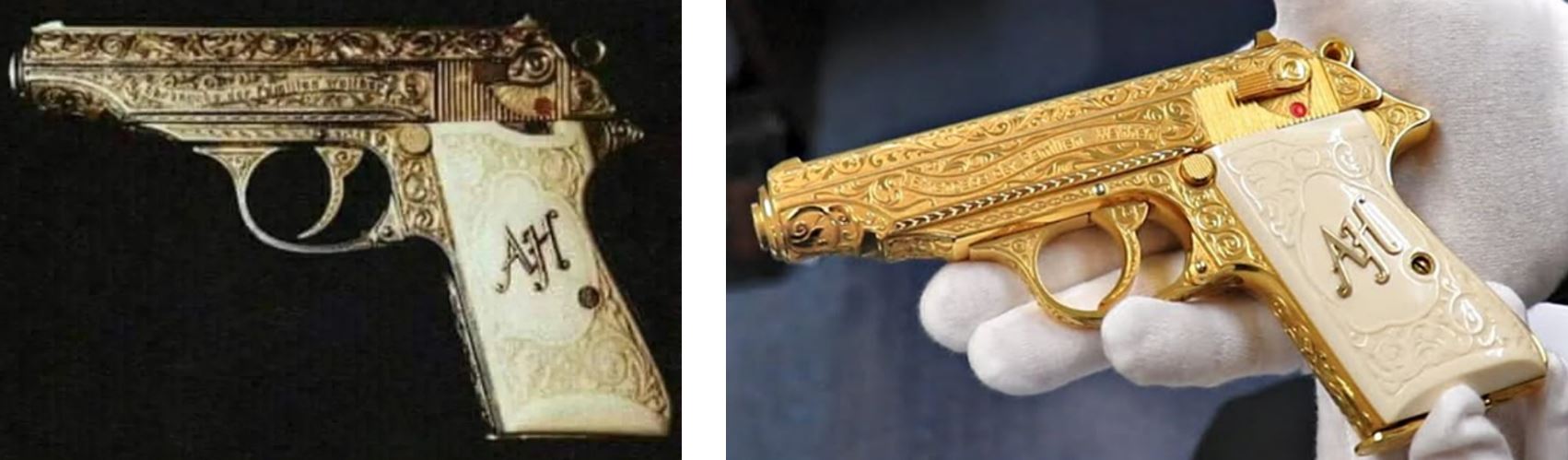
The Walther PP and PPK that Hitler had in his possession at the time of his death have subsequently been lost. They could have been taken by occupying, Soviet troops or hidden away by a member of his inner circle, present at the end. Without a detailed description or serial numbers, we may never know the real answers.
The Walther PP and PPK were certainly among the very best handguns of that era, highly sought after by the Nazi Party elite. Even the small-caliber, .22 Long Rifle version was quite popular, because it held nine (PPK) or 10 rounds (PPK/S) of ammunition, compared to just seven rounds of 7.65mm ammunition in the standard PPK.
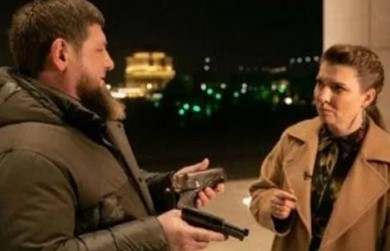
Finally, during a February 13, 2023, interview with a Russian TV station, Chechen warlord Ramzan Kadyrov (and prime minister of the Chechen Republic, part of Russia) claimed to possess Hitler’s actual, suicide pistol, saying that is was “a trophy pistol with which Hitler shot himself…brought to him (Kadyrov) by his commanders.” Kadyrov referred to traces of blood on the breechblock, which allegedly matched Hitler’s blood type. The biggest problem with the Chechen leader’s story is that the pistol in his hands is very clearly a Mauser Model 1934, not a Walther, and Hitler did not possess any Mausers.
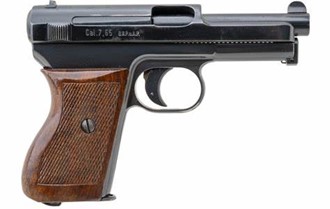
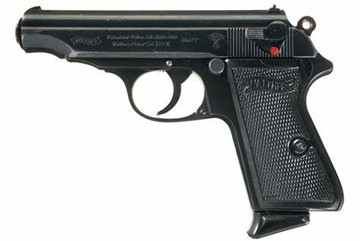
What if Hitler’s infamous suicide pistol was just an ordinary service weapon, his standard belt-sidearm for venturing out into the field to inspect the troops? After all, carrying an expensive, custom-engraved, gold-plated handgun from day to day in an enclosed holster, where no one ever sees it, and the leather may be likely to wear away some of the gold finish, makes very little sense, so Hitler’s everyday, military sidearm was likely quite ordinary.
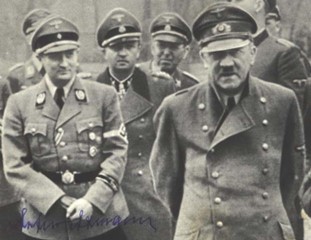
According to the head of Hitler’s bodyguards, SS Obergruppenführer Hans Rattenhuber, Reichsleiter Artur Axmann, the Reich Youth (“Hitler Youth”) leader of the Nazi Party, took the Walther PP pistol that Hitler used to commit suicide, and said that he would “hide it for better times.”
During his daring escape from the Führerbunker on May 1, 1945, Axmann later stated that he hastily buried the pistol next to the Sandkrug Bridge over the Berlin-Spandau Shipping Canal downtown, only one mile north of the bunker. He survived the war, was later exonerated of any war crimes, and died peacefully in Berlin in 1996, at the age of 83.
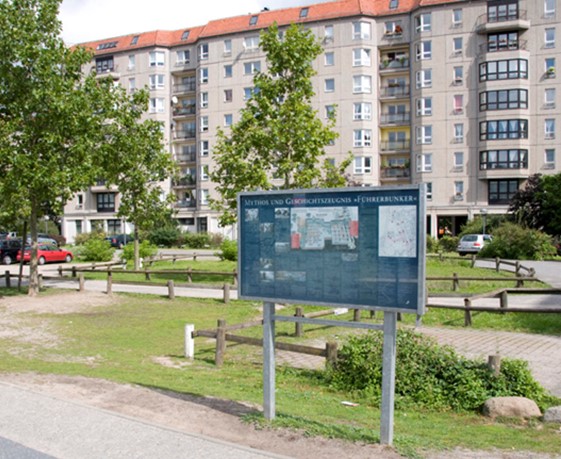
Axmann certainly had no reason to lie, so his account is the most credible of all. His own adjutant, Gerhard Welzin, reportedly escaped from the bunker with the PPK in .25 ACP, which soon disappeared without a trace. He was captured by the Red Army.
Soviet dictator Joseph Stalin was said to have possessed a blued, Walther PPK that he was told was Hitler’s suicide weapon, but that story does not correspond with any of the known facts regarding Hitler’s actual weapons. Then again, as Julius Caesar once observed, “People believe what they want to believe,” whether it’s actually true or not.
The bottom line is that no one currently knows for certain what Hitler’s last Walther looked like, or the exact model, engraved or standard, except that it was apparently a 7.65mm weapon, and most likely a Walther PP model. Like so many other aspects of the dark and menacing Third Reich, it remains an enduring mystery for the ages.








COMMENTS