

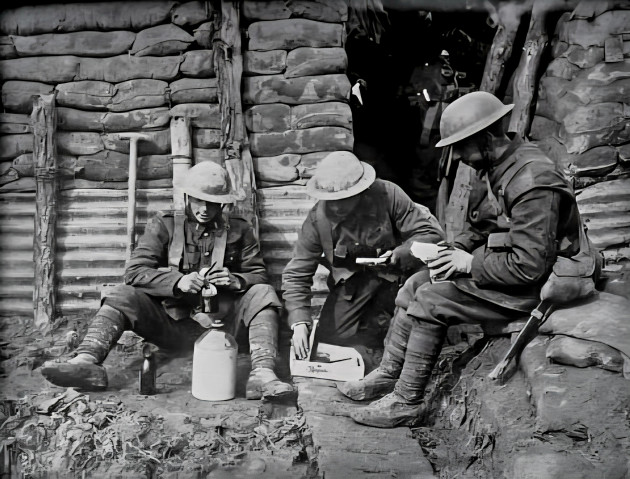
By the middle years of World War I, the Western Front had stopped moving and started grinding. The line from the North Sea to Switzerland was no longer a front in the traditional sense. It was a scar, layered with trench systems, barbed wire, and mud so churned by artillery that the ground itself seemed wounded.
Life in those trenches settled into rhythm. Men stood-to at dawn and again at dusk because everyone understood that those were the hours attacks favored. Rations moved forward on a rough schedule. Wiring parties slipped out after dark to repair the belts of barbed wire that separated one trench from the next, working in the open ground between the lines while the rest of the company listened for incoming fire. Patrols crossed No Man’s Land at intervals both sides came to recognize.
In a landscape where survival depended on reading the habits of the enemy, predictability became a kind of currency. If you could anticipate what the other side would do next, you could live through it.
The Canadian Corps arrived in Europe as a volunteer force tied to Britain, untested on a continental battlefield. That changed quickly at the Second Battle of Ypres, where German gas attacks tore through Allied lines and forced Canadian units to hold exposed positions under conditions no one had prepared them for. They absorbed heavy losses. They did not collapse. From that point forward, the Corps hardened.
By 1916 and 1917, Canadian formations were not simply occupying trenches. They were studying them. They refined trench raiding into a deliberate instrument of pressure. Raids were rehearsed behind the lines on mock trench systems. Artillery was timed with increasing precision. Small assault parties crossed No Man’s Land at night to kill, capture prisoners for intelligence, destroy dugouts, and unsettle the enemy. These were calculated disruptions designed to deny the opposing side rest and certainty.
Within that environment, stories began to circulate about deception along the line.
Among them is the account of Canadian troops who developed a strange exchange with German soldiers opposite their sector.
During lulls between major engagements, when the guns fell quiet and men could shout across the wire, German troops reportedly called out for food. Canadian soldiers answered by tossing tins of corned beef into No Man’s Land. A thrown object from the Canadian trench began to mean something harmless. It meant rations, not explosives.
Repetition builds expectation. Expectation lowers guard.
According to later memoirs and retellings, that pattern held long enough to become familiar. Then one day it changed. When the calls came again and figures lifted themselves slightly to watch for the next can to land, grenades followed instead.
Hard archival documentation tying the episode to a specific unit and date is limited. Like many trench anecdotes, it exists between recorded fact and soldier’s lore.
But the tactic itself would not have been out of character for the kind of war being fought. Deception was routine. Surprise was survival. Conditioning an opponent to relax into habit and then breaking that habit at the worst possible moment fits squarely within the logic of trench warfare.
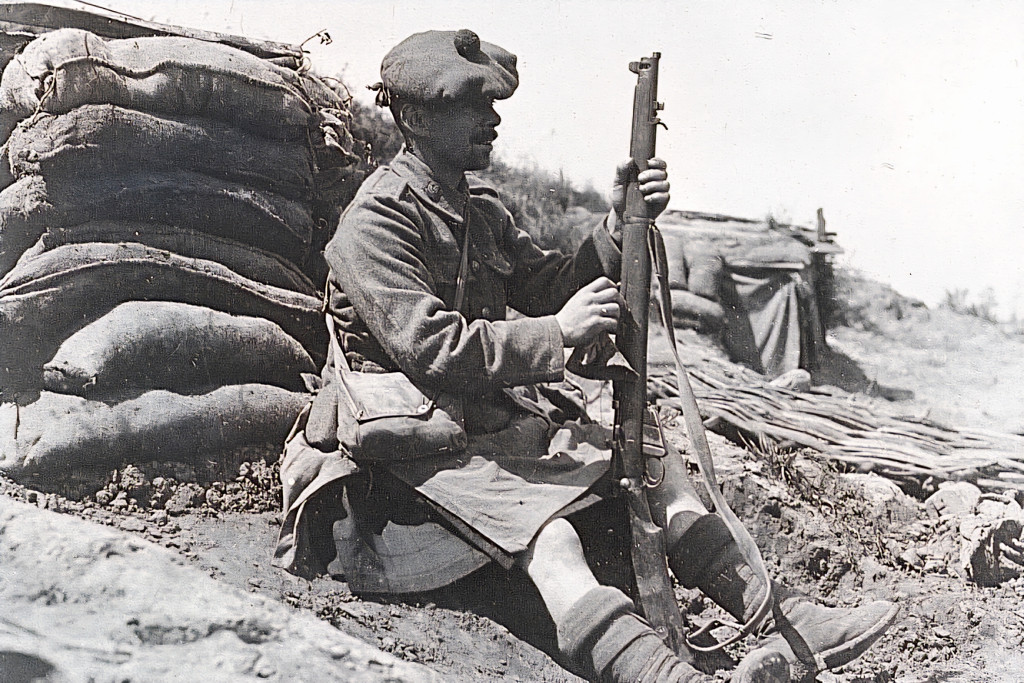
The Canadian Corps did not gain its reputation through cruelty alone, nor were they uniquely brutal among the armies locked in that conflict. The Western Front was an industrial machine of death that consumed Germans, French, British, Canadians, and later Americans with equal indifference. What distinguished the Canadians was the systematic way they adapted. Under commanders such as Arthur Currie, they embraced detailed planning, limited objectives, and the close integration of infantry and artillery. Their success at Battle of Vimy Ridge and later during the Hundred Days Offensive cemented their standing as one of the most effective formations on the Western Front.
Trench raids were part of that identity. Raiders blackened their faces, moved with clubs and knives for silence, and relied on speed inside the cramped geometry of trench bays. The goal was often as psychological as it was tactical. A unit that never allowed the enemy to settle into predictable calm forced that enemy to expend energy on constant vigilance.
Fatigue accumulates, nerves fray, and mistakes follow.
Whether the “corned beef and grenades” story unfolded exactly as described or hardened into legend over time, it captures something true about that war. In static lines measured in yards, where artillery barrages could last for days and advances were counted in hundreds of feet, routine became both shield and weakness. A pattern that keeps you alive can also expose you, especially when someone else is watching it as closely as you are watching them.
Modern battlefields look different. Sensors replace sentries. Drones replace observation balloons. Precision munitions replace creeping barrages. Yet the underlying principle remains stubbornly familiar.
When one side settles into rhythm, the other side studies it. When expectation becomes comfort, it also becomes vulnerability.
On the Western Front, the Canadian Corps learned that lesson early, and they proved willing to exploit it.








COMMENTS