
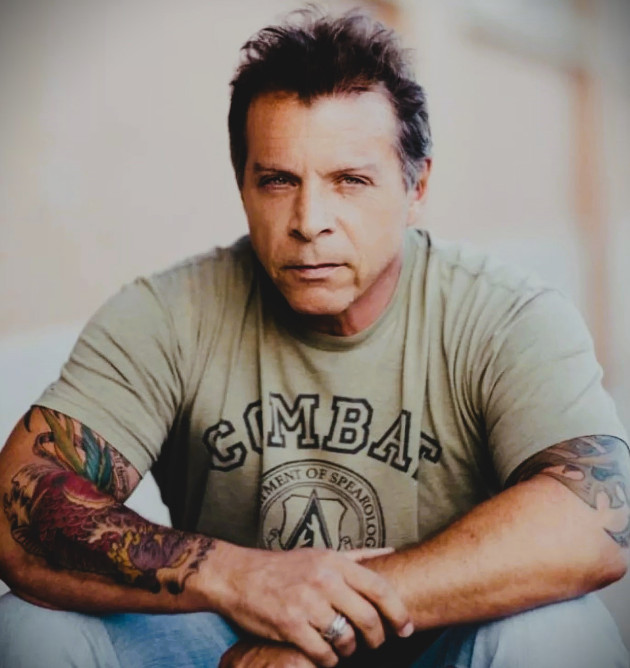
Tony Blauer is a world-renowned self-defense and fear-management expert whose research has been adopted by elite military units, law-enforcement agencies, and first responders worldwide.
I won’t attempt to distill the key lessons from Tony’s KNOW FEAR® program, or his broader coaching philosophy. But I can say this with confidence: one of the most impactful things I’ve learned from Tony is that our stories shape not only our future, but how we interpret the past, and the meaning we assign to it.
It’s easy to think of fear as something we experience in the present about the future.
But it’s often fear from the past, leeching into the present, that jacks up our future.
Fear is what stops us. What slows us down.
As Tony says, “Fear impacts everything we do, from who we talk to, to who we marry, from where we work, to where we live. The ability to recognize and manage fear directly impacts the quality of our life.”
You have to “get to know fear.” Because, like it or not, it’s a lifelong companion.
Tony himself admittedly still experiences fear on a regular basis:
“The person you see on my social media is me. But it’s also a façade. That Tony Blauer—the Instagram Tony Blauer—is a badass. People see me doing stuff with the military, or teaching 700 people about fear in a seminar setting. What they don’t realize is that when I walked out to that room to teach, my heart was pounding. In that situation, I could focus on the fear and have it turn into anxiety. Or I could recognize my fear, use it for fuel, and step on the gas pedal.”
How I Met Tony
I met Tony by chance, through an experience he had with one of my company’s products. Tony was dealing with nighttime leg cramps and reached out with some questions.
He was grateful that the product helped him find relief and get some sleep. I sent him a copy of my book along with a few other products I thought might help him. That exchange led to an ongoing relationship—part business, part personal.
Tony is one of those rare men who are disarmingly authentic and easy to talk to, yet also wise and able to effortlessly weave the core principles of his philosophy into conversation. He’s always ready for the moment he can drop into coach mode and help someone navigate fear and internal roadblocks.
I don’t remember exactly how we got onto this topic, but at one point on a phone call, I received some impromptu coaching from Tony that completely changed the way I saw a traumatic event from my past.
I’ve never told this story publicly. To you, this story may seem mild—and I’d agree with you. But still, it weighed heavily on me. I didn’t know what to do with it.
During that conversation, I told Tony the story of how I nearly drowned along with my 5-year-old son while traveling with my family.
Although I had no intention of ever sharing this publicly—either out of fear of appearing irresponsible or just sheer embarrassment—I think it’s important to share what happened and how Tony helped me reinterpret it.
“I couldn’t breathe. My 5-year-old boy was on my back. And we were sinking.”
We were in Sicily, on a small tour boat off the coast of Syracuse.
I’d just done my first hard workout after weeks of being sick, then we drove to the harbor and hopped on a sightseeing boat with the kids. The captain took us around sea caves and rocky bluffs, then stopped for a swim in deep, clear water.
As soon as I hit the water, something felt off. Treading water was way harder than it should’ve been. My muscles felt heavy from the workout, and my stomach was full. But I shrugged it off.
My little boy, Wyatt, climbed on my back like we’d done a thousand times in swimming pools.
Then, another boat came speeding by, causing a large wake and pushing our boat toward shore. Immediately, the captain spun the boat away from us to anchor further out. The waves started picking up. Then, my daughter Ellie swam over and grabbed on, too.
With both kids hanging on, I tried to kick us back toward the ladder, but the boat was drifting. The wakes from passing boats were pushing it around. Every time I came up for air, a wave hit my face.
I managed to get Wyatt onto the ladder and Ellie close enough to climb up. Then I let go and floated on my back, fully expecting that in 30 seconds I’d recover like I always do.
But I didn’t.
My heart was pounding. My bones felt like lead. I couldn’t catch my breath. I watched Wyatt walk right back to the bow, eager to jump in again. I told him to wait, but he didn’t hear me.
He jumped in again. And this time, the waves were way too high for a 5-year-old to be swimming. He immediately climbed on me, and my head went under.
I was swallowing water and needed air badly.
I finally got my legs under me enough to thrust upward out of the water and prepared to take a deep breath. When I surfaced, I gasped hard for air, but nothing happened.
My lungs weren’t working. I had no idea what was happening. Even after repeatedly trying to inhale, it was impossible to breathe.
At this point, I realized we were in big trouble. The boat had spun around again. Nobody could see us. And the boat was still moving away from us by the second.
I began kicking frantically and paddling with one arm while holding Wyatt in the other. I remember blackness creeping in from the sides like closing elevator doors just as I made it to the boat and grabbed a buoy rope.
I started to catch my breath with shallow inhales. By this point, another swimmer realized we were in trouble and came to help. I handed Wyatt to her, and someone else pulled him up onto the boat.
I managed to get myself around to the ladder and nearly collapsed when I finally got back on the boat.
Looking back, I realize exactly what happened. Fear and panic got the best of me. I had hyperventilated, making it impossible for me to inhale anymore.
In that moment where I couldn’t breathe, I actually needed to exhale.
The mechanics of it make sense. But the whole experience shook me to my core.
As a father and a husband, I’ve always prided myself on being calm under pressure. But now I knew better. I had panicked, and it nearly cost me everything.
I relayed this story to Tony a few weeks later while on a call. And that’s when he gave me a virtual slap in the face.
“You’re Telling the Wrong Story.”
“Scott, you’re telling the wrong story. You didn’t drown. You didn’t quit. You had no air, a 5-year-old on your back, and you still swam both of you to safety. That’s not panic. That’s courage. You’re a f—ing hero.”
I had been so focused on the moment where fear hijacked my breathing that I missed a key detail: I kept moving anyway. Fear didn’t make me cave. It didn’t make me freeze. If anything, it was fuel to get me out of a dangerous situation.
What Tony helped me see that day was that our stories shape our reality. Not just the reality of our present and what we will do next. But how we interpret the past. And how we interpret past events is critical in determining how we’ll move forward.
It’s a lesson I’ve learned—and relearned—again and again throughout my life.
And it’s a universally human problem.
One of the most common stories I hear from clients and readers is that they’re too old, too broken down, or too injured to live pain-free.
When I started SaltWrap, I thought we were simply helping people recover from injuries, relieve pain, and get back to doing the things they love to do.
But what I eventually realized is that we’re actually giving people hope—and helping them see that real transformation is possible.
Once someone overcomes obstacles they once viewed as insurmountable, they build a kind of confidence and momentum that becomes virtually unstoppable.
It’s not surface-level confidence. And it’s not ego.
It’s more like self-efficacy—the belief that you can do something.
You’ve been injured. You’ve been in pain. Yet you came back. And because you came back once, you know you can do it again.
The process starts with choosing courage over fear. That’s step one. And there’s no getting around it.
Courage has to come before confidence. As legendary business coach Dan Sullivan writes, “the difference between confidence and courage is that confidence feels good. Courage doesn’t.”
Most people are stuck waiting for the right time. Frozen in fear. And they often don’t even realize what has them in fear’s grip. This is what Tony calls the “Fear Loop.”
But those who have overcome obstacles have already built the necessary foundation. They know they have chosen courage in the past, and they can do it again.
This is the story I see played out again and again.
You can see it in our documentary with UFC fighter Josh Emmett, and the way he handles setbacks.
You can see it in our documentary with Tony, and the grit and perseverance it takes to live a lifelong passion for fitness, self-empowerment, and martial arts.
And you can see it in every Built from Broken reader who chooses to face their pain voluntarily. Not because it’s easy, but because it’s necessary to come back stronger than before.
The process of rebuilding your body and conquering pain from injuries is as much psychological as physical.
Over 200,000 people have read my book. And I wish every one of them could go through Tony’s program before starting their Built from Broken journey.
Because, like Tony says, “Those who manage their fear manage to fight.”
That’s why I partnered with Tony to offer a truly unique experience to SOFREP readers.
The revised and expanded version of my award-winning pain and recovery book, Built from Broken, is now available in stores nationwide.
As a subscriber to SOFREP, we want to give you free access to the full video library of therapeutic exercises featured in Built from Broken. And we want you to have full access to Tony’s KNOW FEAR® Program.
If you’ve been dragged down by old injuries, painful joints, and movement limitations, I truly believe there’s no more potent combination on the planet for rebuilding your mind and body than Tony’s KNOW FEAR® combined with the principles in Built from Broken.
This limited-time offer isn’t available anywhere else.
To take advantage of it, go to SaltWrap.com/SOFREP and grab your free downloads. This includes the Built from Broken Guide to Regenerative Therapies, Built from Broken Video Library, Built from Broken Exercises Guide, and, of course, access to Tony’s KNOW FEAR® Program.
Start turning fear into fuel and rebuilding your body today.








COMMENTS