

An Israeli researcher has revealed that military radar systems, specifically the American-made Patriot missile systems, can be identified using commercial satellite data from the European Space Agency's Sentinel-1 satellites. This discovery poses significant implications for U.S. defense strategies as these radar systems can be pinpointed in near real-time globally.
Key points from this article:
The research by Harel Dan demonstrates that the AN/MPQ-53/65 radar used in Patriot missile systems can be detected through synthetic aperture radar images from Sentinel-1 satellites.
How this affects U.S. defense: The ability to identify Patriot missile locations in real-time could compromise their operational security and effectiveness against threats.
Why this matters: The findings suggest that similar radar systems, including Russia's S-300 and S-400, could also be tracked, raising concerns about military vulnerabilities in conflict zones like Syria.

Updating summary...
Israeli researcher discovers American patriot missiles can be pinpointed using civilian satellite data
Alex Hollings
Speed
1x
Listen
COMMENTS
An Isreali researcher working with publicly accessible data sourced through the European Space Agency has discovered that certain types of military radar systems are identifiable through commercial satellite data sets. As a result, civilian organizations using satellite-based synthetic aperture radar systems can pinpoint the exact locations of American-made Patriot missile systems in near real-time, anywhere […]
U.S. Service members stand by a Patriot missile battery in Gaziantep, Turkey. (WikiMedia Commons)
An Isreali researcher working with publicly accessible data sourced through the European Space Agency has discovered that certain types of military radar systems are identifiable through commercial satellite data sets. As a result, civilian organizations using satellite-based synthetic aperture radar systems can pinpoint the exact locations of American-made Patriot missile systems in near real-time, anywhere in the world.
Advertisement
Synthetic aperture radar (SAR) is used in some defense applications, such as JSTARS (Joint Surveillance Attack Radar System), but it’s primarily used as a tool for earth science researchers to track changes on the earth’s surface. Unlike optical imaging, which can be interfered with by cloud cover and other visibility issues, SAR systems create two-dimensional and even limited three-dimensional images of the Earth’s surface using radar that can penetrate weather.
The European Space Agency, for instance, employs two satellites in a constellation called Sentinel-1 that do nothing but provide up-to-date mapping of the entire earth’s surface using synthetic aperture radar. Sentinel-1 — which, it’s important to note, is considered a civilian satellite constellation — maps the whole globe every six days, meaning the data provided freely on the internet from these two satellites is never more than a week out of date.
Impressive as that timeline may be, it also poses a real problem for the American defense apparatus, as the SAR systems are also pretty good at pinpointing the AN/MPQ-53/65 multi-function radar employed by Patriot missile systems to alleviate the need for multiple radar arrays to triangulate targeting data. While older missiles like the HAWK surface-to-air platform would need to rely on up to four separate radar installations to acquire a target, the AN/MPQ-53/65 system combines G and H band radars (per their NATO designations) into one feed commonly referred to as the C band.
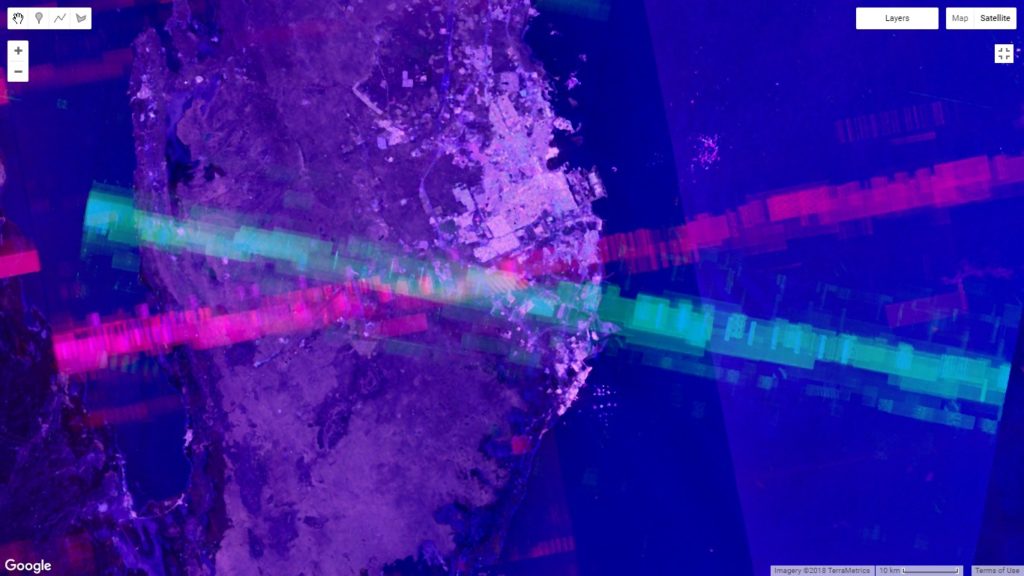
This image provided by Harel Dan shows how AN/MPQ-53/65 radar arrays appear on a map when SAR data is fed through Google Maps. (Medium)
Dan explains in his piece:
Advertisement
Long story short, some of these are AN/MPQ-53/65 phased array radars that form a Patriot missile battery C². Looking at official documentation, the military G-band is the civilian C-band. Sentinel-1 central frequency is 5.405 Ghz, well within this range, hence my working hypothesis is that there is some sort of ground based interference with the Sentinel-1 signal.
So anywhere in the world these artifacts appear, they may point to a location of a patriot battery, or other early warning system.
He goes on to offer side-by-side comparisons of where these Xs appear in his data, and how they correlate to known locations of Patriot missile batteries. Although Dan didn’t conduct the same thorough analysis of other platforms, it stands to reason that weapons systems that utilize similar radars would also appear on the map in a similar way; including Russia’s S-300 and even more advanced S-400 anti-aircraft and missile defense systems. That hypothesis would be more difficult to verify, however, as there is less information readily available about where to find these platforms for comparison against the data available.
Advertisement
However, it seems like that if there wasn’t already a team of analysts pouring over similar SAR maps of Russia and Syria before, there certainly is now.
COMMENTS






