

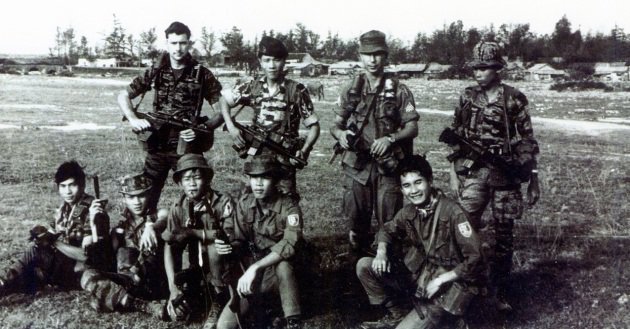
Teams carried a mishmash of American and captured weapons, equipment, and uniforms. Teams were inserted via helicopters. Communications were relayed through a Forward Air Controller (FAC) fixed-wing aircraft.
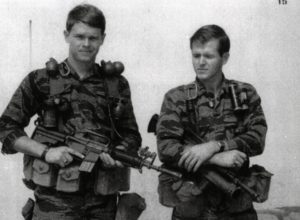
Unlike the JSOC troops of today, the SOG warriors had none of the technology-based items to give them an advantage over their adversaries.
Not long ago, I spoke with one of SOG’s best, author John Stryker Meyer. He told me that other than the aircraft, SOG’s enemies usually had better equipment. “We’d have given anything for a pair of NODs (night vision goggles),” Meyer said. He added that the communists normally could and would listen in to all of their radio transmissions.
In an interview with the Sarasota Herald-Tribune a few years ago, Meyer recounted his last mission in 1970.
“We were on the ground for a few hours and made a light contact. We could not move the way I wanted to and made another contact — not a firefight but we were compromised,” he said. “I wanted a tactical extraction, but my request was denied. A colonel I’d argued with denied my request for a tac extract, which every One-Zero could do. An NVA came through the elephant grass — really young kid who looked like a student. He never moved his AK. I had my CAR-15 pointed right at him. He just backed out and went away. I called in Sky Raiders for direct gun runs and they pulled us out on ropes.”
During their eight-year campaign against communist forces, SOG suffered horrible casualties, with a rate that exceeded 100 percent, meaning that many of their members were wounded more than once. It was the highest casualty rate since the Civil War.
But the kill rate for SOG warriors was an incredible 158-1. Twelve SOG warriors were awarded the Medal of Honor: nine Green Berets, two Navy SEALs, and an Air Force pilot:
- Staff Sergeant Roy P. Benavidez (awarded from President Ronald Reagan)
- Staff Sergeant Jon Cavaiani
- First Lieutenant James P. Fleming (USAF 20th Special Operations Squadron)
- First Lieutenant Loren D. Hagen (posthumous), CCN/TF1AE
- Sergeant First Class Robert L. Howard (awarded on his third separate recommendation)
- Specialist 5 John J. Kedenburg (posthumous)
- Staff Sergeant Franklin D. Miller (5th Special Forces Group)
- Lieutenant Thomas R. Norris (Navy SEAL)
- Sergeant Gary M. Rose (awarded by President Trump in 2017)
- First Lieutenant George K. Sisler (posthumous)
- Engineman Second Class Michael E. Thornton (Navy SEAL), STDAT-158
- Sergeant First Class Fred W. Zabitosky
In addition, 22 members of SOG were awarded the Distinguished Service Cross, the nation’s second-highest award for valor. Of the nearly 300 Americans still declared MIA from the war in Vietnam, 50 of them were Green Berets who disappeared while on SOG missions.
Vietnamization scaled back SOG’s missions and President Johnson ordered all operations into North Vietnam stopped. The 5th Special Forces Group, where the vast majority of SOG’s warriors came from, was rotated back to the United States in March of 1971. On April 30, 1972, SOG was deactivated.
However, it wasn’t until April 4, 2001, that the U.S. Army officially recognized the bravery, integrity, and devotion to duty of the SOG warriors by awarding the unit a Presidential Unit Citation during a ceremony at Fort Bragg, North Carolina.








COMMENTS