

But they reacted with a savagery that the VC weren’t prepared for. With storms of small arms fire, they cut down the first skirmishers in seconds. The VC went to ground, realizing that they weren’t going to overwhelm the Marines by assault. Instead, they turned to probing the perimeter with small groups, trying to get close to a Marine, then take him out with a grenade. The Marines were alert however, and were able to throw their own grenades, often before the VC could get close enough. The Marines could throw farther and the US grenades had a wider blast radius than the ChiCom stick grenades the VC were using.
Howard got on the radio to Sullivan, saying, “You’ve got to get us out of here. There are too many of them for my people.” Sullivan was immediately on the line to the 1st MarDiv Direct Air Support Center, asking for flare ships, helos and fixed wing aircraft to support and extract Howard’s Marines. But the support wouldn’t come fast enough. Howard and the rest of the platoon had to hold out until daylight.
At midnight the VC rushed the position again and were thrown back again, though now the Marines were out of grenades and were already keeping their rifles on semiautomatic to conserve ammunition. Their accuracy was making up for lack of volume, but all of them were now wounded and several were dead. The living salvaged the ammo from the dead and got ready for the next assault.
For some time it didn’t come. The VC had been badly mauled by 18 Marines and 2 Corpsmen. From his earlier combat experience, Howard knew they were listening for signs that they’d broken the Marines morale. Soon, taunts started to come out of the dark. “Marine, you die tonight” and “Marines, you die in an hour.” When his men asked if they could shout back, Howard said, “Sure, go ahead and yell anything you want.” The Marines proceeded to bellow out every bit of invective and verbal abuse they could think of. When the VC screamed back at them, Howard called out, “All right. Ready? Now!”
The Marines laughed as loud as they could, taunting the VC. The hillside went quiet. Howard later said, “They were shooting at us, and when we started laughing…they stopped. There was complete silence. I think it had a chilling effect on them. They must have known we were terribly outnumbered, but here we were laughing at them.”
At 0100, air support arrived, heralded by a flare from the flare ship “Smoky Gold.” PFC Joseph Kosglow described the scene revealed by the light. “There were so many, it was just like an ant hill ripped apart. They were all over the place.” The jets and Hueys that Sullivan had called for had been on station for some time but couldn’t strike without light. Now that the flare ship was lighting up the battlefield, they went to work, strafing and rocketing the VC in the valleys.
While Howard was signaling the Marines’ position with a red-filtered flashlight, the air controllers in the air couldn’t be 100% sure where all the Marines were, so they left a space around the perimeter. The VC, using a tactic that would later be called “hugging”, got close in response.
The fight continued. The Marines used single, aimed shots, instructed by Howard not to shoot unless they were sure of their target. Out of grenades, they used rocks to flush out the VC, lobbing them like grenades, then picking off the VC when they tried to scramble away before the “grenade” exploded.
At 0300, a flight of H34 helicopters arrived to extract the team, but the fire was too heavy and they had to break off. At about the same time, Howard took a ricochet in the back and his voice died over the radio. Back in the rear, Sullivan and the rest feared the worst, but Howard came back on a moment later. Refusing to accept morphine, and unable to use his legs, he dragged himself around the perimeter, encouraging the Marines, dragging the PRC-25 radio with him the entire time.
At 0525, he announced that reveille was going in 35 minutes. He proceeded to call reveille at the top of his lungs at 0600. They were still under sporadic fire from two of the VC 12.7mm machineguns, though the VC had dug in to wait for darkness. They still had the hill surrounded, and LtCol Sullivan later theorized that after taking such significant losses from Recon units in the recent past, they wanted very badly to destroy one. Howard’s platoon was their chosen target.
Shortly thereafter, a Huey, flown by Maj Goodshell, flew in to see if they could extract the platoon, testing the VC fire. There was nothing until the helo got low enough to drop a smoke grenade, when the VC opened fire, killing Maj Goodshell. The Huey crashed. Howard desperately waved off the medical helicopter, lest it be shot down as well.
The jets and Huey gunships swooped down to take their vengeance on the VC and managed to knock out the two remaining 12.7s. Shortly after that, the infantry arrived in the form of Charlie Company, 1/5. They had been forced to circle in their H34s for 45 minutes until a secure landing zone could be blasted out of the terrain that was still swarming with VC. When the grunts got within sight of the rocks where Howard and his surviving Marines were holed up, they were greeted by requests for cigarettes.
Fighting continued until noon, with Charlie Company losing four more Marines. Of the 18 men who had inserted onto Hill 488, only 12 had survived, every one of them wounded. When the grunts got to them, they had only 8 rounds left between them.
Some of the Marines’ story will never be told, as they fought and died alone along that 20-meter perimeter, in the dark. One was found dead under a Vietnamese body, his hand still wrapped around the knife buried in the VC’s back. Another position only held a heap of mangled Vietnamese bodies and two Marine entrenching tools, covered in blood.
Four Navy Crosses and thirteen Silver Stars were awarded for the battle of Hill 488. SSgt Jimmie Howard, for his leadership under fire, was awarded the Medal of Honor.
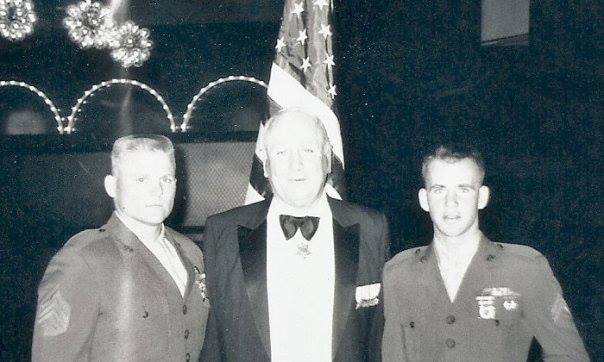
Jimmie Howard retired as a 1st Sgt in 1977. He died in 1993.








COMMENTS