

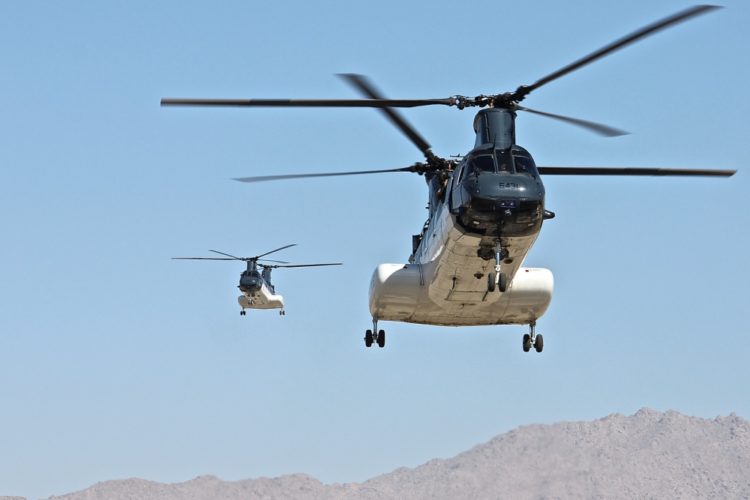
The helicopter on the left is a Phrog. On the right is a Chinook.
In fact, many of the photos and videos that surfaced from the evacuation were Chinooks. There hasn’t been confirmation who was flying the Chinooks, though the 10th Mountain Division had soldiers on the ground.
Telling Phrogs From Chinooks
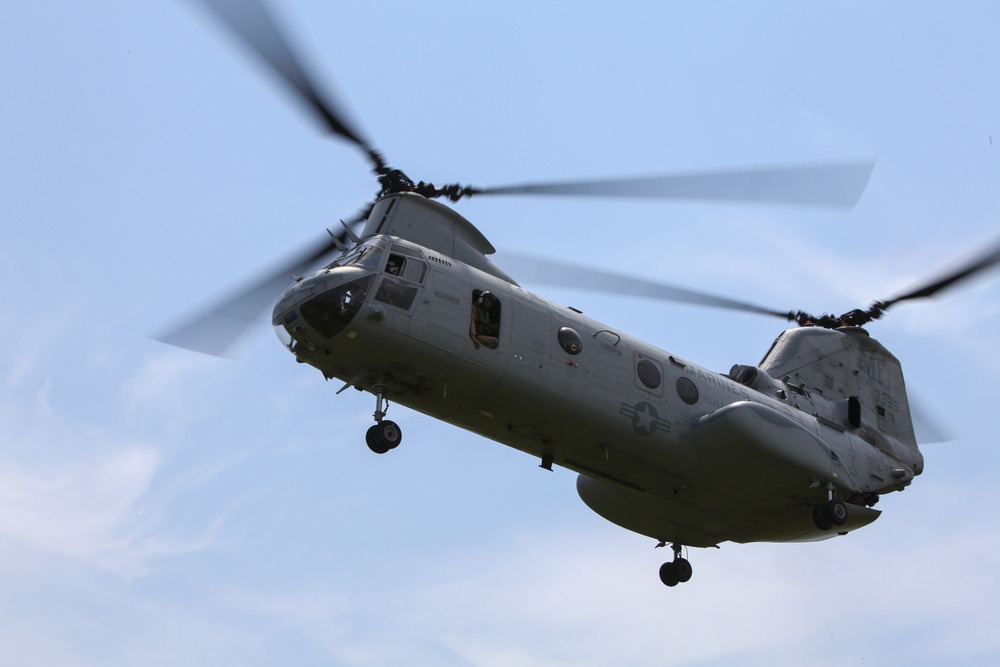
Without having them side-by-side for comparison – the Chinook is larger – the easiest way to tell a CH-46 from a CH-47 is the shape. A Phrog is named so for a reason: it looks a little like a frog. It has a bulge on either side at the rear, called a sponson, where the wheels attach.
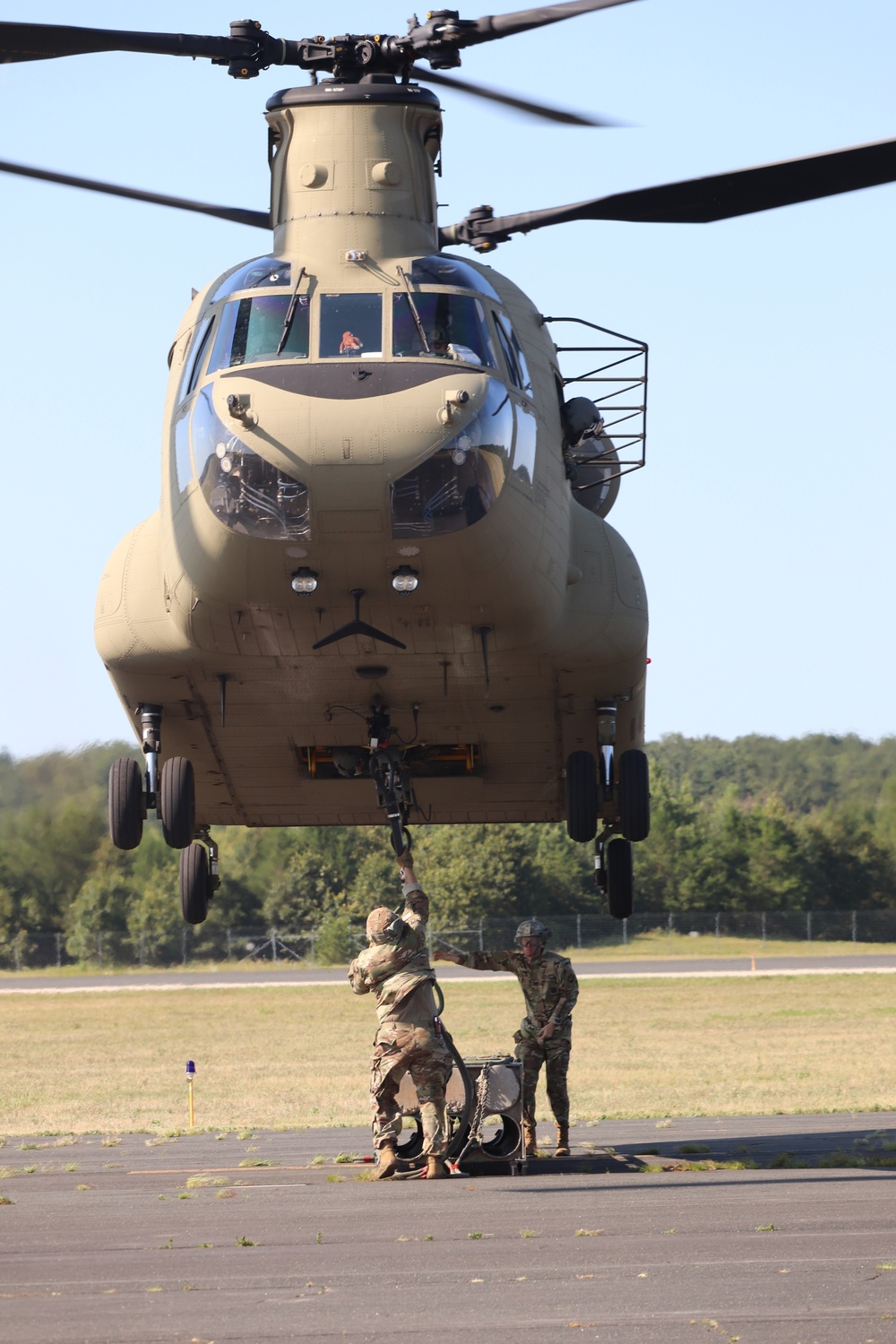
The 46’s larger and slightly younger cousin, the CH-47, bulges along most of its body. If you’re close enough, you can also just count the wheels. A Phrog has three and a Chinook has four.
Both airframes have been in service since the 1960s, though the first Phrog flew in 1958, while the Chinook waited until 1961.
The Embassy Air airframes also tend to be painted a tell-tale blue-and-white, though there are photos with original paint jobs as well. Even in Kabul, a CH-46 without the State Department paint job was spotted in the background of photos as recently as 2020.
From Saigon to Kabul
The CH-46 entered State Department service, much like many contractors, as it left military service. After serving Marines through the initial operations of the War on Terror, the Phrogs were replaced by the MV-22 Osprey.
But that long lineage was on display during the evacuation of the Kabul Embassy. One Twitter user even spotted a bit of serendipity. One of the CH-46s in the Kabul evacuation had also, purportedly, evacuated the U.S. ambassador from Saigon some 46 years prior.
The US State Dept CH-46 currently evacuating people to Kabul airport is ex-USMC 154038.
By a quirk of fate, the CH-46 that evac’d the US ambassador from Saigon was 154803. pic.twitter.com/Xw4MBI4HZx— Sticky (@stickybloke) August 15, 2021
The CH-46 wasn’t as iconic to the Vietnam War as the Bell UH-1 “Huey” Iroquois. Still, it played a big role, including during the 1975 Saigon evacuation.
A lot of different airframes participated in the evacuation of Saigon and many of them were Republic of Vietnam aircraft. The rush to exit Vietnam even saw Hueys dumped into the ocean to make room on ship decks.
With U.S. carriers playing a central role in that evacuation, it’s no surprise the Marines were front-and-center with the Phrog.
Yet, in land-locked Afghanistan, with the airport as the only way out, Phrogs were once again central to the evacuation. And, given how many contractors have military service, there’s a good chance some crewmembers had prior service with the airframes.
A Final Resting Place for the Phrogs of Kabul
Through decades of service, the CH-46 flew Marines from the jungles of Vietnam to the deserts of Iraq. Anyone who ever rode in one knows there was no better way to travel.
They carried Marines into, and out of, the Battle of Baghdad and had very competent aircrews. This author helped look over some of the relevant awards recommendations and remembers enough to still hold the Marine aircrews in high regard.
As the Marines transitioned to the Osprey, the Phrog continued to serve. For more than a decade Phrogs flew across the skies of Afghanistan, carrying State Department personnel in their new role.
That ended in more ways than one with the evacuation of Kabul.
The U.S. State Department confirmed by email that it had seven Phrogs operating in Afghanistan during the evacuation. But the Air Wing stopped operating aircraft in Afghanistan after the embassy evacuation ended on August 15.
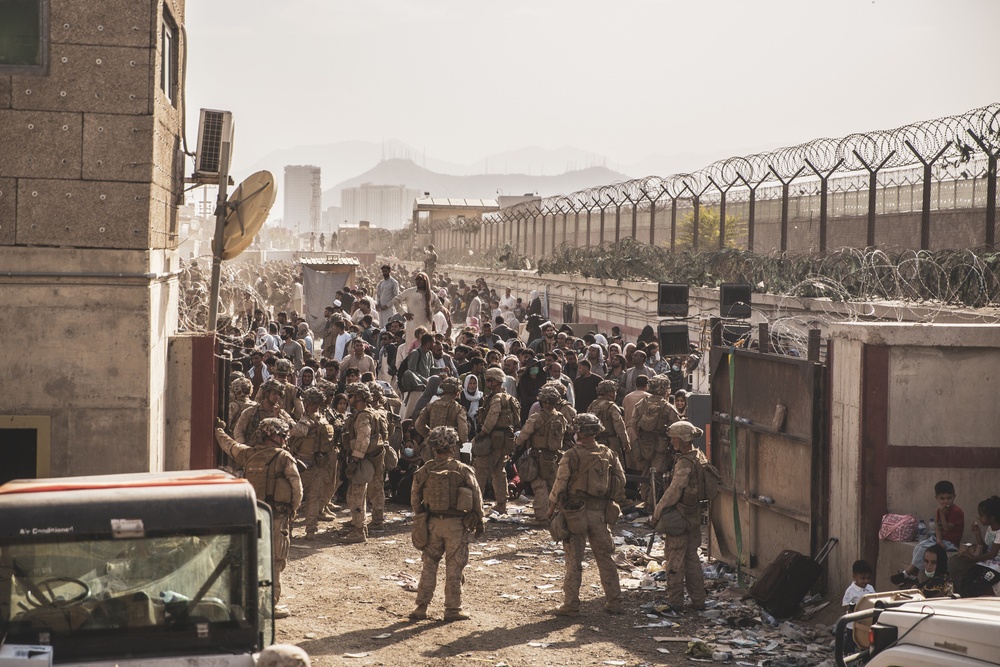
And that is where the story of those Phrogs ended as well. The State Department stated that the seven CH-46s in Air Wing service in Afghanistan were “rendered inoperable and left in Afghanistan.”
It seems, maybe, a little wrong, with all the other tragedy of the withdrawal, to get emotional about a helicopter. Still, this author has to take a moment for the seven Phrogs that will never leave Afghanistan.








COMMENTS