

Except in one area.
At the tip of this fighting force lay the South Korean Special Forces. Highly trained and just as capable as their western counterparts, they’ve found themselves the victims of manpower cuts which have seen their numbers dwindle to less than 20,000.
Contrast this with the North which has boosted its Spec Ops units to its present level from 80,000 in the previous years. A 10:1 ratio.
Granted, most of the North’s units aren’t as highly trained as the South’s, and the U.S has its own Special Operations Command in country called SOCKOR (Special Operations Command Korea) on call, but never in history have small specialized teams of men played such a vital role on the battlefield and in the shadows like now, and fearing a grave mistake made, a Presidential review board has suggested boosting the numbers.
South Korea’s Army Special Forces fall under the command of the Republic of Korea Army Special Warfare Command. These comprise about 10,000 Spec Ops personnel in 7 Brigades and attachments.
Established in 1958, tens of thousands of its members have worn its trademark black beret and traveled throughout the globe to fight alongside allies, as it did with the U.S during the Vietnam War, and to provide security during U.N peacekeeping missions.
The latter is unique as it is performed by ‘Evergreen’ unit, a composition of Spec Ops, Marine Corps, Army Engineers and Medics of battalion strength.
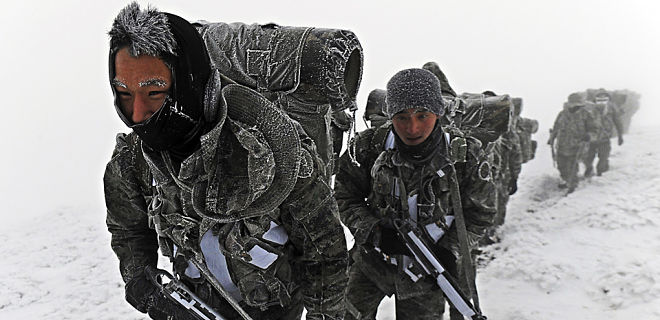
Training of Army Spec Ops (Rangers included) is based somewhat on the U.S model, with all required to be airborne qualified with a few nuances thrown in, such as requirements for each member to become a black belt in the Korean martial art of Tae Kwon Do, and to participate in an annual exercise of winter warfare training in temperatures as low as minus 22 degrees in deep snow with shirts off. There are also female members who take part – but they are allowed to remain fully clothed.
Females have been allowed to join Spec Ops and are used in missions where their presence would be less likely to attract attention. Their numbers are unknown.
The most elite unit in the command is the 707th Special Mission Battalion ‘White Tigers’ counter-terrorist group, which was formed in 1981 to deal with hostage situations leading up to and beyond the 1988 Olympics in Seoul.
Prospective trainees apply from all branches of South Korea’s armed forces, while others are handpicked. All members are airborne and scuba qualified, and they frequently train alongside other counter terror groups from around the world.
Impressive as it is, the Army Spec ops contingent totals only about 10,000 personnel, which brings us to the Navy and Air Force contributions, which provide the other 10,000.
The Naval Special Warfare Flotilla is older than the Army’s Special Warfare Command, having been established in 1955. Providing UDT/SEAL Teams, it borrows from its U.S. counterpart in severity of training (it has a Hell Week, too),and passage rate. Its missions are identical and it’s also the Korean spec ops unit perhaps most active in recent times as it combats piracy as part of the Cheonghae Anti-Piracy Unit off Somalia.
Separate from the flotilla but under Navy command is the Republic of Korea Marine Corps. Though it can be debated whether it truly falls under the heading of Spec Ops, the Republic of Korea Marine Corps has a storied and revered history going back to the Korean War, and offers the Special Reconnaissance battalion to the mix involving intelligence, raids, ambush and interdiction. If added to the Spec Ops grouping, the South Korean Marine Corps counts for another 29,000 personnel,
Last is the Air Force. Its Combat Control Team are assigned to any of the Army and Navy units as needed, and provide air coordination and fire support.
Whether there is a significant boost in size in any of these units over the coming years remains to be seen. At this time though, it is clear that there is a crisis in in the South’s Special Operations Capability… A tragedy created by near sighted politicians failing to understand history.
Units of The Republic of Korea Army Special Forces Command consist of the following:
- Special Warfare Training Group
- 1st Special Forces Brigade (Airborne) ‘Eagle’
- 3rd Special Forces Brigade (Airborne) ‘Flying Tiger’
- 5th Special Mission Group (Airborne) ‘Black Dragon’
- 7th Special Forces Brigade (Airborne) ‘Pegasus’
- 9th Special Forces Brigade (Airborne) ‘Ghost’
- 11th Special Forces Brigade (Airborne) ‘Golden Bat’
- 13th Special Forces Brigade (Airborne) ‘Black Panther’
- 707th Special Mission Battalion ‘White Tiger’
ROK Naval Special Warfare Flotilla Consists of the following:
- Special warfare squadron (UDT/SEAL)
- Mine Warfare Squadron
- Rescue squadron
- Ship Salvage Unit (SSU)
ROK Air Force Special Units consist of the following:
- Combat Control Team (CCT)
- 6th Search and Rescue Group
(Featured Image Credit: blog.wsj.com)








COMMENTS