

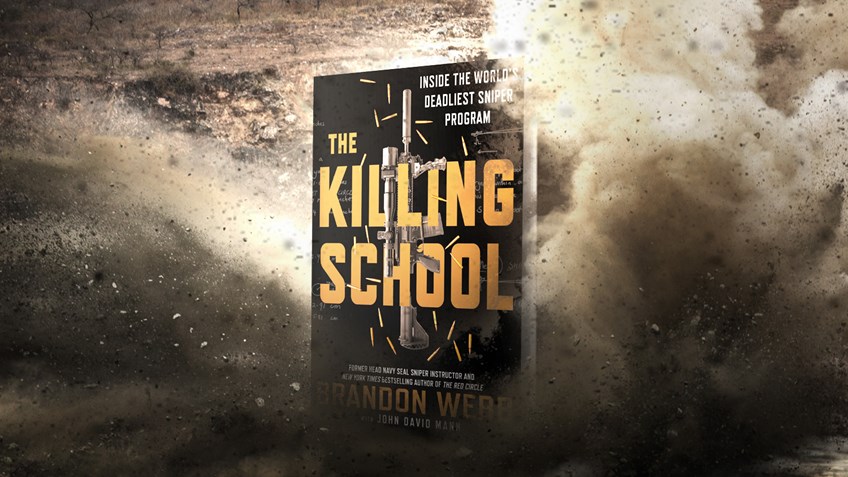
We recently asked Webb about his latest book, and about how learning about Navy SEAL training might help us.
A1F Daily: In the military they often say, “There is no ‘I’ in team.” But the SEALs and other elite groups also train soldiers to think like individuals, even to hone different strengths that fit together into a team. Even a sniper has a spotter. How does this team dynamic work in the SEALs?
Webb: In the SEAL Teams, we teach guys to think independently, but it’s all about the team 100 percent. Even when it comes to admin cleaning of gear, it’s always team gear, your buddy’s gear, your gear and then yourself last.
A1F: In the military there is accountability for actions, but in civilian life, especially in politics, duplicity might be rewarded. Is this a necessary difference, or is it something rotting in our culture? I realize this is a subjective question, but when reading your book, I kept seeing the sacrifices those in uniform make while thinking that we need to understand and celebrate the code they ideally live by, if only as a check on the Machiavellian nature of the mainstream.
“To this day I still use the positive psychological coaching elements I incorporated into the SEAL sniper course in my life as a parent to my children and a leader in my team I work with today in business.” — Brandon WebbWebb: I couldn’t agree more with you on the duplicity in politics; it’s one of the reasons I supported Donald Trump upending the political system in D.C. He’s turned the process on its head, and the press follow him around like a lost puppy. America needs to bring back a culture of accountability.
A1F: What made you want to be a SEAL?
Webb: I dig deep into this in my first book, The Red Circle, my memoir that describes my crazy childhood, hippie parents and leaving home at age 16. The short answer is I’ve always had a desire to serve my country, and I initially wanted to become a fighter pilot. However, fate stepped in, and while I was working on a SCUBA diving boat as a young man I learned about the SEAL Teams, read the book Rogue Warriorand was hooked on joining the Navy to become a frogman.
A1F: What firearm platforms did you use most? Does a SEAL have the freedom to choose from different options or model and/or caliber and even to set up his own?
Webb: I was a fan of the M14 (for its reliability and 7.62 round), and the .300 Win Mag. The SR-25 was also a great 7.62 semi-auto, but we started to have QA issues with the weapon system and a lot of guys stopped trusting the platform. As a SEAL sniper, we had a variety of weapons to choose from and were free to configure them to our imagination’s delight. And to be completely honest, one of my all-time favorite weapons was when I was a new guy SEAL and carrying the big M-60 machine gun. There is nothing like being in a live-fire, 60-minute contact drill with four 60s up and singing together.
A1F: A lot of SEALs seem to do very well in business. Have you found that the skill set you learned in the Navy translated to civilian life?
Webb: I think it’s because a lot of us grew up in extreme adversity in our childhoods, and a majority came from hard-working poor families; it’s a common theme I’ve noticed. They do all these fancy studies on how to select the best candidate for SEAL training, but if I were in charge I’d just screen for childhood adversity! The Navy and SEAL Teams taught me an incredible amount about leadership, both good and bad, but you take the bad experiences and learn from them and try and become a better leader for it. To this day I still use the positive psychological coaching elements I incorporated into the SEAL sniper course in my life as a parent to my children and a leader in the team I work with today in business.
A1F: How does a SEAL team stay successful after winning? What I mean is, there must be a big let down after mission is completed, so how does a team stay in the game so they can be ready to go into action again?
Webb: This one is easy, and our motto answers it: “The Only Easy Day Was Yesterday.” We realize this, and that you have to earn your gold SEAL Trident pin every day. I teach this to my own kids, and tell them they always have to strive to do better in life, and can never rest on past accomplishments.
A1F: What do you hope people take away from The Killing School?
Webb: I hope they get a greater appreciation for what it takes to become a sniper and to deploy downrange on the battlefield—both the professional aspect and the very real human toll it takes. I also hope people recognize the elements in the book—during the training portion, especially—that can be applied in their everyday lives, and that it makes them better leaders in life.
Frank Miniter is the author of The New York Times bestseller The Ultimate Man’s Survival Guide—Recovering the Lost Art of Manhood. He is also the author of This Will Make a Man of You and The Future of the Gun. He is a contributor to Forbesand writes for many publications. His website is FrankMiniter.com.








COMMENTS