

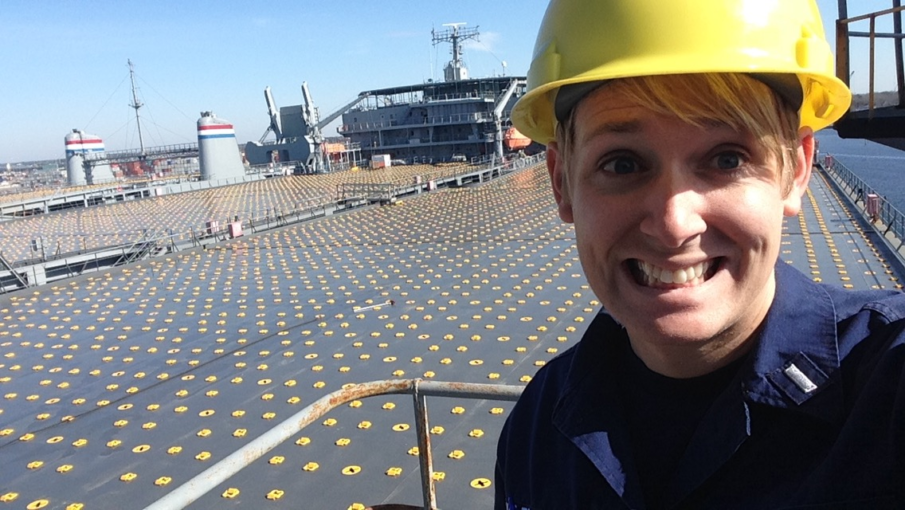

While the HRT made Miller generally happier, hiding it made for some tough days. Her assigned job was as a Marine Inspector, meaning she would board and inspect commercial vessels and check their engineering spaces to make sure everything was functioning properly. This often meant flying out to oil tankers in a helicopter in order to ensure that the next Exxon Valdez spill didn’t happen. Checking engineering spaces in particular was difficult, as Lt. Miller was wearing baggy mens’ clothes and wrapping her chest in ace bandage in order to prevent the effects of HRT from showing, whilst climbing and crawling through tight spaces in 130 degree heat.
Some notes on the trans-ban and Secretary of Defense Ash Carter:
- In June of 2015 Carter effectively lifted the ban, which basically stated that no one would be discharged for being transgender without the approval of the SECDEF, which wouldn’t be given, whether the member came out publicly or was outed. It also established a working group to establish the policies that would welcome trans personnel into the military.
- No guidance was given as to how the trans service members were to be treated, other than “at command discretion.”
- This meant that some were allowed to transition while others weren’t. It all depended upon the command.
- In June of 2016 Carter officially eliminated the ban after a year of ‘trial.’ This meant that trans personnel could serve openly and that the policies for it would be phased in over the next year. That year however, extended out of Carter’s time as SECDEF and President Obama’s term.
- The current statements from SECDEF Mattis and the Joint Chiefs of staff indicate that more assessments are being made to evaluate military readiness and effectiveness, SECDEF Carter acknowledged in his 2015 guidance that “the working group will start with the presumption that transgender persons can serve openly without adverse impact on military effectiveness and readiness.”
- While the Coast Guard is funded by DHS, it still follows DoD guidelines and functions in a military capacity depending on the situation.
- As Lt. Miller sees it, it would appear some personnel were allowed to transition before 2015, as news stories about them began circulating immediately after the 2015 statement.
Though good at her job and racking up qualifications, Miller had some awkward moments at work, sharing a locker room with men who assumed her to be gay. Then after coming out as trans and wearing women’s civilian clothes but still having to use the male locker room caused things to be a bit worse. She was still subject to male grooming and physical standards as well. But being an effective teammate may be more important to some than a few awkward moments; Taylor is good friends with some of her former coworkers in Texas.
Then after two years in Texas, she was transferred out to Long Beach as the trans ban was lifted and she was allowed to serve in female uniforms adhering to female grooming and physical standards. After six months she was allowed to use the women’s locker room which, according to her “there are fewer girls, so there’s less likely to have a problem anyways.”

Currently Lt. Miller is still serving as a Marine Inspector in Long Beach, although there have been difficulties. Estrogen and testosterone blockers have had an adverse effect on physical performance.
“The female physical standards exist for a reason. I used to run a 7:30 mile, rain or shine, having prepped or not. Now I’m at 9:30… This little frame used to bench 225 and squat 365. I’d be lucky to put up the bar on bench now.” While that last part is a slight exaggeration, it’s not without merit. Miller went from the frame of a Texas football captain to a slim female. “I couldn’t meet the men’s standards now. With a lot of work, maybe.” Lt. Miller passes the female standards without a problem.
To the question of going without hormone therapy if the supply chain failed her, Lt. Miller isn’t worried. She has been without for five days before and it wasn’t a problem. She also hasn’t had to go to sea since she began HRT, and even before that it wasn’t more than a few days. In the event that she was to go without HRT the would be a slow testosterone elevation followed by emotional distress and body hair recurrence.
The costs have also been adding up. Lt. Miller estimates that her transition so far has run up a tab of approximately $20,000. The costs have been higher because she was doing it all out-of-pocket without insurance in order to remain secret. Her expenses have included: doctor visits, blood work, HRT, legal fees, and hair removal. Were she doing it all now, under current guidance the blood work, doctor visits and HRT would be covered, and at less of an expense to the Coast Guard as things like blood work, are part of basic medal checkups anyway.
Lt. Miller isn’t fond of the hair removal, as it takes approximately 80 man-hours at a cost of $100 an hour. The complete transition surgery is now covered by Tricare, but that involves finding a physician who performs the surgery and takes Tricare. The only one Lt. Miller has found is not very experienced and she isn’t fond of the idea of trusting “what could be the biggest surgery of my life,” in the hands of a novice. As such, she may be forced to pay for the transition surgery out-of-pocket in order to have access to a seasoned doctor.
Granted, Lt. Miller has five years of active service and is paid accordingly on the officer pay scale, and still checks Goodwill for updating her wardrobe. “I’m lucky in that regard that I had a little disposable income.” While enlisted personnel are often still relegated to a barracks, and have much less income to live on.
In the event that Lt. Miller has to leave the Coast Guard, she would look toward becoming and LGBTQ Advocate. The Coast Guard has even set up workshops for her to answer questions and help commands in dealing with their trans members. Although one was set up and it was abruptly postponed in light of the current situation. Miller’s second choice for work would be to use her degree in mechanical engineering.
For all the speed bumps that life has thrown her way, Miller goes out of her way to be happy. Meeting her entails a firm handshake, a smile, and likely a hesitant dog on a pink leash. Of her struggle, Miller says, “I just don’t want anyone to have to do what I did.”
To the members of the military at large who may have a transgendered person to work with in the near future, Miller says, “Have an open mind and try to understand.”
Author’s note: After coming out as trans to the Coast Guard, Miller did receive a box in the mail. It contained a hand-written letter from Adm Thomas and a command coin.
Images courtesy of Lt. Miller
Correction: An earlier version of this article stated that an LGBTQ workshop had been cancelled. The workshop has been postponed.








COMMENTS