A clean operation, an unclean world
Nicolás Maduro is no longer the president of Venezuela, and on its face, that is good news. Venezuelans seem to agree. Videos circulating online show people celebrating in Caracas, Miami, and Madrid, inside the country and across the diaspora. After years of repression, scarcity, and decay, the removal of an incompetent dictator feels like relief.
I understand that reaction. I share part of it.
What unsettles me is not who was removed, but how.
Venezuela has everything it needs to succeed. Vast oil reserves. Strategic geography. A large, educated diaspora that could return if conditions allow. Yet like much of Latin America, it has been trapped by two forces that usually travel together: criminal violence so entrenched it becomes political power, and poverty so extreme it hollows out institutions. In Venezuela’s case, the criminal organization did not merely influence the state. It effectively became the state.
I have lived in Brazil, Argentina, Colombia, and Mexico. I speak fluent Spanish and studied Spanish literature as part of my foreign languages and literature degree. I have seen the human cost of criminal governance up close. The quiet normalization of fear. The way people adapt to dysfunction because resistance feels pointless. I want these countries to succeed, not as abstractions, but as places where ordinary life is possible.
That reality forces uncomfortable questions. Sometimes it seems that breaking international norms is the only way to sever systems that feed on them. I do not claim certainty there. But I am certain that the ethical consequences of what just happened in Venezuela extend far beyond Caracas.
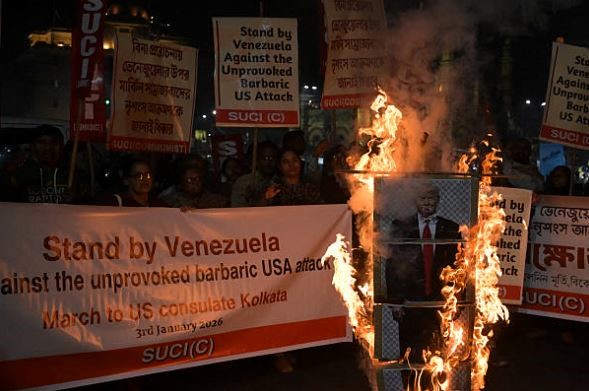
The United States has now demonstrated, openly and unmistakably, that it is willing to remove a sitting head of state through direct action. This was not a drawn-out pressure campaign or an indirect struggle fought through proxies, but a decisive operation aimed at leadership removal.
Maduro deserved removal. That is not the argument. The argument is precedent.
Our adversaries are already exploiting it. Russian state media is openly asking why Washington claims moral urgency over Ukraine or Taiwan when it just removed Venezuela’s leader by force. Who, they ask, appointed the United States the global judge of legitimacy?
That line of attack was predictable, and it will resonate in parts of the world that already distrust American power.
From a narrow realpolitik perspective, the operation makes sense. Venezuela had become an openly hostile state. It hosted Russian-linked mercenary elements, aligned itself closely with Iran, and embedded China deeply into its security architecture through arms purchases, officer training, satellite infrastructure, and dual-use surveillance systems. Its intelligence services were tied to narcotics trafficking and hostage-style detentions of foreign nationals. This was not a neutral actor. It was an active problem.
I encountered that reality personally. While I was in Argentina, the FBI visited me to explain that Russia considers me a wanted fugitive. They walked me through which countries were unsafe for me to enter. Venezuela topped that list, not only because of Russian influence, but because the Maduro government had a documented pattern of unlawfully detaining foreigners to extract political concessions. They made clear that even without my personal status, Venezuela was a country where the rule of law simply did not apply.
Strategically, removing Maduro cuts a hostile node out of the hemisphere. It deprives adversaries of oil, access, and leverage. It disrupts criminal and intelligence networks that had embedded themselves in the region. On paper, it is a clean solution.
Ethically, it is anything but.
Already have an account? Sign In
Two ways to continue to read this article.
Subscribe
$1.99
every 4 weeks
- Unlimited access to all articles
- Support independent journalism
- Ad-free reading experience
Subscribe Now
Recurring Monthly. Cancel Anytime.
What stood out most was how uncontested the operation appeared. Helicopters came in without resistance. No tracer fire. No air defense response. No MANPADS engagement. Any moderately prepared force could have inflicted serious losses. That did not happen. This suggests either total institutional decay or internal betrayal, or both.
That brings us to the historical parallel worth remembering.
In 1989, the United States removed Manuel Noriega in Panama. The operation was justified on narcotics trafficking, threats to Americans, and regional stability. It worked. Noriega was gone. Panama eventually stabilized. But it also cemented a precedent that powerful states can enforce justice unilaterally when institutions fail.
For decades, Washington argued that Panama was an exception. A product of the Cold War’s closing chaos.
Venezuela suggests something else. That this model is back.
We are entering a world where wolves behave like wolves. For a long time, the United States cast itself as the sheepdog. Armed, disciplined, dangerous when necessary, but ultimately enforcing order rather than dominance. What the world just saw in Venezuela looked different. It looked like a wolf acting decisively.
Maybe that reflects reality more than nostalgia. But if that is the case, we should be honest about it. The norms we discard today will be cited tomorrow, not by our friends, but by our enemies. And the cost of that reckoning will not be paid in Venezuela. It will be paid somewhere far more consequential.










COMMENTS