
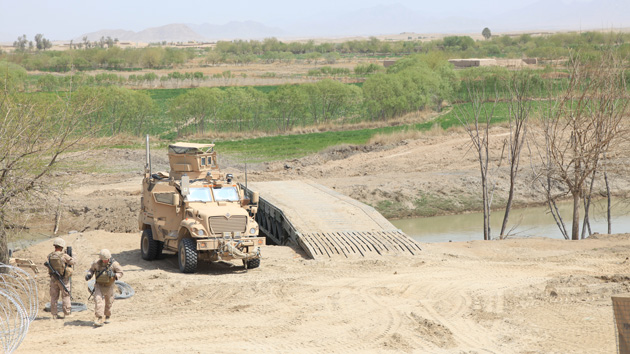
It was rush hour inside; a gridlock of forklifts and bulldozers and side-by-sides and hordes of engineers, all scrambling to put the finishing touches on the base. We were told to leave our bags in the vehicles as we would not be staying long. The MISO techs and myself, along with the team’s second element, were being banished to a second site that lay just beyond the river. Supposedly it was even smaller than this one, which was hard to believe. The first thing that struck me about this site is that it didn’t even have an LZ.
Before the move, I’d sent the SOTF a few products – ALP training stories, a few incidents of Taliban CIVCAS. But so far my time in Watan had yielded nothing for the archives; nothing of MARSOC. My efforts had been solely concentrated on IO, because the team, understanding it to coincide with the VSO mission, could tolerate it.
Documentation, on the other hand, was less of a priority for them, if one at all. “They might not think they want these photos, but they do,” my Top told me. “Fifty, sixty years from now, when these guys are the next Raider Association, they’ll want them.”
I clambered out of my MRAP, stretched my legs. Through the tumult and dust I spotted the team chief on his way to the TOC.
“Excuse me, gunny,” I said, catching up to him.
“Public Affairs,” he said, not slowing down. “What the fuck can I do for you?”
“I wanted to see about getting on a patrol.”
My words stopped him. He turned and looked back at me, smiling, almost salivating at the chance to put me in my place.
“Not a chance in hell,” he said.
That night we threw on our gear and trudged out single-file, bound for The Crater, a line of exiles. A short hump took us out into the poppy fields, where Site II lay like some scourge amidst the picturesque bulbs. When we trailed in through the ECP, a soldier pulling back an accordion of C-wire, it became apparent that the engineers had spent considerably less time constructing it.
“Jesus,” said one of the operators behind me. “One mortar round and this place is fucked.”
The Crater, as it turned out, was exactly that — a dirt hole bulldozed into the ground, encircled by a pile of earth and crowned with one coil of razor wire. Three hastily-built towers leaned on all sides of the perimeter, the noses of machine guns and MK-19’s sniffing out from their portals. At the center (or bottom) stood the VSP’s one structure: a Hesco bunker that would serve as the TOC and living quarters for everyone on the base.
Beside this lay the mortar pit, beyond that, the burn pit, a red glow pulsing within, the sour fumes of shit and fuel and trash filling our new home with a rancid and perpetual fog. This, in all its glory, was The Crater.
“What a fucking shithole,” said the operator.
The bunker was divided in threes — a portion for the Army, a portion for the TOC, and a portion for the rest of us. We crammed inside a narrow hallway of Hescos, our quarters, stumbling in the dark as we hauled our bags inside. It was just wide enough to lay out a cot and squeeze around one side. Fifteen people would live in here. Assorted by precedence, I was relegated to the very back, next to the cook. Stuffing my bags under my rack, I looked down the long aisle of occupants, all packed in like sardines, their gear heaped and mountainous around them, the bunker’s only entrance glowing beyond like the mouth of some deep cavern. Welcome home.
That night I awoke suddenly, shivering, gripped by a biting cold. My clothes were soaking wet. I sat up on my cot, hearing the patter of rain outside, the thunder rolling overhead. A steady tapping at my side indicated a drip from the ceiling, which glinted with similar leaks stretching the length of the bunker.
The operator beside me threw off his sleeping bag, cursing. The leak over his cot had intensified to the force of a faucet sink. Other tenants began pushing their cots aside, amassing their belongings away from the water.
“Those goddamn engineers,” said my neighbor.
A ripping sound above unleashed a sheet of water that crashed squarely on his shoulders, splashing the rest of us and sending us scrambling to get our remaining gear off the floor. We pulled poncho liners from our bags and began tying them above, diverting the flow of water. As we set up our impromptu tent, the leaks cascading down around us, we did the only thing we could do; the thing that all Marines have done at some point or another when the suck is too much. We laughed.
Dawn found us on the bunker roof, filling sandbags and laying down tarp, most of us shirtless, the rain billowing down. I looked out over the gray landscape, the poppy fields stretching endlessly to the horizon, rippling with wind, the odd tree rocking and bowing out there like a buoy. A cluster of mud huts here, the chimneys sprouting with frayed stands of smoke from cook fires within. This is what it looked like a thousand years ago.
“Whenever you write your story,” said one of the operators as we patched up the roof, “you should call it ‘The Struggle.'”
The humor came from the underlying truth. There was a struggle ahead — or many, and more so than adapting to life within The Crater. For the team, it would be the mission itself; gaining the trust of the people, bringing them to our side, training them to defend themselves. For IO, it would be facilitating these efforts. And for myself, it would be getting the products that were long overdue.
“The Struggle,” for all of us was just beginning.








COMMENTS