Kentucky Roots and No Frills
Dakota Meyer grew up in Columbia, Kentucky, the kind of place where people start working early in their lives and don’t talk much about it. There is no mythology here, just expectations. You show up. You carry your weight. You don’t quit because something got hard. That sticks with a young man. After high school, Meyer went where a lot of young men go when they want something more demanding than whatever is waiting at home. He joined the Marine Corps.
Learning the Job
The Marines have a unique process for building warfighters. They don’t build you from scratch. They strip you down and see what’s left. Meyer trained as an infantryman and later worked as a scout sniper. Nothing too flashy about that. He learned how to move, how to think under pressure, how to operate in small units where hesitation costs time you don’t have, and mistakes get people hurt. That foundation is what held when everything else started to give way.
Ganjgal, Afghanistan
The patrol stepped into Ganjgal at first light. Marines, Afghan soldiers, and embedded personnel were moving into a village that had already decided how the day was going to go. The ambush hit fast. Machine guns, RPGs, fire from high ground, and buildings that had been prepared in advance. The patrol was pinned almost immediately. Requests for supporting fire went up. They didn’t come back in time. Men were cut off in the valley, wounded, exposed, taking fire from multiple directions.
Meyer was outside the kill zone when it started. He could have stayed there.
Instead, he got into a vehicle and drove in.
Then he did it again. And again. And again. And again.
Five trips into a live ambush, down roads already covered by enemy fire. Each time he went in, he brought something out, wounded Marines, Afghan soldiers, pieces of a situation that was breaking apart. At one point, he dismounted and moved on foot through the fight, linking up with elements that had been cut off. He pulled the wounded out. He helped recover the dead. He kept moving when stopping would have been the far easier call.
He was not the only one moving toward the fire that day. William D. Swenson was already inside it, moving through the same fight, pulling men to cover, trying to hold together what was left. Two different uniforms, same problem, same refusal to leave it there.
By the end of it, eight Americans were dead. More would have been if nobody had driven back in.
The Medal and What It Carries
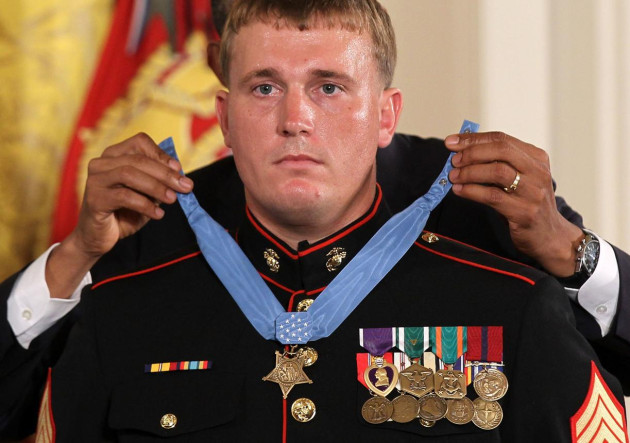
On September 15, 2011, Meyer stood at the White House while the Medal of Honor was placed around his neck. He was the first living Marine in this war to receive it. The ceremony was controlled and precise, the way those events are supposed to be. Citations were read cleanly. Applause happened at the right moments. None of that changes what the medal represents. It marks a day where things broke down, where decisions above the fight had consequences below it, and where a handful of men kept moving anyway.
After the Corps
Meyer left active duty, but he didn’t disappear. He stepped into public life the same way he fought, direct and without much interest in softening the edges. He spoke openly about what happened at Ganjgal, including the failures that left that patrol exposed. That didn’t sit well with everyone. It wasn’t supposed to. He built a presence through books, interviews, and commentary, and at times contributed to outlets like SOFREP, bringing that same unfiltered perspective into print. Say what happened. Don’t dress it up. That approach comes with friction. It also carries weight.
Personal Life and the Palin Chapter
Meyer’s personal life stepped into the spotlight when he married Bristol Palin, the daughter of former Alaska governor Sarah Palin, in 2016. The marriage pulled him into a very different kind of arena, one driven by media attention, politics, and public scrutiny rather than combat or service. They had two children together before divorcing in 2018, and the split played out with the kind of visibility that comes with the Palin name. It added another layer to Meyer’s public persona, one that mixed his identity as a Medal of Honor recipient with the realities of a high-profile personal life that didn’t always stay private.
Back Into Uniform
After receiving the Medal of Honor, most people close that chapter and move on. Meyer went back in. Years after leaving active duty, he rejoined the Marine Corps Reserve. Same institution, same expectations, and no guarantee that anything would be easier the second time around.
What Stays
Dakota Meyer’s legacy is not built on the medal alone. It’s built on a decision made in a few seconds outside a kill zone. Get in the vehicle or don’t. Drive in or stay out. He drove in.
He chose to do the hard thing, the right thing…and that has made all the difference.










COMMENTS