On a winter day over Oschersleben, James H. Howard turned a lone P-51 into a brick wall for the Luftwaffe, riding nerves of steel and dead-eye gunnery to shove a sky full of Fortresses home.
Read the full article for more on:
Important insights and detailed analysis
Expert commentary on current events
Breaking developments and updates
Updating summary...
Medal of Honor Monday: James H. Howard’s One-Man Air Force
Guy D. McCardle
Speed
1x
Listen
COMMENTS
On a winter day over Oschersleben, James H. Howard turned a lone P-51 into a brick wall for the Luftwaffe, riding nerves of steel and dead-eye gunnery to shove a sky full of Fortresses home.
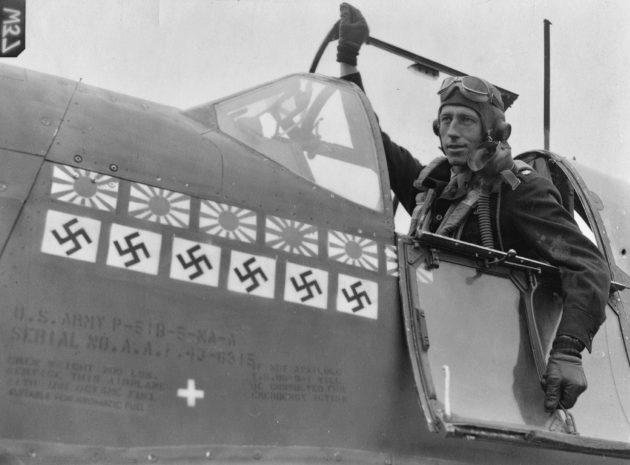
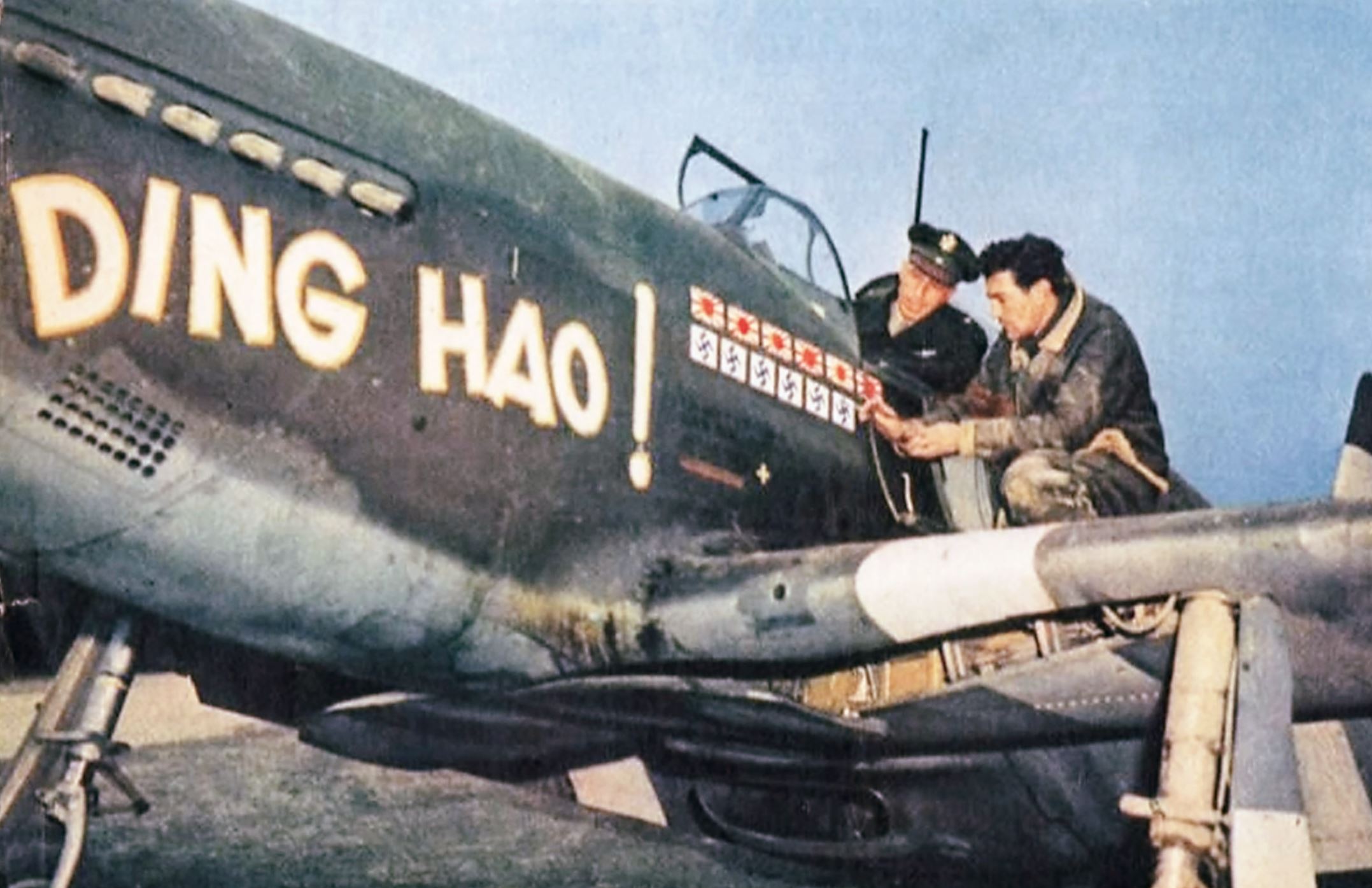
James H. Howard stands beside his battle-scarred P-51B Ding Hao, its nose art lined with Japanese and German victory marks—a visual record of a man who fought two wars in one sky. Image Credit: This Day in Aviation
Before the cockpit
James Howell Howard began life a long way from the American Midwest. He was born on April 8, 1913, in Canton, China, where his American father taught eye surgery at Canton Christian College. The family returned to St. Louis in 1927, and Howard graduated from John Burroughs School before heading to Pomona College in California. He planned on medicine until flying caught his eye late in his senior year. In 1938, he chose the Navy cockpit over the clinic, earned his wings at Pensacola, and headed to carrier duty out of Pearl Harbor. That turn set the trajectory for one of the great air combat stories of the war.
In mid-1941, Howard left the Navy to join Claire Chennault’s American Volunteer Group (AVG). He flew P-40s with the AVG’s Panda Bears squadron over Burma and China. Across 56 missions, he was credited with six Japanese aircraft destroyed, including a tight scrap over Rangoon and Hengyang. He also learned a phrase that would follow him across two oceans. “Ding Hao” — a colloquial Chinese expression roughly meaning number one or top good — became the name on his Mustang later in Europe.
When the AVG disbanded in 1942, Howard returned to U.S. service, transitioned through the P-38 and P-39, and took command of the 356th Fighter Squadron in the 354th Fighter Group in England. His unit was among the first in theater to work the P-51B hard as a long-range escort.
Oschersleben, January 11, 1944
Howard’s Medal of Honor action reads like fiction until you check the mission logs. Escorting B-17s to the German aircraft works at Oschersleben, his P-51B became separated from the group after downing a German Bf 110. He climbed back to the bombers and found them under attack with no friendly cover in sight. For about thirty minutes, he repeatedly hurled a single Mustang into a swarm of Luftwaffe fighters, breaking up passes and shooting down three confirmed despite three of his four guns eventually failing and his fuel running low. Bomber crews watched a lone Mustang carve a shield around them. The Medal of Honor citation names his target area, his unit, and the timeline of those attacks. The medal was presented in London on June 27, 1944, by Lt. Gen. Carl Spaatz.
Reporters descended on him the next week in London. Stars and Stripes correspondent Andy Rooney called it the greatest fighter pilot story of the war, and the press ran with headlines like One Man Air Force. Claims varied in the papers, as claims do, but the official credit stands at three destroyed that day, and six Luftwaffe kills in Europe overall. He had six with the Flying Tigers in Asia, which made him an ace in two theaters.
The Citation
His Medal of Honor citation reads as follows:
For conspicuous gallantry and intrepidity above and beyond the call of duty in action with the enemy near Oschersleben, Germany on 11 January 1944. On that day Col. Howard was the leader of a group of P-51 aircraft providing support for a heavy bomber formation on a long-range mission deep in enemy territory. As Col. Howard’s group met the bombers in the target area the bomber force was attacked by numerous enemy fighters. Col. Howard, with his group, at once engaged the enemy and himself destroyed a German ME. 110. As a result of this attack Col. Howard lost contact with his group, and at once returned to the level of the bomber formation. He then saw that the bombers were being heavily attacked by enemy airplanes and that no other friendly fighters were at hand. While Col. Howard could have waited to attempt to assemble his group before engaging the enemy, he chose instead to attack singlehandedly a formation of more than 30 German airplanes. With utter disregard for his own safety he immediately pressed home determined attacks for some 30 minutes, during which time he destroyed three enemy airplanes and probably destroyed and damaged others. Toward the end of this engagement three of his guns went out of action and his fuel supply was becoming dangerously low. Despite these handicaps and the almost insuperable odds against him, Col. Howard continued his aggressive action in an attempt to protect the bombers from the numerous fighters. His skill, courage, and intrepidity on this occasion set an example of heroism which will be an inspiration to the U.S. Armed Forces.
Howard named his Mustang Ding Hao because of his China years. The nose carried his AVG Japanese victory flags alongside fresh Luftwaffe markings in Europe. The slang itself filtered into American usage among pilots who had rotated through China. It was a small signature that said where he learned his trade.
He is often described as the only fighter pilot in the European Theater to receive the Medal of Honor. Aviation historians sometimes flag that phrasing because 1st Lt. Raymond L. Knight received the Medal of Honor in the Mediterranean. Either way, Howard’s London press conference and the bomber crews’ eyewitness accounts cemented his action as a singular moment in Eighth and Ninth Air Force lore.
His aircraft details draw modelers even now. Early in his tour, Ding Hao retained the original P-51B canopy and sported recognition markings that later changed as the squadron standardized fits. The Boxted Airfield Museum in the U.K. hosts a plaque honoring his January 11 fight.
James Howard with his North American P-51B-5 Mustang (serial number 43-6315), Ding Hao, in England, 1944.
After the war
Howard stayed in uniform through the transition to a separate U.S. Air Force. He was promoted to brigadier general in the Air Force Reserve and later commanded the 96th Bombardment Group. As a civilian, he became Director of Aeronautics for the City of St. Louis, managing Lambert Field. He founded Howard Research, a systems engineering firm, which he eventually sold to Control Data Corporation. In 1991, he published his autobiography, Roar of the Tiger, and retired to Florida, where a permanent exhibit honoring him stands at St. Petersburg–Clearwater International Airport. He died in 1995 and is buried at Arlington.
Why he still matters
Howard showed what flying as an escort really means. It is not merely paint or formation geometry. It is a pilot who refuses to let the enemy near his bombers even when he is alone and out of ammunition. The crews who made it home that day remembered the single Mustang that kept arriving at the edge of every attack. The record shows three kills. The memory that mattered showed a wall of defiance where there should have been none.
Advertisement
What readers are saying
Generating a quick summary of the conversation...
This summary is AI-generated. AI can make mistakes and this summary is not a replacement for reading the comments.










COMMENTS