From Flowood to the Fight
Some men are born into quiet places and carry that quiet with them all the way to the blast crater where history finally takes notice. Kyle Carpenter is one of those men.
He was born on October 17, 1989, in Jackson, Mississippi, and raised mostly in the small town of Flowood. It was not a place that screamed destiny. It was a typical American town of backyards, school sports, church parking lots, and those long, humid Southern afternoons that teach you patience whether you want them to or not.
Carpenter grew up wrestling, lifting weights, and working odd jobs. Nothing out of the ordinary there. He was not chasing glory. He was chasing direction.
After high school, he bounced through a semester of junior college and worked construction. Like a lot of young men in the mid-2000s, he felt the gravitational pull of something harder, something that demanded more than showing up and cashing a check.
Choosing the Hard Road
In 2009, he enlisted in the United States Marine Corps. He did not hedge. He went infantry. Rifleman. 0311. The oldest job in the Marine Corps and still the one that asks the most with the least explanation. After training, he was assigned to 2nd Battalion, 9th Marines. By 2010, he was in Afghanistan, posted to Marjah in Helmand Province, a place that existed primarily to remind Americans why maps matter and why wars never unfold cleanly.
The Rooftop in Marjah
On November 21, 2010, Lance Corporal Carpenter was manning a rooftop fighting position with another Marine. It was early morning. Cold. Quiet in the way that makes your neck tense. An enemy grenade cleared the parapet and landed inside their sandbagged position. There was no time for heroics as cinema understands them. No shouted orders. No dramatic pause. Carpenter moved. He crossed the small space between life and death and threw himself onto the grenade, pulling it into his body and away from his fellow Marine.
The grenade detonated.
Survival Beyond Reason
The blast shattered his right arm, collapsed a lung, broke his jaw, fractured his skull, and drove shrapnel into his brain. His right eye was destroyed. His body was burned and torn in ways that do not heal neatly. He was dead by any reasonable accounting, saved only by immediate medical intervention and a series of surgeries that pushed modern trauma medicine to its edge. Doctors told his family he might not survive the flight to Germany. Then they told them he might not wake up. Then they told them he might never walk, talk, or feed himself again.
Already have an account? Sign In
Two ways to continue to read this article.
Subscribe
$1.99
every 4 weeks
- Unlimited access to all articles
- Support independent journalism
- Ad-free reading experience
Subscribe Now
Recurring Monthly. Cancel Anytime.
They were wrong.
Carpenter woke up. He endured dozens of surgeries. He learned to walk again. He learned to eat again. He learned to live inside a body that had been permanently altered by a single second of violence.
The Medal of Honor
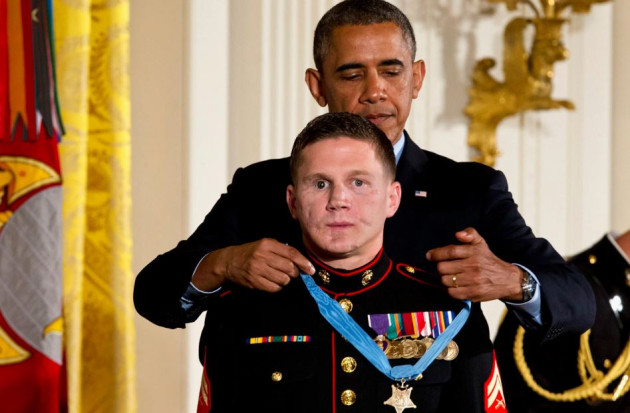
In June 2014, at the White House, President Barack Obama placed the Medal of Honor around his neck. Carpenter stood at attention, visibly scarred, his right arm gone, his face a roadmap of survival. He was 24 years old. The youngest living recipient of the Medal of Honor at the time.
What matters is not the ceremony, though it was deserved. What matters is what came after. How Carpenter continued on.
Refusing to Be Finished
Carpenter stayed in the Marine Corps, refusing to let the medal be a period at the end of his story. He served until 2016, was promoted to corporal, and continued rehabilitation while representing the Corps with a quiet gravity that made speeches unnecessary. He competed in the Marine Corps Trials and the Invictus Games. He did not market his suffering. He wore it like another mission to be completed one painful step at a time.
Life After the Uniform
After leaving active duty, Carpenter enrolled at the University of South Carolina. He carried a full course load. He showed up early and worked hard. He graduated in 2020 with a degree in International Studies.
Along the way, he married, became a father, and continued to speak publicly about resilience, service, and the obligation that comes with surviving when others did not.
The Standard He Sets
Kyle Carpenter does not tell you to be fearless. He shows you what commitment looks like when fear is already present.
His life is not a motivational poster. It is proof that character is revealed in moments you cannot rehearse and sustained in years you never planned for.
He stepped forward when it mattered most, and then he kept walking long after the applause faded.
That is the standard. That is the example set by this, the finest of the United States Marine Corps.










COMMENTS