He didn’t chase glory; he ran toward gunfire because that’s where his brothers were, and that’s where duty called.
Read the full article for more on:
Important insights and detailed analysis
Expert commentary on current events
Breaking developments and updates
Updating summary...
Medal of Honor Monday: Command Sergeant Major Matthew O. Williams – A Green Beret’s Relentless Courage
Guy D. McCardle
Speed
1x
Listen
COMMENTS
He didn’t chase glory; he ran toward gunfire because that’s where his brothers were, and that’s where duty called.
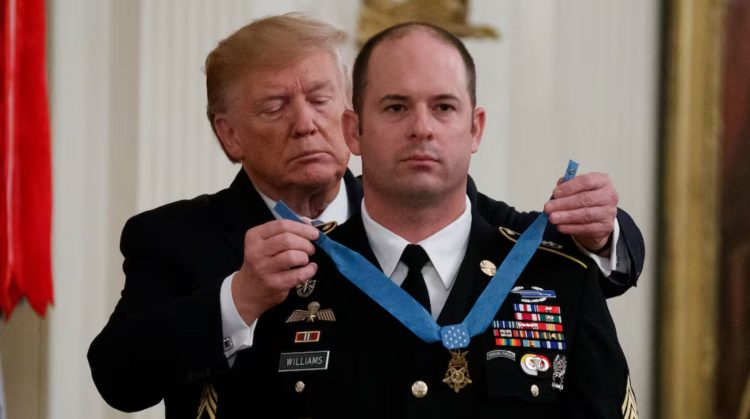
President Donald Trump presents the Medal of Honor to Sergeant Major Matthew O. Williams for his extraordinary heroism during a 2008 battle in Afghanistan’s Nuristan Province. Image Credit: Army Times
From Texas Roots to the Tip of the Spear
Matthew O. Williams grew up in the wide-open expanse of Texas Hill Country, where the air is dry, the sunsets are biblical, and hard work is a birthright. He was the kind of kid who didn’t need to be told twice—athletic, steady, and quietly confident. After earning a degree from Angelo State University, Williams found himself restless, drawn to something that would test every limit he had. When most of his peers were slipping into cubicles, he took a harder road. In 2005, Williams enlisted in the U.S. Army, not to fill a quota or follow a family line, but to find purpose.
Advertisement
He didn’t settle for ordinary soldiering. The Green Beret path—US Army Special Forces—was the crucible he sought. Grueling selection, endless rucks, mind-bending endurance tests; it was where the line between quit and conquer is razor-thin. Williams didn’t quit. He earned the right to wear the long-tab and joined the 3rd Special Forces Group (Airborne), the same outfit that would later send him deep into Afghanistan’s most unforgiving terrain.
Sergeant Major Matthew O. Williams displayed extraordinary bravery and selflessness on April 6, 2008, while serving as a Weapons Sergeant with Special Forces Operational Detachment Alpha 3336 in Afghanistan.
By 2008, Afghanistan was boiling. The war had shifted into a deadly chess game against Taliban and al-Qaeda fighters who knew the mountains better than anyone. Williams, then a weapons sergeant with ODA 3336, was deployed to Nuristan Province—one of those jagged, lawless corners where every ridge line hides a gun barrel.
On April 6, 2008, a combined assault force of U.S. Special Forces and Afghan commandos set out by helicopter to capture a high-value Taliban target. As the team moved up the steep mountain, everything went sideways. The enemy had the high ground, and they used it. Gunfire and rocket-propelled grenades poured down like rain. The ambush was total chaos—men pinned, radios screaming, blood in the dust.
Advertisement
Williams’ team was trapped. The lead element took devastating fire, and casualties mounted fast. Without waiting for orders, Williams moved toward the sound of the guns. He climbed through open terrain under a barrage of fire to reach wounded soldiers, dragging them back to cover while returning fire the whole way. Bullets snapped around him, but he didn’t flinch.
He rallied Afghan commandos, directed suppressive fire, and carried wounded comrades through 100 meters of enemy kill zone—not once, but multiple times. When the medevac bird tried to land under fire, Williams helped secure the landing zone, shielding the wounded with his own body. Then, instead of resting, he went back into the fight. Hours later, after what felt like a lifetime of combat, his actions had saved four lives and prevented the total annihilation of his team.
It took more than a decade for the moment to catch up to the man. In October 2019, President Donald Trump awarded Master Sgt. Williams the Medal of Honor for his actions on that mountain in Nuristan. Williams stood at attention in the White House, calm and composed as the story of that hellish day was retold for the nation.
“Matt’s incredible heroism saved the lives of his teammates and countless others,” Trump said during the ceremony. Williams’ fellow Green Berets stood proud that day—not just for him, but for what he represented: quiet professionalism, bravery without theatrics, and devotion without ego.
Williams, true to form, deflected the spotlight. “It’s about the team,” he said. “It’s about those guys that were there that day.” That’s the Special Forces way—credit the mission, not the man.
Life Beyond the Battlefield
Williams didn’t fade into a ceremonial role after the medal. He stayed in uniform, continuing to serve with the 3rd Special Forces Group at Fort Bragg, North Carolina. That’s rare. Many Medal of Honor recipients retire to speaking circuits and book deals, but Williams remained in the fight, training the next generation of Special Forces soldiers and preparing for whatever the next mission demanded.
He and his wife Kate have spoken often about the weight of the medal—not as a burden, but as a reminder. The medal represents not heroism alone, but loss: the friends who didn’t come home, the moments of chaos etched into memory. Williams carries that with the kind of stoic grace only a warrior can understand.
The Measure of a Modern Warrior
Master Sgt. Matthew O. Williams isn’t a figure carved from myth. He’s a man who saw the worst of war and met it head-on, not for glory or medals, but because his brothers needed him. His Medal of Honor doesn’t rest on a mantle—it lives in every Green Beret who learns that courage isn’t the absence of fear, but the will to act in spite of it.
In an era where words are cheap, he reminds us that action still matters.
-DOL
—
Editor’s Note: As of this writing, Matt Williams is still wearing Army green and serving his country. He is a CSM with 3rd Special Forces Group (Airborne). – GDM
Advertisement
What readers are saying
Generating a quick summary of the conversation...
This summary is AI-generated. AI can make mistakes and this summary is not a replacement for reading the comments.










COMMENTS