Pakistan and Afghanistan have engaged in a significant escalation of military conflict, marked by airstrikes and cross-border fire, following accusations from Pakistan that Afghan territory is being used by militants to launch attacks. The situation has intensified with Pakistan's Operation Ghazab-i-Lilhāq targeting Taliban positions, while the Taliban government warns of violations of sovereignty and retaliatory actions.
Key points from this article:
The airstrikes by Pakistan targeted military installations in Kabul, Kandahar, and Paktia, marking a significant escalation since the Taliban's return to power in 2021.
How the ongoing conflict affects regional stability, as both nations risk prolonged military exchanges that could disrupt trade and humanitarian access at border crossings like Torkham.
Why this matters: The confrontation highlights Pakistan's concerns over the Tehrik-e-Taliban Pakistan (TTP) operating from Afghan soil, raising tensions along the 2,600-kilometer Durand Line and risking further destabilization in an already fragile region.
Pakistan and Afghanistan trade airstrikes in a widening frontier clash, while Ukraine claims a 900-mile missile strike inside Russia amid one of Moscow’s largest drone barrages of the war.
A general view of Kabul, Afghanistan, with snow-covered mountains in the background. Credit: Unknown
Pakistan–Afghanistan Escalation Widens Into Cross-Border Campaign
Pakistan and Afghanistan exchanged airstrikes and cross-border fire this week in the sharpest escalation between the two since the Taliban returned to power in Kabul in 2021. Pakistani aircraft struck targets in Kabul and in the provinces of Kandahar and Paktia early Friday, Afghan officials said, hours after Taliban forces launched what they described as retaliatory attacks on Pakistani border posts.
Advertisement
The clashes followed several days of mounting tension along the Durand Line. Islamabad said it had conducted earlier strikes inside Afghanistan targeting bases used by Tehrik-e-Taliban Pakistan (TTP) and Islamic State affiliates responsible for attacks inside Pakistan. The Taliban government condemned those operations as violations of Afghan sovereignty and warned it would respond.
(Editor’s Note: The following posts are reproduced as part of ongoing coverage. Their authenticity has not been independently verified.)
BREAKING: Pakistan state-run media confirms the Pakistan Air Force carried out multiple overnight strikes inside Afghanistan under Operation Ghazab Lil Haq.
According to reports, aircraft targeted and reportedly destroyed:
Cross-Border Clashes Intensify Along the Durand Line
Late Thursday, Afghan forces opened fire on Pakistani military positions in the mountainous northwest, according to Pakistani security officials cited by Reuters. Fighting lasted more than two hours in some sectors. Both sides claimed to have inflicted heavy losses and to have seized or destroyed opposing posts; those assertions remain unverified by independent observers.
Pakistan has now framed its actions as part of a broader campaign, publicly naming the effort “Operation Ghazab-i-Lilhāq.” Officials in Islamabad linked the operation to repeated militant attacks in Khyber Pakhtunkhwa and Bajaur, which they say originate from Afghan soil. The Taliban administration rejects that charge and insists it does not permit foreign militants to use Afghanistan as a staging ground.
Advertisement
Airstrikes reaching Kabul mark a significant shift in scope. Previous clashes between the two sides since 2021 largely centered on frontier districts and fencing disputes. Strikes in the capital carry political weight and signal a willingness by Islamabad to expand target sets beyond border enclaves.
Casualty figures remain contested. Afghan officials reported civilian deaths and injuries in areas hit by Pakistani aircraft, including near border crossings such as Torkham. Pakistani authorities said their operations killed dozens of militants and denied claims that Afghan forces had overrun major positions. Independent verification has not been possible.
Militant Sanctuary Dispute Drives Escalation
At the center of the confrontation lies Pakistan’s long-standing allegation that the TTP operates from Afghan territory. The TTP has carried out a sustained campaign of bombings and attacks against Pakistani security forces and civilians over the past year. Islamabad argues that Kabul has failed to curb the group or dismantle its networks.
The Taliban government denies providing sanctuary and has previously accused Pakistan of exaggerating the threat to justify cross-border operations. Border tensions have flared intermittently since 2021 over fencing, refugee flows, and disputed territory along the 2,600-kilometer frontier.
Security analysts note that Pakistan’s calculus has hardened amid a rise in high-casualty attacks inside its western provinces. Domestic political pressure has mounted on Prime Minister Shehbaz Sharif’s government to demonstrate resolve against insurgent violence. Publicly naming the current operation reinforces the message that Islamabad views the situation as an organized security campaign rather than a temporary reprisal.
By assigning a formal title to its actions, Pakistan has moved beyond ad hoc retaliatory strikes. Military operations with designated names typically indicate structured command oversight, predefined objectives, and the potential for phased execution. While Pakistani officials have not outlined the campaign’s duration, the framing suggests preparations for continued action if cross-border attacks persist.
The expansion of strike geography is also notable. Reports of aircraft operating over Kabul, even if limited in duration, carry symbolic and strategic implications. Kabul represents the political center of the Taliban government. Strikes in or near the capital communicate reach and resolve.
For Afghanistan’s Taliban administration, direct engagement with Pakistani forces marks a departure from efforts to contain border incidents through rhetoric alone. Afghan forces have now claimed responsibility for organized retaliatory fire against recognized Pakistani military positions. That shift increases the risk of miscalculation and unintended escalation.
The widening confrontation raises the risk of sustained military exchanges between two heavily armed states. Pakistan fields conventional air and ground forces capable of repeated cross-border strikes. Afghanistan’s Taliban government lacks comparable airpower but maintains ground units positioned along key border sectors and retains influence over irregular fighters operating in frontier regions.
A prolonged exchange could disrupt trade corridors and humanitarian access through crossings such as Torkham and Chaman. Civilian displacement in eastern Afghanistan remains a concern if air operations continue or intensify.
Diplomatic channels appear active but strained. Past efforts at de-escalation, including informal mediation through regional actors, have failed to produce lasting stability along the frontier. Neither side has formally declared war. However, the language employed by Pakistani officials and the retaliatory posture adopted by the Taliban government indicate that both are prepared to absorb short-term escalation to defend perceived core security interests.
The immediate trajectory will depend on two factors: whether Pakistan conducts additional strikes beyond border provinces, and whether Kabul takes visible steps to constrain TTP elements operating inside Afghanistan. Absent movement on either front, the confrontation risks settling into a cycle of strike and counterstrike that could destabilize an already fragile region.
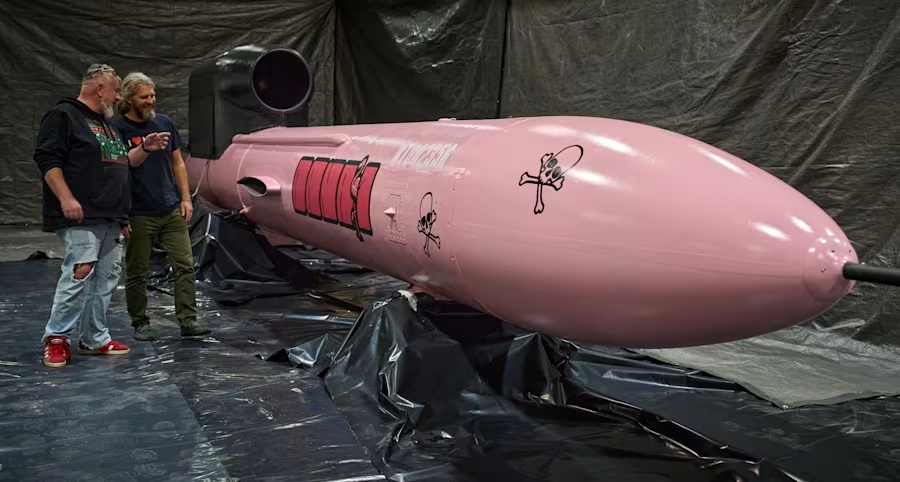
Jan Polak, right, and Martin Ondracek of the Czech organization Weapons to Ukraine look at a Flamingo cruise missile at the Fire Point factory at an undisclosed location in Ukraine, Nov. 16, 2025. Credit: AP Photo/Efrem Lukatsky
Ukraine Expands Long-Range Strike Campaign as Russia Launches Major Overnight Barrage
Ukraine said it used a domestically developed long-range missile capable of traveling roughly 900 miles to strike a military-industrial facility deep inside Russia, marking one of Kyiv’s most ambitious attacks on Russian territory since the full-scale invasion began in 2022.
President Volodymyr Zelenskyy said the weapon was produced inside Ukraine and successfully hit a target described as a factory supporting Russia’s military production. Ukrainian officials did not immediately release full technical specifications, but the claimed range would allow Kyiv to strike well beyond border regions and into Russia’s interior without relying on Western-supplied systems.
The strike coincided with one of Russia’s largest overnight aerial assaults in recent months. Ukrainian authorities reported that Moscow launched approximately 420 drones and 39 missiles in a coordinated barrage targeting multiple regions across the country. Air defense units engaged waves of Shahed-type drones and cruise missiles over several hours.
The dual developments underscore a widening contest over long-range strike capability. Moscow continues to employ massed drone and missile attacks to degrade Ukrainian infrastructure and exhaust air defense systems. Kyiv, in turn, is accelerating domestic weapons production to hold Russian logistics hubs and industrial sites at risk.
Russia unleashed a series of drone and missile strikes on Ukraine on Thursday, injuring at least 20 people and damaging buildings in eight different regions.
Ukrainian officials have increasingly emphasized domestic defense production as Western military aid packages move through slower political processes. Zelenskyy has framed indigenous missile development as central to long-term security, reducing dependence on foreign systems subject to range restrictions or export controls.
If confirmed, a 900-mile range would significantly expand Ukraine’s operational reach. That distance would allow potential targeting of facilities supporting missile assembly, drone production, or military logistics far from the front lines. Previous Ukrainian strikes inside Russia have relied heavily on drones; a longer-range missile introduces different payload, speed, and penetration considerations.
Russia has repeatedly warned that Ukrainian attacks on its territory risk escalation. Moscow has characterized such strikes as terrorism and has pledged to respond with intensified bombardment of Ukrainian cities and energy infrastructure.
Ukrainian officials described the overnight assault as one of the largest coordinated attacks of the year. Air defenses reportedly intercepted a significant portion of incoming drones and missiles, though debris and impacts caused damage in several regions.
The scale of the barrage reflects Moscow’s continued reliance on mass drone deployments to overwhelm Ukrainian defenses. Since late 2023, Russia has steadily increased the size of coordinated drone waves, often launching hundreds of unmanned aerial vehicles in a single night. Cruise missiles are typically layered into these attacks to complicate interception patterns.
Civilian infrastructure remains a primary pressure point. While Ukrainian authorities did not immediately release full casualty figures, regional officials reported damage to residential buildings and industrial sites. Energy facilities have frequently been targeted in previous campaigns, particularly during winter months.
Industrial War and the Production Race
Both developments highlight the industrial dimension of the conflict. Russia has expanded drone production, including domestic assembly of Iranian-designed Shahed systems. Ukraine has invested heavily in domestic drone and missile programs to offset Russia’s numerical advantage.
Western partners continue to provide air defense systems, but Ukrainian officials have warned that interceptor stockpiles must keep pace with the scale of Russian barrages. Large drone waves force Kyiv to expend costly defensive missiles, creating economic as well as tactical strain.
At the same time, Ukrainian long-range strike capability aims to disrupt Russia’s production base. Targeting factories tied to missile or drone manufacturing carries both military and psychological impact, signaling that Russia’s interior is no longer beyond reach.
What Comes Next
The immediate trajectory will depend on confirmation of the reported factory strike and any Russian response. Moscow has historically responded to high-profile Ukrainian attacks inside Russia with intensified missile and drone campaigns.
If Ukraine’s domestically produced missile proves operational at scale, the strategic balance of depth could shift. Russia would need to adapt air defense coverage across a broader geographic footprint, potentially stretching resources away from the front.
For now, the conflict continues to evolve into a contest of endurance and production capacity. Russia is deploying massed aerial attacks to sustain pressure. Ukraine is expanding indigenous strike systems to hold Russian infrastructure at risk. The result is a war increasingly defined not only by frontline movement, but by industrial output and long-range reach.
Advertisement
What readers are saying
Generating a quick summary of the conversation...
This summary is AI-generated. AI can make mistakes and this summary is not a replacement for reading the comments.











COMMENTS