

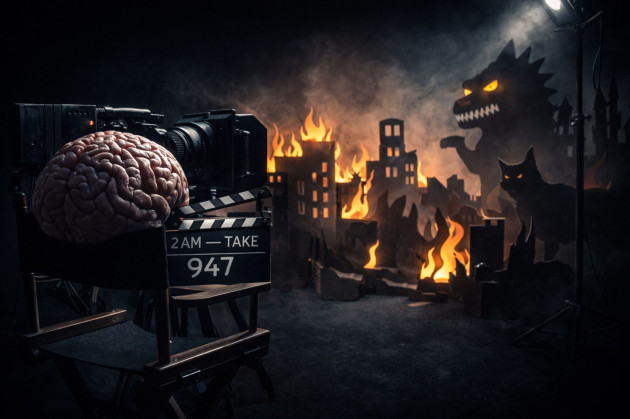
Psychologists call this anticipatory anxiety… the act of bleeding before you are cut. Your brain writes the wound before the knife even exists.
Worry Feels Like Action, But It Isn’t
Now here’s what makes this dangerous and not just uncomfortable. When you’re living in imagined suffering, you’re not solving anything. You’re just marinating in emotion. And emotion without action is just corrosion.
My 2 AM spiral about losing a client? There’s actually a reasonable action buried under all that anxiety. Leverage creativity. Show additional value. Find new ways to demonstrate that our presence is the reason nothing bad happens. That’s a solution. That’s productive. But at 2 AM, I’m not doing that. I’m just rehearsing disaster.
The difference between worry and preparation is a plan. Worry loops. Preparation moves.
We Teach Our Kids There Are No Monsters, Then Forget It Ourselves
And this is where it gets personal for me as a parent, because here’s the thing we don’t talk about enough.
We teach our kids early that there are no monsters under the bed. We sit on the edge of their mattress, turn on the light, look underneath, and say, “See? Nothing there. It’s all in your imagination.”
And then we spend the rest of our adult lives lying awake, terrified of monsters that don’t exist.
We tell our children that the imaginary isn’t real… then we model the exact opposite. And kids are more intuitive than we give them credit for. They absorb what we demonstrate, not what we explain. They don’t hear our words as loudly as they feel our energy.
Watch a two-year-old fall flat on their face. If you rush over in a panic… “OH NO! Are you okay?!” …that kid is going to cry. Every time. One hundred percent. Not because they’re hurt that badly, but because your reaction just told them they should be scared.
But if you stay calm, shrug, and say, “Whoops. You’re alright. You’re tough like me”… most kids, unless they’re genuinely injured, will dust themselves off and keep going. They learn that certain incidents, even mixed with pain, just happen. And it’s okay to move on.
Your reaction writes their operating system. Panic teaches panic. Calm teaches resilience. And if we’re not careful, we raise children who grow up to be adults lying awake at 2 AM, suffering over things that were never real to begin with.
Catch the Spiral Before It Owns You
So what’s the solution? It starts with something deceptively simple.
Awareness.
Catching yourself in the act. Recognizing the fiction as fiction while your brain is still writing it. Not suppressing the thought… just labeling it. Is this real? Or is my brain writing a screenplay again?
I’m not going to pretend that awareness makes the worry disappear. It doesn’t always. I still have those nights. But the difference is I’ve learned to catch myself faster. The spiral still starts… it just doesn’t run the whole reel anymore.
From there, focus on solutions, not emotions. If the worry points to something actionable, act. If it doesn’t, it’s fiction. Put down the script.
Seneca also wrote something else that I think about more than I probably should: “We are more often frightened than hurt; and we suffer more in apprehension than in reality.”
The monsters aren’t under the bed. They never were.
We just forgot the lesson we’ve been teaching our kids all along.
—
About the Author
I don’t try to change minds… just deepen them.- Tegan Broadwater
Tegan spent 13 years with the Fort Worth Police Department, including two years assigned to the FBI working deep undercover inside a violent Crip organization. That operation, detailed in his book Life in the Fishbowl, resulted in 51 convictions. He has since founded Tactical Systems Network, an armed security & protection firm primarily staffed by veterans, is a creative writer and musician, and hosts The Tegan Broadwater Podcast. All book profits benefit children of incarcerated parents. Learn more at TeganBroadwater.com








COMMENTS