

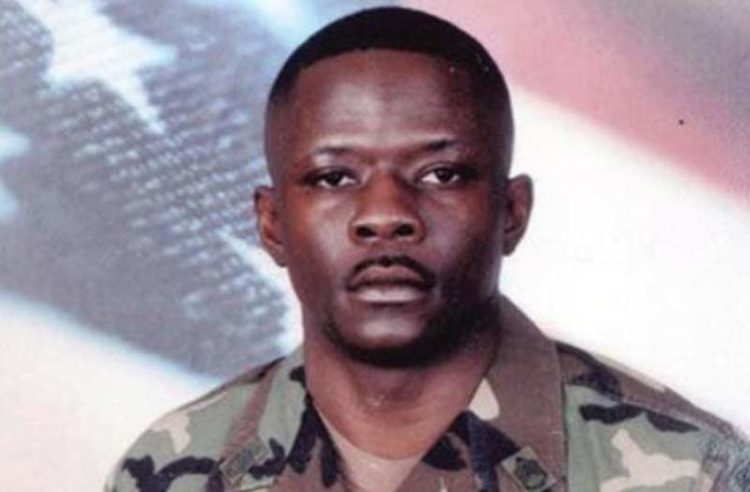
The vehicle came to a stop and immediately erupted in flames. Sergeant First Class Cashe was initially slightly injured and drenched with fuel. Despite his condition, he bravely managed to get out of the gunner’s hatch, crawl down the BFV and assist the driver out of the driver’s hatch.
The driver had been burned, and Sergeant First Class Cashe extinguished his flames. The following minutes were crucial. Six soldiers and a translator were in the back of the Bradley. Flames had engulfed the entire vehicle from the bottom and were coming out of every portal. The squad leader inside the vehicle managed to open the troop hatch door to help the soldiers escape.
Without regard for his personal safety, Sergeant First Class Cashe rushed to the back of the vehicle, reaching into the hot flames, and started pulling out his soldiers. The flames gripped his fuel-soaked uniform. Flames quickly spread all over his body. Despite the terrible pain, Sergeant First Class Cashe placed the injured soldier on the ground and returned to the burning vehicle to retrieve another burning soldier; all the while, he was still on fire.
A crew from a trail Bradley arrived within moments and assisted with CASEVAC. During all this and with severe burns, Sergeant First Class Cashe bravely continued to take control of the chaos. Within minutes, the company First Sergeant was on the scene and began to evacuate the seriously injured soldiers. One of which was Sergeant First Class Cashe.
In the end, the national translator was killed in action, and 10 soldiers were injured. Seven of the 10 were very seriously injured.
Sergeant First Class Cashe stayed a hero through it all.
His injuries were the worst as he suffered from 2d and 3d degree burns over 72 percent of his body. Sergeant First Class Cashe’s heroic actions saved the lives of six of his beloved soldiers. He is truly deserving of this award. His actions are in keeping with the finest traditions of military heroism and reflect distinct credit upon himself, Task Force LIBERTY, and the United States Army.”
When Cashe arrived at the U.S. Air Force Theater Hospital at Balad Air Base in Iraq, he was still fully conscious. Alisha Turner, then an Air Force medic, was part of the team that treated Cashe and three of his wounded comrades. Cashe, she remembers, was the fourth casualty through the door. He was burned badly. What remained of his uniform was melted to his skin. Turner’s team rushed Cashe into the ER, where he started fighting to get off the gurney.
“He just kept saying, ‘I’m good, I’m good, take care of my guys,’ Turner said. “He wanted us to focus on everyone else. It was as if they were his children.”
Kasinal Cashe White, the sergeant’s sister, recalled to The Times that she stayed at her brother’s bedside while he was in the hospital, and the first thing he asked when he was able to speak was, “How are my boys?” He then broke down in tears, saying he “couldn’t get to them fast enough.”
There have been six Medals of Honor awarded for the war in Iraq, all of them posthumously. Eighteen have awarded for the fighting in Afghanistan. If SFC Cashe is awarded the Medal of Honor it would make him the first Black soldier to receive the award in either the Iraq or Afghanistan war.








COMMENTS