

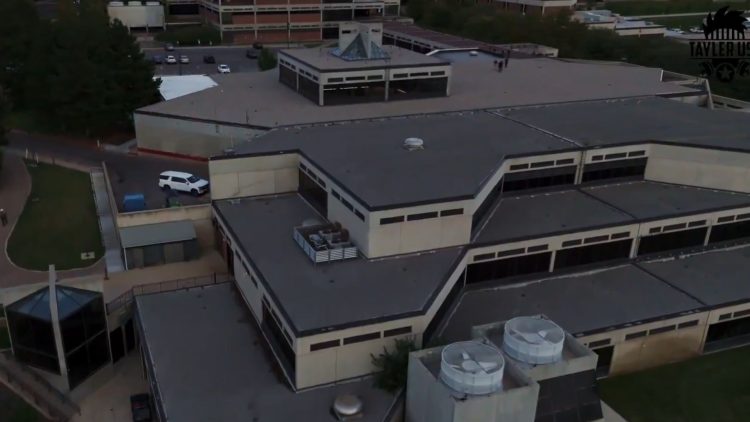
If the rooftop were 6–8 stories high (roughly 60–80 feet), the angle of depression at 200 yards would be around 15–20 degrees.
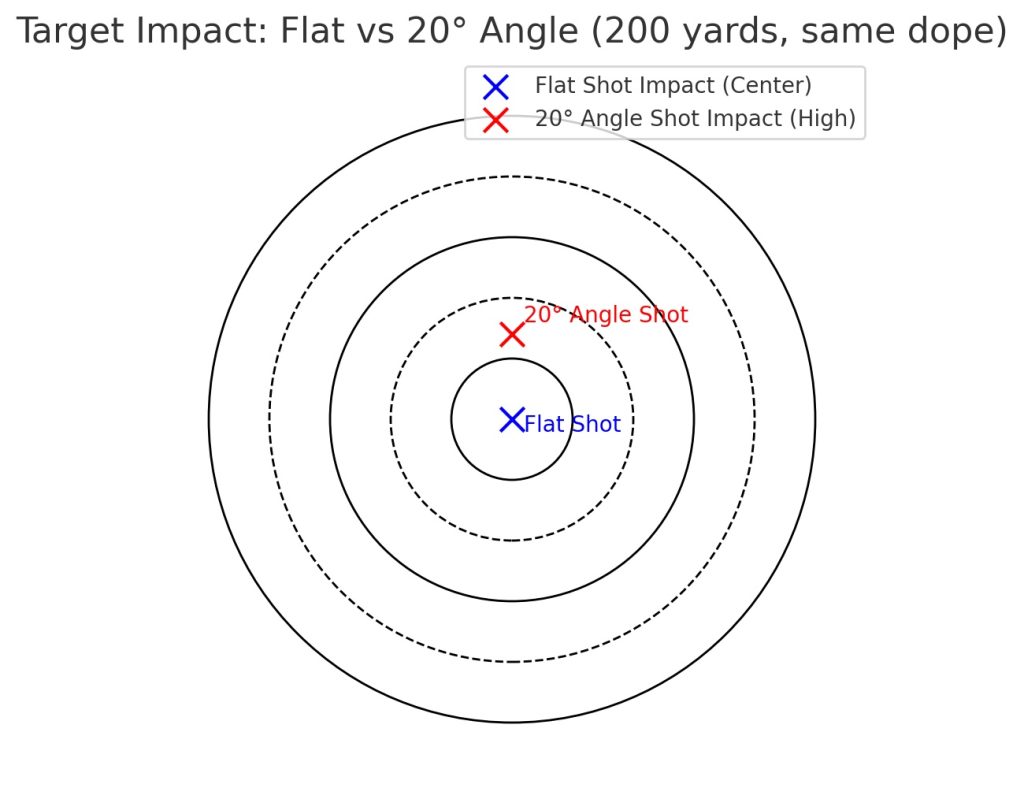
Shooting at an angle changes bullet behavior slightly because of what’s known as the “cosine effect.” In short, bullets don’t drop as much when fired at a steep upward or downward angle. A sniper must account for this, adjusting the point of aim accordingly.
This diagram shows the importance of compensating for rise of impact for high-angle shooting
Caliber Considerations
Without recovered ballistics, we can’t state the exact caliber, but based on the video I saw online, here are some general observations:
- High-powered rifle calibers (like .308 or 6.5 Creedmoor) are common for 200-yard precision shots. These rounds maintain lethal energy and stable flight.
- Smaller calibers (like 5.56 NATO) can still be accurate at 200 yards, but their terminal effects are less dramatic compared to larger rounds.
- From video evidence of penetration and physical reaction of the victim, it’s consistent with a medium-to-large caliber rifle round rather than a handgun or small carbine caliber.
Shooter’s Skill Requirements
Executing this type of shot requires more than just a good rifle.
The shooter must:
- Control breathing and trigger squeeze under pressure.
- Understand how angle and environmental factors affects trajectory.
- Compensate for rooftop winds and thermal currents.
- Maintain stealth and stability in an exposed elevated position.
- Escape without detection.
It’s not just pulling the trigger; it’s executing a complete ballistic equation in real time.
The shooter likely has a military or law enforcement background because evading law enforcement afterwards requires this kind of training, unless luck factors in. The aftermath was chaos, and this creates a diversion in the shooter’s favor.
So my guess is that the shooter has some training, but is not a professional sniper.
At SOFREP, we are deeply saddened by the loss of Charlie Kirk. Regardless of political stance, his voice was an undeniable force in American discourse, and his absence leaves a profound void. We extend our condolences to his family, friends, and supporters. We hope that by shedding light on the technical aspects of this tragic event, we can contribute in some small way to the pursuit of truth and justice.








COMMENTS