The Navy finally stopped grading knife fighters like office workers.
For years, elite maritime operators were judged on a physical fitness test that rewarded jogging endurance and polite calisthenics, as if combat happened on some rubberized track with a clipboard nearby. That era is ending. Starting in 2026, the Navy is rolling out a Combat Fitness Test for its hardest jobs, and the message is blunt: if your job is violence in bad places, your fitness test should look like that job.
The End of the Participation Trophy Test
The standard Physical Readiness Test was designed for a fleet that spends most of its time afloat, not for operators who swim into denied areas, hump heavy gear, and fight while exhausted. That disconnect has bothered the special operations community for years.
Now the Navy has acknowledged it in writing.
Naval Special Warfare personnel, including Sea, Air, and Land teams and Special Warfare Combat Crewmen, along with Explosive Ordnance Disposal technicians and Fleet Divers, will take one traditional Physical Fitness Assessment and one Combat Fitness Assessment each year. The Combat Fitness Assessment includes a new Combat Fitness Test that replaces jogging in shorts with work under load.
This is not a tweak. It is a long-overdue philosophical correction.
What the Combat Fitness Test Looks Like
The Combat Fitness Test is a single-session event sequence designed to measure real-world physical readiness.
It starts with an 800-meter swim, timed, wearing fins. Any stroke is allowed. You start in the water. No diving starts, no snorkels, no rubber duck floaties. This is about propulsion and breath control, not pool theatrics.
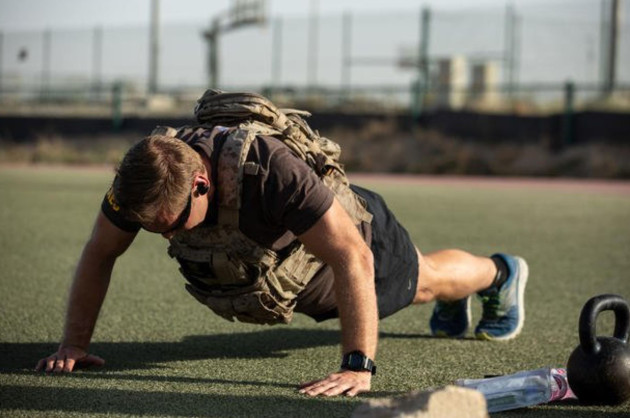
After a ten-minute rest, the test moves immediately into strength under load. Push-ups are performed for two minutes while wearing a 20-pound weighted vest or plate carrier. No sagging, no collapsing, no half reps. The standard is strict because the job is strict.
After a brief rest, weighted pull-ups follow. There is no time limit, but there is no kipping (a way of doing pull-ups by using momentum from the hips and legs instead of relying on your upper body strength) either. You start from a dead hang and pull until your chin clears the bar. You can rest while hanging, but stepping off the bar ends the event.
Following another ten-minute rest, the test finishes with a one-mile run on a flat, firm surface while carrying a 20-pound load. This is not a jog. It is rapid movement under a burden.
Already have an account? Sign In
Two ways to continue to read this article.
Subscribe
$1.99
every 4 weeks
- Unlimited access to all articles
- Support independent journalism
- Ad-free reading experience
Subscribe Now
Recurring Monthly. Cancel Anytime.
Fail one event and the entire test is a failure.
Why SEALs and SWCC Feel This First
For Sea, Air, and Land teams and Special Warfare Combat Crewmen, the standards are higher. The scoring is sex-neutral and age-adjusted, but the expectations reflect the mission set.
A perfect score for a SEAL or SWCC in the 25 to 29 age bracket includes an 11:20 swim, 54 weighted push-ups, 21 weighted pull-ups, and an eight-minute weighted mile. Those are not aspirational numbers. They are the benchmark.
That matters because these are the sailors most likely to transition directly from water to violence with little warning. Their boats do not stop for warm-ups. Their insertions do not care about personal bests.
This test acknowledges that reality.
The Culture Shift Behind the Numbers
The Combat Fitness Test is more than a new scorecard. It is part of a broader push to force physical training back into the workday instead of treating it like a hobby sailors are supposed to pursue after hours.
Commanders are now directed to integrate physical training into daily schedules. The Navy has also laid out clearer administrative consequences for repeated fitness failures once the program is fully implemented.
It is worth noting that 2026 functions as an initial implementation period for the new Combat Fitness Test. During this phase, the Navy will evaluate standards and execution before full administrative enforcement applies. The signal, however, is unmistakable.
Fitness is no longer a personal lifestyle choice. It is a readiness requirement. It always has been, but now there’s even more of a focus on it.
Why This Test Actually Makes Sense
The new test flows the way missions do. You exert yourself in the water, then immediately work under load, then move fast while tired. It rewards durability rather than flash.
It is like checking whether a race car can still hit speed after being driven through mud and gravel instead of only polishing it back in the garage.
For years, elite sailors trained around the test instead of through it. Now the test aligns with how they already train.
What Comes Next
This will not be painless. Scores will drop once enforcement begins. Some sailors will find out, on paper, what their teammates already knew.
That is the point.
The Combat Fitness Test does not care how good you looked on a treadmill. It cares whether you can swim hard, lift heavy, and move fast when your lungs are burning and your shoulders are screaming.
For Naval Special Warfare personnel, that is not a new expectation. It is simply the Navy finally catching up to the reality they have lived for decades.










COMMENTS