

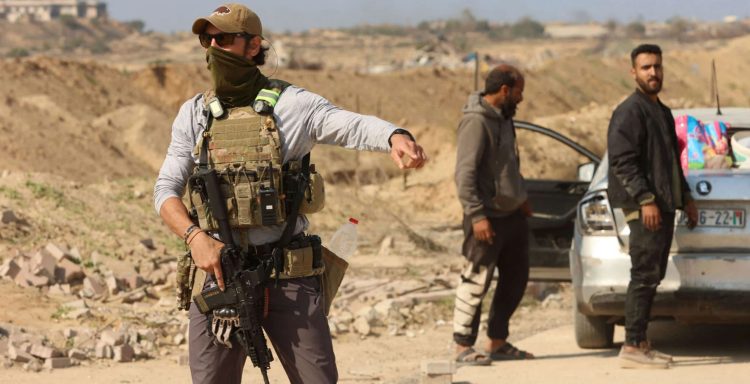
The location of the checkpoint was likely chosen through careful coordination between all involved parties to control movement effectively. Funding for the operation comes from Israel and unnamed Arab countries, highlighting the collaborative financial backing behind this effort. While the U.S. government is not directly involved in awarding the contract, American contractors are central to its execution.
Security measures at the checkpoint include the use of scanners by Egyptian forces to detect weapons and contraband, while U.S. contractors are armed with small arms for self-defense. This points to a well-coordinated approach to security, with multiple countries contributing personnel, equipment, and expertise. Oversight of the operation falls under a “multinational consortium,” which includes U.S.-based companies like Safe Reach Solutions and UG Solutions, as well as an Egyptian security firm.
The entire arrangement was part of the Israel-Hamas ceasefire agreement, brokered with Qatar’s mediation and involving both the U.S. and Egypt. Initially, Israel wanted its own troops to staff the checkpoint but later agreed to the use of private security contractors as a compromise. Although the specific rules of engagement have not been publicly disclosed, they have been finalized through coordination among all involved parties to ensure a unified security protocol.
This collaborative effort is designed to maintain security while allowing for the movement of aid and people between southern and northern Gaza. By working together, the U.S., Israel, and Egypt aim to uphold the terms of the ceasefire agreement while preventing the smuggling of weapons and maintaining stability in the region.
Navigating the Risks
The deployment of private security contractors to operate a checkpoint in Gaza comes with significant risks that require careful management. One of the primary concerns is the direct threat from militant groups like Hamas or other armed factions, which could lead to violent confrontations or even hostage situations. Additionally, any engagement by the contractors carries the risk of escalating tensions in the region, as private security forces typically have a lower threshold for engagement compared to regular military personnel. This could inadvertently trigger a larger conflict.
Another challenge is the strong local opposition to the presence of armed foreign contractors. Many Palestinians see their presence as unwelcome, which could lead to increased hostility and potential security incidents. Beyond these concerns, the volatile nature of the region and the checkpoint’s critical role in managing humanitarian aid access make operational challenges a constant reality.
Another key measure is limiting direct interaction with civilians. The contractors have been instructed not to engage with the local population and will be stationed away from residents passing through the checkpoint. This is intended to reduce tensions and prevent conflicts from arising. Additionally, backup support is available from the Israeli Defense Forces (IDF) if needed, providing an extra layer of security should a situation become critical.
The contractors’ backgrounds also play a significant role in risk mitigation. By hiring veterans with SOF experience, the operation ensures that those on the ground have the necessary training and expertise to handle complex security situations. Moreover, maintaining a clear and specific mandate—focusing strictly on vehicle checkpoint management and inspections—will help prevent the mission from expanding beyond its intended scope.
Despite these precautions, the unusual nature of this deployment means the risks remain high. The success of the operation will largely depend on the contractors’ ability to enforce security measures while avoiding unnecessary conflicts in an extremely sensitive environment. Avi Melamed, a former Israeli intelligence official, candidly stated, “Of course, there is a threat they will face.”
Historical Context and Controversies
The use of private military companies (PMCs) in war zones has a long and controversial history, with their presence growing significantly over the past few decades. While private military forces have existed for centuries, the modern PMC industry began to take shape in the 1990s after the Cold War. Companies like Executive Outcomes and Sandline International became prominent, particularly in African conflicts, where PMCs were involved in an estimated 65 wars between 1990 and 1998. However, it wasn’t until after 9/11 and the start of the Global War on Terror that the industry saw explosive growth. During the Iraq War, over 20,000 private military contractors served alongside U.S. forces, at times outnumbering the contributions of other allied countries.
The use of PMCs has led to numerous controversies, mainly due to legal and ethical concerns. One major issue is the legal ambiguity surrounding their operations, which makes accountability difficult. Unlike regular military forces, PMCs often operate in a grey area, where laws governing their actions are inconsistent or nonexistent. This has led to allegations of human rights abuses and war crimes, with some PMC personnel implicated in serious misconduct. A notorious example is the 2007 Nisour Square shooting in Baghdad, where Blackwater contractors killed 17 Iraqi civilians, severely damaging the industry’s public perception.
Another major criticism of PMCs is the lack of oversight. Without consistent international regulations, monitoring their activities is challenging. Ethical concerns also arise, as critics argue that profit-driven motives can create conflicts of interest, potentially prolonging wars for financial gain. Additionally, PMC actions have strained diplomatic relations between nations and affected the reputations of the countries that employ them.
Some contractors have even been implicated in prisoner abuse scandals, such as those involving CACI International at Abu Ghraib prison in Iraq. Furthermore, in places like Iraq, PMCs were initially granted immunity from local laws under policies like “Order 17,” signed by L. Paul Bremer in 2005, raising further accountability concerns.
Despite these controversies, the private military industry continues to expand. Today, PMCs generate an estimated annual revenue nearing $200 billion and operate in over 110 countries worldwide. Their growing role in global conflicts and security operations raises ongoing questions about regulation, oversight, and the ethical implications of outsourcing military force to private entities.
The Bigger Picture
This initiative is part of a broader ceasefire agreement mediated with assistance from Egypt and Qatar, aiming to stabilize Gaza following extensive conflict and devastation. The deployment of American contractors speaks to the international community’s commitment to maintaining peace and facilitating humanitarian efforts in the region.
Summing Up
The deployment of US SOF veterans to operate a key checkpoint in Gaza represents a significant development in the world of private military contracting. While the mission aims to uphold the fragile ceasefire and ensure the safe passage of humanitarian aid, it also brings to the forefront the inherent risks and historical controversies associated with private security operations in conflict zones. As this situation unfolds, the actions and experiences of these contractors will undoubtedly be scrutinized, serving as a critical case study for future engagements of this nature.








COMMENTS