
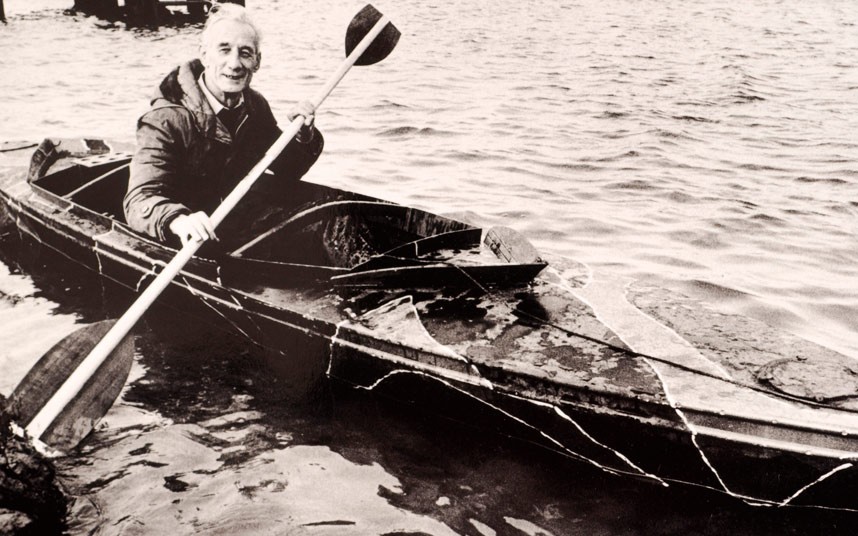
Each canoe with a name starting with C. In his section, known as Division A, he and Marine Bill Sparks would pilot the Catfish, Corporal A.F. Laver and Marine W. H. Mills the Crayfish, and Corporal G. J. Sheard and Marine D. Moffatt the Conger.
Division B was entrusted to Lieutenant J. W. Mackinnon and Marine J. Conway in the Cuttlefish, Sergeant S. Wallace and Marine R. Ewart in Coalfish, and Marine W. A. Ellery and Marine E. Fisher in Cachalot.
Hasler gave each of these crews their own targets estimated from intelligence reports and ensured each Cockle was loaded with eight limpet mines to do the job. These useful explosives, housed in a magnetic container, packed quite a punch when placed below the waterline of a ship. Other supplies included three sets of paddles, a repair kit, extra clothes, flashlight, fishing line, placing rod compass, depth sounding reel, and a magnet to keep the canoe held to the side of its target ship while a mine was planted. Topping this off was enough water and rations for six days, a camouflage net, and personal weapons, consisting of two grenades, a Colt 1911A1 .45 pistol and a Fairbairn-Sykes dagger-shaped fighting knife.
All of this gear was carried every time the crews plied the practice rivers and harbors to the point the distance and effort was ingrained into each one until it was second nature. And once the 12 ended their arduous training cycle, not a single one had dropped out and no finer boatmen could be found in the entire world. They were ‘salty,’ so to speak. Ready to overcome anything that came their way, and dedicated to their mission, which kicked off when they transferred to the submarine HMS Tuna on November 30th and slipped out of a Scottish harbor into a foreboding sea.
Their journey was mostly uneventful, save for when they approached the estuary. Here the Tuna had to slow to negotiate minefields, all the while staying submerged from the ever-present patrol boats. Furthermore, bad weather topside meant the starting time was delayed by 24 hours. Then, she surfaced in the bitter cold and windy night on December 7. Hatches swung open and darkened figures protected against the weather began shuffling the awkward 15-foot Cockles out on the deck. The cargo followed, armload by armload, and once the two-man teams stepped aboard they pushed off the slick hull and began paddling into the darkness.
It was 1730 hours.
The sea was choppy and they were missing a canoe, the Cachalot, which was damaged passing through the hatch. It and its crew had to remain behind, as Hasler and his men paddled onward 10 miles through a rough sea and high crosswinds to the mouth of the estuary. From there they started upriver, but not before losing two more crews – the Conger and Cuttlefish – to the merciless waves. Chopped to just three craft, they also began to encounter their first German river patrols, which they managed to avoid and beach safely after they covered the first 20 miles of water in five hours.
Then, tragedy struck once more when Coalfish’s crew was captured by a squad of German soldiers. Now down to just a third of his force, Hasler and his men set out again the second night and paddled 22 more miles in six hours, then another 15 miles on the third night. The fourth night, due to strong currents, they only managed 9 miles, which led to Hasler postponing the attack by one day.
On that final day, the four men prepared their limpets and plans for escape, as they set out just after dark to make the final miles to the harbor. They fought against the constant tide, which attempted to push them back as they neared the enormous harbor. There the fruits of their labor began to outline themselves in the form of sleeping merchant ships, tied up alongside the many docks, discharging or taking on new cargo.
Hasler veered Catfish towards the westernmost ships, while Crayfish took the East. They went to work in silence, like automatons honed through so much practice, with Catfish placing eight limpets on four vessels (three Cargo ships, one patrol boat), and Crayfish placing eight mines on two vessels (five on a cargo ship, three on a small liner). For all the trouble they had been through, the actual attack went off without a hitch as the canoes slipped away downstream, as quite as ever, the only close call being a curious guard shining his light down on the water for a moment, close-by but missing the Catfish.
At 2100 hours, with the canoes safely away, the timed limpets detonated in a huge simultaneous roar across the harbor. Sirens wailed and sailors discharged out hatchways as water flooded into hulls, causing them to list or settle into the chilly water. Men who couldn’t make it ashore leapt into a frothy mix bubbling and churning through gaping holes peppering the sides of once-smooth steel.
All who witnessed it knew that even if the vessels could be saved, they would be out of action for several days to months, leaving an already taxed merchant fleet that much more unable to deliver goods to Hitler’s war machine. Even more, news raced up the German high command about how something like this could have been pulled off in such a heavily guarded harbor so far from the sea.
For the British, Frankton’s primary mission was over. After more hours of paddling, the two canoes by chance saw each other a final time just before the crews scuttled them and set out ashore toward Spain. They hoped to make contact with the French resistance, who would pass them house-to-house and eventually deliver them to the border.
For the crew of Crayfish, these hopes were quickly dashed when they were caught two days later and imprisoned.
On the other hand, Hasler and Sparks promptly disappeared and linked up with the resistance. They traveled over 100 miles from where they scuttled their canoe, hiding out for days in different locations until being led across the Pyrenees Mountains into Spain, and then arriving at the British base on Gibraltar. On February 23, a secret memo was sent to Combined Operations announcing the two men were safe. They were back in England a short time later.
Of the others, it is known that six of the eight men who started Operation Frankton were later executed based on Hitler’s infamous Commando Order, which decreed that any Special Forces personnel captured were to be executed. The other two missing men were believed to have died of hypothermia. All were later decorated posthumously, with the living, Hasler, receiving the Distinguished Service Order, and Sparks the Distinguished Service Medal.
Was it worth it? According to Winston Churchill, absolutely. He reckoned the war was shortened by up to 6 months because of the attack. Lord Mountbatten heaped praise upon the little band of men, saying their mission was “the most courageous and imaginative of all the raids ever carried out by the men of Combined Operations.” And forever after, the men were always to be known as the “Cockleshell Heroes.”
Previously published on SOFREP by Mike Perry, 11.10.13








COMMENTS