

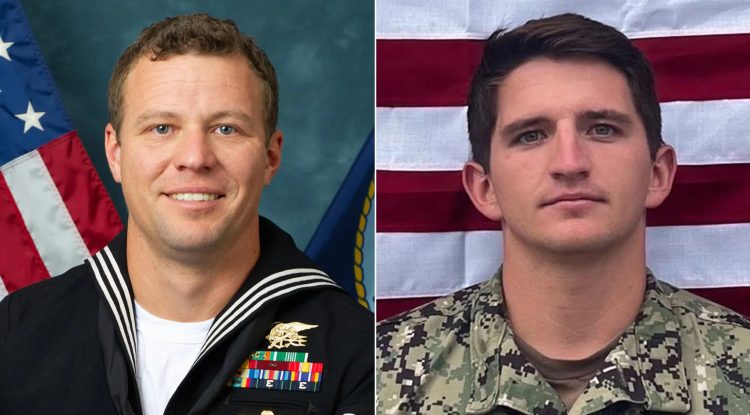
On October 16th, 2025, a federal judge in Virginia sentenced Pakistani boat captain Muhammad Pahlawan to 40 years in prison for running Iranian weapons toward Yemen’s Houthi fighters, a scheme that turned deadly when two U.S. Navy SEALs were lost at sea during the boarding of his unflagged dhow in January 2024. Court records show the terms include 20 years for providing material support to a weapons-of-mass-destruction program and additional concurrent terms on related counts, for a total of four decades behind bars.
What Happened That Night
On January 11, 2024, U.S. Central Command forces operating from USS Lewis B. Puller executed a nighttime flag-verification and boarding in the Arabian Sea, off Somalia. As the team closed on the dhow in six-to-eight-foot seas, Chief Special Warfare Operator Christopher J. Chambers climbed for the rail, slipped, and fell into the dark water. Special Warfare Operator 1st Class Nathan Gage Ingram went after him. Both men were hauled under by gear weight and waves in a sequence that lasted seconds, not minutes. The Navy’s investigation later reconstructed it in tight frames: Chambers surfaced intermittently for about 26 seconds; Ingram for about 32; video showed attempts to grab a ladder extension and deploy flotation, but the sea won. Depth in the area was roughly 12,000 feet.
The dhow—unsafe to keep—was later sunk by U.S. forces after the seizure. Fourteen mariners were taken into custody.
Who They Were
Chambers, 37, a Maryland native, enlisted in 2012 and earned his Trident in 2014. Teammates called him a powerhouse in the water. Ingram, 27, of Texas, enlisted in 2019, pinned his trident in 2021, and—according to the investigation—jumped in to save his partner, an act for which the command recommended recognition. Both men received posthumous promotions; Ingram later received the Navy and Marine Corps Medal for heroism. Think of them as climbers moving on a sheer face at night: one slip, a partner’s immediate commitment, and gravity that does not negotiate.
What the Boarding Team Found
CENTCOM’s inventory speaks plainly. The dhow carried Iranian-made ballistic and anti-ship cruise missile components—propulsion, guidance systems, and warheads—and air-defense related parts consistent with gear the Houthis used to menace merchant and naval traffic in the Red Sea and Gulf of Aden. Separately, that same month, another interdiction netted more than 200 packages, including medium-range ballistic missile components, explosives, unmanned surface and underwater vehicle parts, military-grade communications gear, and anti-tank guided missile launcher assemblies. It was a pipeline, not a one-off.
یک قاچاقچی اسلحه که با استفاده از قایق ماهیگیری قطعات موشک بالستیک را از ایران به حوثیهای یمن منتقل میکرد، به ۴۰ سال زندان در آمریکا محکوم شد. لینک خبر:https://t.co/zwT0dho1PK pic.twitter.com/fY87YnNKes
— BBC NEWS فارسی (@bbcpersian) October 18, 2025
What Pahlawan Did—and Was Convicted Of
Prosecutors said Pahlawan wasn’t a bystander on a shady boat; he was the captain who worked with two Iranian brothers tied to the Islamic Revolutionary Guard Corps (IRGC), running voyages from Iran to the Somali coast and coordinating nighttime ship-to-ship transfers bound for Yemen. During the Jan. 11 interdiction, he lied to the boarding team, directed crew to lie, threatened witnesses, and even told crew to burn the vessel rather than submit. A federal jury in June 2025 convicted him on multiple counts: conspiring to provide material support and resources to terrorists; providing material support to Iran’s weapons-of-mass-destruction program (including to the IRGC’s WMD program); transporting explosive devices knowing they would cause harm; and witness intimidation. The 40-year sentence followed on October 16, 2025.
What the Navy Investigation Concluded
The Navy’s line-by-line review called the drownings preventable. Investigators found gaps in training, conflicting guidance on emergency flotation devices, and weak standardization on buoyancy configuration for operators wearing body armor and additional equipment, such as radios adding upward of 40 pounds. The report’s timeline is brutal: a 47-second cascade from slip to loss. It recommended upgrades to training and gear checks, and a force-wide policy on water safety and buoyancy requirements for maritime ops. In plain terms, the system set two professionals up to solve a physics problem with seconds on the clock and their lives on the line.
Why This Case Matters
This wasn’t piracy with rusty rifles. It was a covert logistics run feeding a missile and drone campaign that has threatened a global shipping artery. Courts are now reaching back along that chain to impose consequences. Forty years for a captain may feel abstract until you connect it to two operators fighting for breath in black water, and to the factories and advisors enabling Houthi attacks from hundreds of miles away. As with any high-risk maritime boarding, tactics and judgment matter, but so do process and kit; the Navy says it is tightening both after this loss.
The Bottom Line
Pahlawan helped move the parts that power the Houthis’ shot at international shipping. The U.S. intercepted one run; two SEALs paid with their lives during the take. A jury rendered the verdict; a judge measured out four decades. The Navy, meanwhile, is rewriting how it prepares its people for the exact moment when a hand misses steel and the ocean reaches up.








COMMENTS