

I’ll never forget that smell.
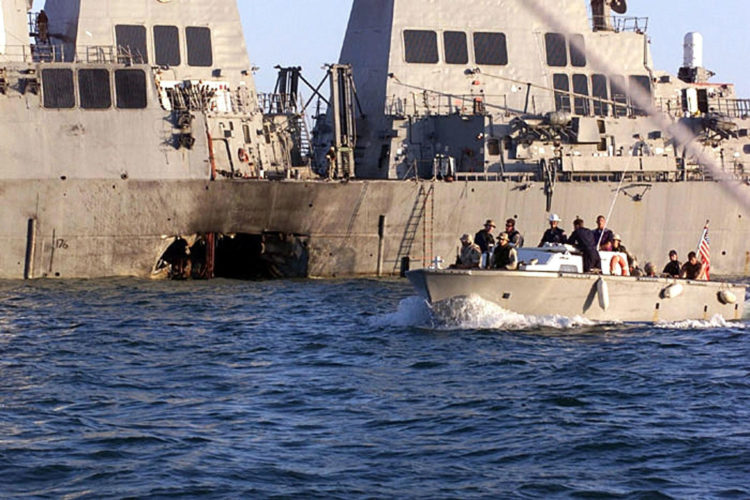
Command had serious concerns that there might still be unexploded ordnance, so some of our guys went to work searching the vessel while others circled out on the water and maintained a defensive perimeter around the harbor. Meanwhile, Glen and I, fresh from our sniper school training, joined the platoon’s two more experienced snipers up on the USS Cole’s bridge and began round-the-clock overwatch rotations with a full complement of weapons at the ready. Our orders were unambiguous: If anyone came within a hundred yards of that ship, we were cleared to use deadly force.
Our reaction when we heard those orders were raised eyebrows, followed by fist pumps. These were unusually aggressive ground rules. Ask any Spec Op warrior about ROEs (rules of engagement) and he will tell you they are seldom our friends. As SEALs, we are trained to operate independently in any situation, which means we’re expected to use our own judgment and make snap life-and-death, mission-critical decisions. In essence, every SEAL is a fully operational army of one. The last thing we want is to be second-guessed on the battlefield by shortsighted restrictions motivated by political considerations parsed from comfy armchairs thousands of miles from the realities of war. Unfortunately, the typical ROEs in situations of armed conflict more often reflect the conditions on Capitol Hill than those on the battlefield. In years to come, such timid and impractical ROEs would routinely drive us nuts. But not here on the bridge of the USS Cole. Right now our orders were simple: “Anyone approaches without permission, shoot to kill.”
As snipers it was our job to maintain constant, 100 percent, 360-degree situational awareness, and threat assessment. What were the strengths and weaknesses of our position? Where were threats most likely to come from? At any given moment, what should we be most focused on — and what was happening everywhere else? Glen and I and the other two snipers spent hours at a stretch on the spotting scope or binos, surveilling every inch of the harbor, Win Mag at the ready, different sectors arranged in our heads and accurate ranges dialed in on our scopes so that if at any second we had to take a shot, we’d be prepared and not have to scramble to set our parameters.
Meanwhile, the USS Cole was slowly sinking under our feet. Our team of naval engineers brought in special equipment to keep the bilges pumping and the ship afloat. If someone farted in the wrong direction, that boat was going down. It almost sank a few times right there in port.
As we watched the shore, the shore was watching us.
Yemen was not exactly the most U.S.-friendly nation in the Middle East. The Yemeni military forces had their weapons trained on us, which meant that the guys we were staring at through our binos were peering at us through their binos. It felt like a high-tech Mexican standoff. Technically speaking, they were our hosts; after all, we were tied up to their pier. But what did we really know about them? Were they in sympathy with the guys who’d just blown up our ship? Had they sent those guys? We had no way of knowing. It was eerie. And it went on like that for days, while our naval engineering crews furiously pumped out the putrid bilge water and struggled to keep the ship from giving up the ghost and sloughing off to rest at the bottom of the Port of Aden.
Within 12 hours after we first arrived, a team of FBI agents was on the scene, soon followed by a Naval Criminal Investigative Service detail and a crew from the CIA. This was some serious shit. Most of the world didn’t yet fully grasp what had happened, and few would understand its implications until 11 months later when the World Trade Center would lie in blood-soaked ruins.
We hadn’t just been attacked by a few rogue terrorists. We had entered a new age of warfare.
In the Civil War, long lines of soldiers armed with bayonet-clad rifles massed into great walls of firepower, facing off in leaden hailstorms of Minié balls and black powder, just as Xerxes and the Spartans had faced off with spears and shields. In World War II, Patton’s and Rommel’s tank battalions pummeled one another in the African desert. In Desert Storm, fleets of warplanes wreaked such rapid and complete devastation on Saddam’s offensive line that ground troops were practically an afterthought. As the tools of war evolved, the form of battle changed, but it was all fundamentally the same tactic: Line up the biggest mass of weaponry you can and hurl it at the enemy with all the force you’ve got.
But not with the Cole. Here the old rules of engagement no longer applied. A crappy little speedboat manned by two guys had just crippled and nearly sunk a billion-dollar, 10,000-ton warship, killed and wounded dozens of sailors, and inflicted some $250 million in damages on the mightiest military force on earth. This wasn’t conventional warfare, and it wasn’t even guerrilla warfare. This was asymmetrical warfare — a brand-new kind of war, where mass meant nothing and intelligence meant everything.
This was our own modern-day Pearl Harbor and the rise of the Dirty Wars. Just the beginning of over 20 years of sustained combat that would come, and still no end for American Special Operations in sight.
If you enjoyed this excerpt from my first book, The Red Circle, please share it.








COMMENTS