The Pentagon has warned military personnel about the security risks associated with home DNA and ancestry kits, which are becoming increasingly popular as holiday gifts. Officials express concern that these unregulated tests could expose sensitive genetic information and create security vulnerabilities for military operations.
Key points from this article:
The Pentagon's memorandum, issued by Under Secretary of Defense for Intelligence Joseph Kernan and acting Under Secretary of Defense for Personnel and Readiness James Stewart, highlights the targeting of military members by DNA testing companies with discounts.
How the popularity of these kits, with over 26 million users and projections of 100 million by 2021, raises concerns about the potential for genetic data to be exploited for surveillance and tracking purposes.
Why this matters is underscored by Admiral John Richardson's warning that sharing DNA could compromise military anonymity and operational security, especially as the U.S. Army already utilizes biometric data in tracking suspected insurgents in Afghanistan and Iraq.
Updating summary...
Pentagon: Testing your DNA more dangerous than you might think
Steve Balestrieri
Speed
1x
Listen
COMMENTS
The Pentagon has issued a directive advising military members to beware of the growing popularity of the home DNA and ancestry kits, as they pose a higher security risk for military members than for their civilian counterparts. The home kits are growing in popularity and are at this time of year a popular Christmas gift […]
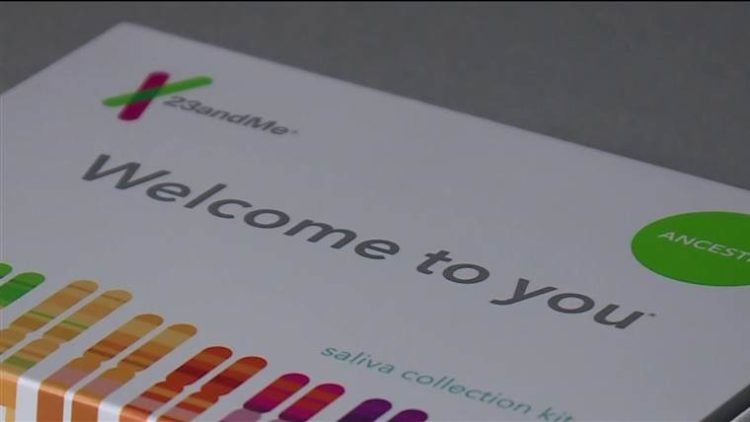
Photos: DNA Kit Ancestry, DVIDS
The Pentagon has issued a directive advising military members to beware of the growing popularity of the home DNA and ancestry kits, as they pose a higher security risk for military members than for their civilian counterparts.
Advertisement
The home kits are growing in popularity and are at this time of year a popular Christmas gift so that people can trace their ancestry. So far, in a study conducted by the Massachusetts Institue of Technology (MIT), over 26 million people have voluntarily sent their DNA to be tested. That number is expected to skyrocket to over 100 million by 2021.
That’s what worries some Pentagon officials. Under Secretary of Defense for Intelligence Joseph Kernan and acting Under Secretary of Defense for Personnel and Readiness James Stewart, said in a memorandum dated December 20, that DNA testing companies were targeting military members with discounts and other undisclosed incentives.
“These genetic tests are largely unregulated and could expose personal and genetic information, and potentially create unintended security consequences and increased risk to the joint force and mission,” the memorandum read. “Tests that provide health information have varying levels of validity, and many are not reviewed by the Food and Drug Administration before they are offered.”
Advertisement
“Moreover, there is increased concern in the scientific community that outside parties are exploiting the use of genetic materials for questionable purposes, including mass surveillance and the ability to track individuals without their authorization or awareness,” it stated, but gave no explanation of how this was being done.
Several of the more popular companies, Andcestry.com and 23 and Me which have targeted the military community with discounts, have publicly commented that they do not share their data with third parties, employers or insurance companies without explicit consent forms from the individuals.
Advertisement
But consumer advocates warn all users, not just military ones, that their data can be sold by these companies in a variety of ways. It has been reported that some other companies have sold their data to third parties as well as law enforcement organizations.
However, back in July, the Navy’s Chief of Naval Operations, Admiral John Richardson, cautioned military members about using these DNA kits as he said scientific advancements are making biological weapons easily tailorable.
“Be careful who you send your DNA to,” Richardson said. “There’s a number of those companies where you can go and find out what your makeup is. That’s a lot of information.
Advertisement
“You learn a lot about yourself, and so does the company who’s doing it,” the Admiral added.
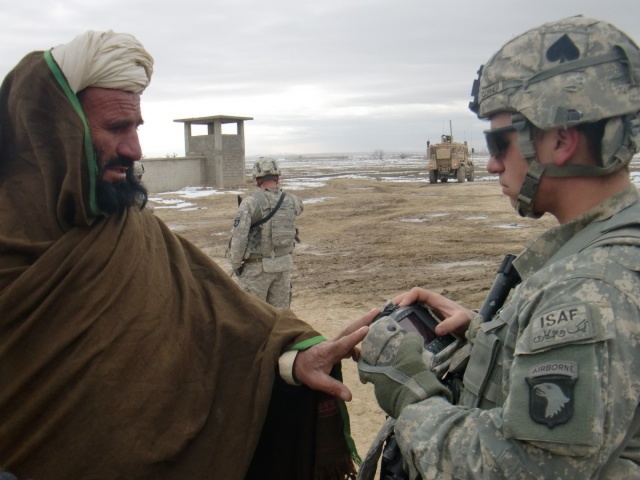
U.S. Army using biometric data in Afghanistan. DVIDS
“It’s not hard to imagine a world where people are blithely sharing information online without realizing their third cousin is a Navy SEAL or an operative of the CIA,” said Erin Murphy, a former intelligence professional and now a professor at New York University’s School of Law.
“It all boils down to the same basic idea,” Murphy said. “In a world in which a few stray cells can be used to identify a person, there is no such thing as covert action, and no such thing as anonymity.”
The U.S. Army already uses biometrics to track and record data of Afghans suspected of being Taliban bomb-makers. They are recording eye scans, fingerprints and facial images. These can be used when conducting operations or checking on possible insurgent activity. The Army is using the same method in Iraq as well.
So far about 1.5 million Afghans and 2.2 million Iraqis have had biometric data placed in databases. And that number is growing.
Advertisement
What readers are saying
Generating a quick summary of the conversation...
This summary is AI-generated. AI can make mistakes and this summary is not a replacement for reading the comments.










COMMENTS