Poland's Minister of National Defense, Władysław Kosiniak-Kamysz, announced a $3.8 billion contract to upgrade the Polish Air Force's F-16s to the latest F-16V model, addressing the obsolescence of current capabilities amid rising threats from Russia. The modernization, set to begin in 2028, will enhance Poland's defense capabilities on NATO's eastern flank.
Key points from this article:
The Polish Air Force will upgrade its 48 F-16CM/DM Block 52+ Fighting Falcons to the F-16V configuration to counter evolving threats from Russia and its allies.
How the upgrade will enhance Poland's defense: The F-16V will feature advanced radar and weapons systems, improving situational awareness and combat effectiveness against potential aggressors.
Why this matters: With Poland's strategic location bordering Russia's Kaliningrad exclave and Belarus, modernizing its air force is crucial for NATO's collective security in Eastern Europe.
Updating summary...
Poland Will Upgrade to F-16V “Viper” Jets
Warren Gray
Speed
1x
Listen
COMMENTS
Facing Kaliningrad, Belarus, and a live war next door, Poland is pushing its F-16s to the Viper standard with APG-83 radar, Viper Shield, and standoff punch to hold the line while F-35s spin up.
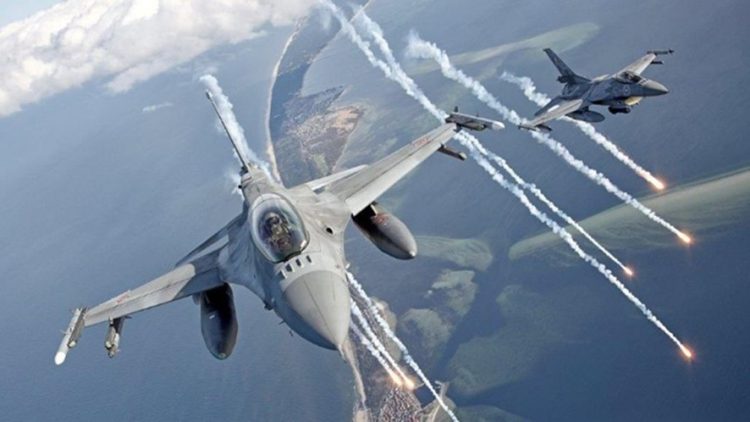
Polish Air Force F-16CM Block 52+ fighter jets deploying flares in flight.
Photo credit: Bartek Bera/Poland MoD.
“The current capabilities of the F-16 in the C/D versions are good, but not adequate to counter present threats after these 20 years. We must enhance our…capabilities.” — Władysław Kosiniak-Kamysz, Polish Minister of National Defense, August 13, 2025.
The Republic of Poland is strategically located on the front lines of Eastern Europe, sharing a common, 130-mile border with the heavily-militarized, Kaliningrad exclave region of the Russian Federation to the north, plus 65 miles with Lithuania, another NATO ally, in the Suwałki Gap region, plus 260 miles with Belarus, Russia’s staunchest ally, to the east, and 330 additional miles with embattled Ukraine to the southeast, where most of the U.S. and NATO military support for Ukraine flows in.
Advertisement
Since 2006 to 2008, the Polish Air Force has been equipped with 48 F-16CM/DM Block 52+ Fighting Falcon jet fighters (F-16C/D-52-CF models), one of which recently crashed on August 28th, while rehearsing for an air show at Radom Air Base, killing the pilot, Major Maciej “Slab” Krakowian, age 37, of the F-16 Tiger Demo Team, a graduate of the U.S. Air Force Academy. They are stationed at Łask Air Base and Poznań-Krzesiny Air Base with the 3rd (“Ravens”), 6th (“Tigers”), and 10th (“Dragons”) Fighter Squadrons in multirole missions, but the Dragons are also tasked with low-level, photo-reconnaissance missions, using the Goodrich DB-110 digital, airborne reconnaissance pod.
At the time of their purchase, these Fighting Falcons were absolutely state-of-the-art aircraft, incorporating APG-68(V)9 airborne radar with high-resolution ground-mapping, Pratt and Whitney F100-PW-229 engine with 29,160 pounds of thrust, ALQ-211(V)4 electronic warfare systems, the Joint, Helmet-Mounted Cueing System (JHMCS), AAQ-33 Sniper ER targeting pods, AIM-120C-7 “Slammer” radar-guided missiles, AIM-9X Super Sidewinder heat-seeking missiles, M61A1 20mm Gatling gun with 511 rounds ammunition, as well as GPS-guided Joint Stand-Off Weapons (JSOW-C) and Joint, Direct-Attack Munition (JDAM) bombs.
They were the most advanced F-16s in NATO, aside from U.S. Air Force fighters. However, with the passage of time and technological advances resulting from the ongoing Russia-Ukraine War, even these latest Fighting Falcons have become outdated.
Advertisement
Poland ordered 32 F-35A Lightning II stealth fighters in 2020 as replacements, but they’ve only received six aircraft so far, to be used primarily for training pilots and mechanics for the next five years, until the new jets become fully operational in the 2030s.
So, onAugust 13, 2025, the Polish Ministry of National Defense signed a $3.8-billion contract with the U.S. government to upgrade all of its F-16s to the very newest model, the F-16CM Block 72, more commonly known as the F-16V “Viper.”All of the modernization work will be performed locally at the Wojskowe Zakłady Lotnicze No. 2 (WZL-2) armaments plant in Bydgoszcz, Poland, which employs 1,400 people.The actual modernization process will begin in 2028and last for up to the next 10 years, as required.
Advertisement
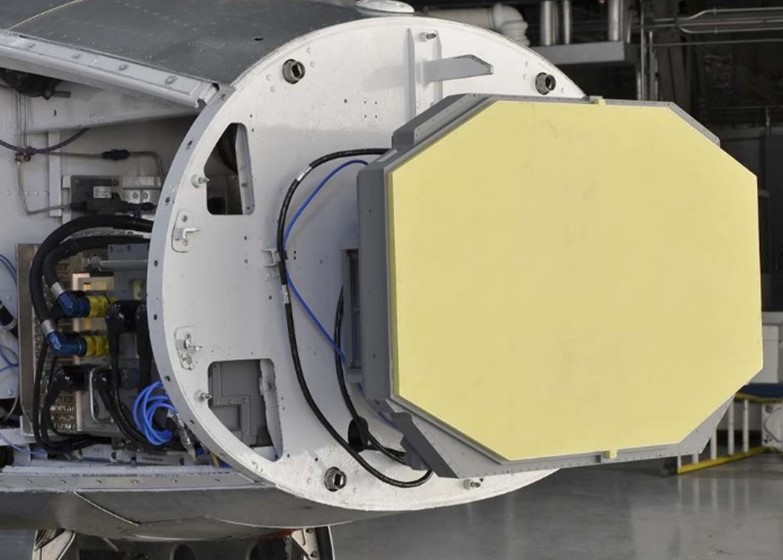
APG-83 SABR fire-control radar on F-16CM. Photo credit: RadarTurorial.eu.
At the heart of the F-16V “Viper” upgrade is the Northrop Grumman APG-83 Scalable, Agile-Beam Radar (SABR, or “Saber”), an active, electronically-scanned array (AESA) fire-control radar with a range out to 230 miles, using synthetic-aperture radar (SAR) for high-resolution, ground mapping. Its detection range is at least 30 percent better than previousF-16CM radars.
The Viper also employs an advanced, Raytheon MMC 7000AH+ modular mission computer, integrated with the newerJHMCS II helmet cueing system to improve pilots’ situational awareness in combat.The aircraft is protected by the brand-new, ALQ-254(V)1 Viper Shield electronic warfare suite, incorporating digital radar warning and countermeasures systems.
U.S. Air Force F-16CM test-firing an AIM-120D-3 missile in 2023. Photo credit: U.S. Air Force.
Weapons upgrades will include AIM-120D-3 “Slammer” missiles (93 miles+ range), AIM-9X-2 Super Sidewinder heat-seekers, GBU-53/B StormBreaker Small-Diameter Bombs (with four different guidance modes), and AGM-158 Joint, Air-to-Surface Standoff Missiles (JASSMs), with a range exceeding 230 miles. The DB-110 reconnaissance pods will be upgraded to the current MS-110 standard, utilizing multi-spectral imagery. The engine and gun on the F-16V remain the same as those of the earlier, Block 52 models.
Advertisement
Other nations upgrading to the Viper configuration include Bahrain (39), Bulgaria (16), Greece (84), Morocco (48), South Korea (134), Slovakia (14), and Taiwan (66). The U.S. Air Force is upgrading 680 of its active duty and Air National Guard F-16CMs to Block-72 standard.
Poland’s F-16V Vipers will serve as multirole workhorses for the air force, reserving their F-35A stealth fighters for very special missions, such as deep strikes behind enemy lines. With the growing threat of Russian aggression, especially recent drone and aircraft incursions over Poland and Estonia, upgrading Polish F-16s has become a critical element in safeguarding NATO’s eastern flank.
Advertisement
What readers are saying
Generating a quick summary of the conversation...
This summary is AI-generated. AI can make mistakes and this summary is not a replacement for reading the comments.











COMMENTS