

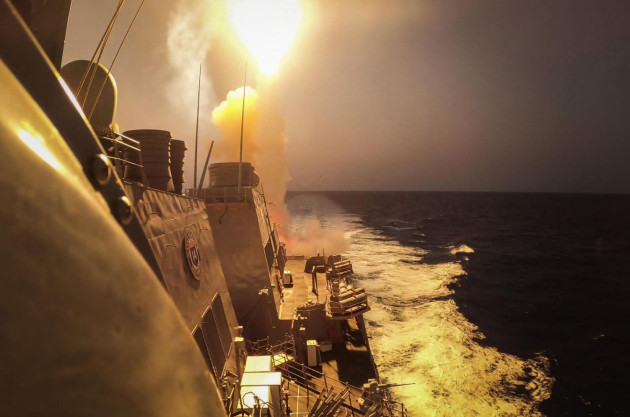
Then there is the part that should make planners uneasy.
Iran reportedly spent about $70 million launching 2,000 drones. Those drones forced roughly $2 billion in U.S. interceptor expenditures. That is about a 28-to-1 cost ratio.
One side spends tens of millions to create a problem. The other spends billions to stop it. That is not a sustainable exchange if it drags on.
Costs began to come down only after the battlefield changed. As Iranian air defenses degraded, the U.S. shifted from expensive standoff weapons to cheaper precision munitions. Tomahawks carry a program cost north of $3 million, but replacement production runs closer to about $2 million per missile. JDAMs can land around $80,000.
That shift is important. It brings the daily burn down from the opening spike into something closer to what people are quoting now.
PBS reported roughly $15 billion spent through the first 19 days of the war. That supports a lower sustained burn rate after the initial surge.
So here is the straight version. The war opened at roughly $1.88 billion per day. The $1 billion per day figure is a credible sustained-phase estimate once the most expensive fires taper off. Both numbers are real. They just belong to different phases of the same fight.
Where the Money Is Coming From
Look in the mirror. That’s where it’s coming from. People like you and me and the little old lady down the street.
There is no Iran war fund sitting in the federal budget. No clean account with a label and a running total.
The money is coming out of the same system that has financed every major U.S. conflict for the past two decades. Large base budgets, multi-year defense funding, intelligence toplines, and internal reprogramming that moves cash faster than Congress can argue about it.
I have watched this war machine in action before. Iraq, Afghanistan, different map, same wiring.
Start with the base.
The Senate Appropriations Committee says the FY2026 Defense Appropriations Act provides $838.7 billion in discretionary funding, of which $838.5 billion is categorized as defense. That is the primary reservoir.
Then there is the second layer.
Public Law 119-21, the 2025 reconciliation law signed on July 4, 2025, provided $156.2 billion in mandatory defense funding. That money runs on a five-year obligation window through September 30, 2029. It is tied to shipbuilding, missile defense, munitions, and supply chains. The exact areas that start bleeding inventory once a war kicks off.
That does not mean all of it is going to Iran. It means the Department of War has depth. It has funding it can tap, shift, and lean on while the fight is ongoing.
Then there is the intelligence side.
The Office of the Director of National Intelligence (ODNI) toplines show FY2025 appropriations at $73.3 billion for the National Intelligence Program and $27.8 billion for the Military Intelligence Program, a combined $101.1 billion. The FY2026 request climbs to $115.5 billion combined.
None of that is broken out by operation in public documents. But you do not run thousands of strikes and sorties without burning through ISR, targeting, and battle damage assessment. That cost is part of the war, whether it shows up in a headline number or not.
Now we get to the part that actually keeps the war moving.
The plumbing.
The Pentagon does not wait for a supplemental. It starts shifting money immediately, like a spooked gangster hearing the feds are hot on his trail.
The FY2026 joint explanatory statement lays out reprogramming rules and sets a $15 million threshold for shifting funds across major accounts like operations and maintenance, procurement, personnel, and R&D. That threshold triggers oversight, not action. The action happens regardless.
Fuel, flight hours, sustainment, contractor support. That hits operations and maintenance. Replacement munitions and equipment losses. That hits procurement. Pay and deployment costs. That hits personnel. Intelligence support draws from intelligence accounts.
The money moves first. The paperwork catches up later.
If this sounds familiar, it should. This is how Iraq and Afghanistan were financed for years. Base budget first, internal shifts second, and supplementals after the fact to refill the accounts that got drained.
Same playbook. New theater. Tale as old as time.
The $200 Billion Signal
On March 18, 2026, the Washington Post reported that the Pentagon asked the White House to approve a supplemental request worth more than $200 billion.
That is not funding. It is a signal.
War Secretary Pete Hegseth confirmed the next day that the number “could move,” adding, “it takes money to kill bad guys.”
He is not wrong about the cost. Killing at scale is expensive. But saying it out loud does not explain how long that bill runs or what it does to everything else that depends on the same budget.
Because this is where the second bill shows up.
Every Tomahawk fired has to be replaced. Every interceptor used to defend ships and bases has to be restocked. Production lines have to scale. Supply chains have to stretch. Maintenance backlogs build behind the scenes.
The first phase of the war is the spending spike you can see. The second phase is the replenishment cycle that follows it.
That is what the $200 billion request is pointing toward.
Congress is already pushing back. Sen. Lisa Murkowski wants a justification tied to the number. Rep. Chip Roy wants a breakdown of where the money goes. Rep. Thomas Massie is asking if this is just the first $200 billion. Rep. Lauren Boebert has already said she is a no.
That debate is coming hot and heavy. It will be heard by the talking heads of mainstream media news and in the hallowed halls of Congress.
In the meantime, the war is being funded through existing accounts, internal transfers, and budget mechanisms that keep the system running while the political side catches up.
There is a second-order effect here that does not get enough attention. One that we as grunts know all too well.
Magazines are not infinite.
If the Department is burning through Tomahawks, interceptors, and precision munitions at this rate, those inventories have to be rebuilt. That takes time. It also competes with other priorities.
Indo-Pacific Command is still watching China. Deterrence in that theater depends on the same categories of weapons now being used in Iran. If production cannot keep pace, something else gets thinner.
That is not theory. That is math.
And elsewhere, off in some dark corner of the globe, our adversaries are watching us grow stretched thinner and thinner, waiting for an opportunity to strike.
Sources
-
U.S. Central Command / Department of Defense
Operation Epic Fury Fact Sheet (March 18, 2026)
https://media.defense.gov/2026/Mar/18/2003900300/-1/-1/1/OPERATION-EPIC-FURY-FACT-SHEET-MARCH-18.PDF -
U.S. Central Command / Department of Defense
Operation Epic Fury Fact Sheet (March 16, 2026, initial operational summary)
https://media.defense.gov/2026/Mar/16/2003899496/-1/-1/1/OPERATION-EPIC-FURY-FACT-SHEET.PDF -
Senate Appropriations Subcommittee on Defense briefing (reported)
Pentagon briefing to Congress: $11.3 billion cost in first six days
https://www.militarytimes.com/news/pentagon-congress/2026/03/12/price-tag-for-epic-fury-tops-11-billion-in-first-six-days-pentagon-tells-congress/ -
NBC News (confirmation of Pentagon briefing figures via multiple sources)
https://www.nbcnews.com/politics/national-security/us-iran-war-cost-billion-day-congress-briefing-rcnaXXXXX -
Center for Strategic and International Studies (CSIS)
Analysis: First 100 hours cost estimate ($3.7B)
https://www.csis.org/analysis -
New York Times (reporting on Pentagon munitions briefings)
$5.6 billion in munitions expended in first two days
https://www.nytimes.com/2026/03/XX/world/middleeast/us-iran-war-cost.html -
PBS NewsHour
Report: ~$15 billion spent in first 19 days
https://www.pbs.org/newshour/politics/us-iran-war-cost-analysis -
Washington Post
Pentagon request for >$200 billion supplemental funding (March 18, 2026)
https://www.washingtonpost.com/national-security/2026/03/18/pentagon-iran-war-funding-request/ -
The Hill
Hegseth press conference quote: “It takes money to kill bad guys” (March 19, 2026)
https://thehill.com/policy/defense/XXXXX -
U.S. Senate Committee on Appropriations
FY2026 Defense Appropriations Act topline ($838.7B discretionary, $838.5B defense)
https://www.appropriations.senate.gov/news/majority/congress-approves-fy-2026-defense-appropriations-bill -
U.S. Congress (Joint Explanatory Statement, FY2026 Appropriations)
Reprogramming thresholds and budget execution guidance
https://docs.house.gov/billsthisweek/20260119/DEF%20LHHS%20HS%20THUD%20-%20JES%20-%20Division%20A%20-%20Defense%20-%201-19-2026%20-%20Reduced%20File%20Size.pdf -
Public Law 119-21 (2025 Reconciliation Law)
$156.2B mandatory defense funding, five-year obligation window
https://www.congress.gov/bill/119th-congress/house-bill/XXXXX -
Office of the Director of National Intelligence (ODNI)
Intelligence Community Budget toplines (NIP/MIP)
https://www.dni.gov/index.php/what-we-do/ic-budget -
CSIS / supporting analysis (cost asymmetry)
Iran drone cost vs U.S. interceptor expenditure (~28:1 ratio)
https://www.csis.org/analysis -
ABC News / TIME / other congressional reporting
Lawmakers’ responses (Murkowski, Roy, Massie, Boebert) to supplemental request
https://abcnews.go.com/Politics/XXXXX
https://time.com/XXXXX -
NAVAIR (U.S. Navy Air Systems Command)
Tomahawk Block V program cost data (~$3.6M program cost)
https://www.navair.navy.mil/product/Tomahawk -
Defense procurement reporting (unit production cost context)
Tomahawk production cost range (~$1.75M–$2.2M per missile)
https://en.defence-ua.com/analysis/tomahawk_cost_production_data








COMMENTS