L3Harris Technologies has been awarded an $86.2 million contract to develop the Red Wolf long-range missile for the U.S. Marine Corps, following successful live-fire tests. This new missile aims to provide a cost-effective, precision strike capability that can engage targets from over 230 miles away, enhancing the Marines' operational effectiveness without entering high-risk zones.
Key points from this article:
The U.S. Naval Air Systems Command selected L3Harris Technologies to develop the Red Wolf missile for the Marine Corps' Precision Attack Strike Munition program.
How the Red Wolf missile enhances the Marine Corps' capabilities by allowing AH-1Z Viper helicopters to strike targets from a safe distance of up to 230 miles, thus avoiding adversary defenses.
Why the development of the Red Wolf missile is crucial as it offers a more affordable alternative to existing high-cost munitions, addressing the need for cost-effective solutions in modern warfare.
Updating summary...
Red Wolf Long-Range Missiles for Marine Corps AH-1Z Vipers
Warren Gray
Speed
1x
Listen
COMMENTS
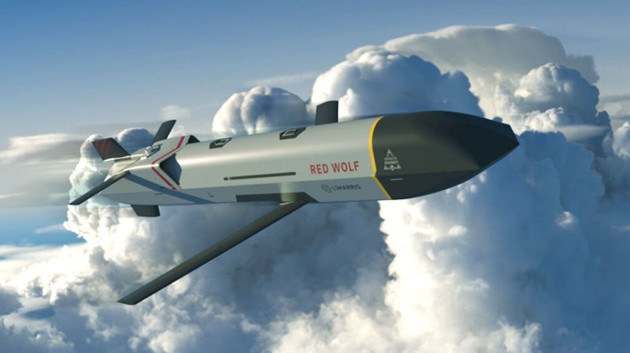
A six-foot, turbojet-powered mini-cruise missile that flies nap-of-the-sea out past 200 miles for roughly the price of a JAGM, Red Wolf gives Marine Corps Vipers a way to hit ships, radars, and missile sites from well outside the danger ring and in numbers that actually matter.
Artist depiction of new, Red Wolf long-range missile. Photo credit: L3 Harris Technologies.
“We’ve now proven our (Red Wolf missile)…will help provide our warfighters the asymmetrical advantage they need to handle increasingly sophisticated threats, without the need to enter into adversary weapon engagement zones.” — Ed Zoiss, President of L3Harris’ Space and Airborne Systems.
On January 30, 2026, L3Harris Technologies of Ashburn, Virginia, was selected by the U.S. Naval Air Systems Command (NAVAIR) to develop, test, and manufacture brand-new, Red Wolf long-range missiles for the Marine Corps’ Precision Attack Strike Munition (PASM) program with an $86.2-million contract, after 52 successful, live-fire tests of the new missile system, including a low-altitude launch from a Marine Corps AH-1Z Viper attack helicopter in September 2025 over the Atlantic Test Range. The test results were officially disclosed on December 19th, 2025, resulting in the successful engagement of a sea-based target.
Advertisement
The Red Wolf mini-cruise missile was initially unveiled on July 17, 2025, in an effort to provide large quantities of comparatively low-cost, stand-off, precision munitions to complement existing, high-end, cruise missiles in a major war scenario.
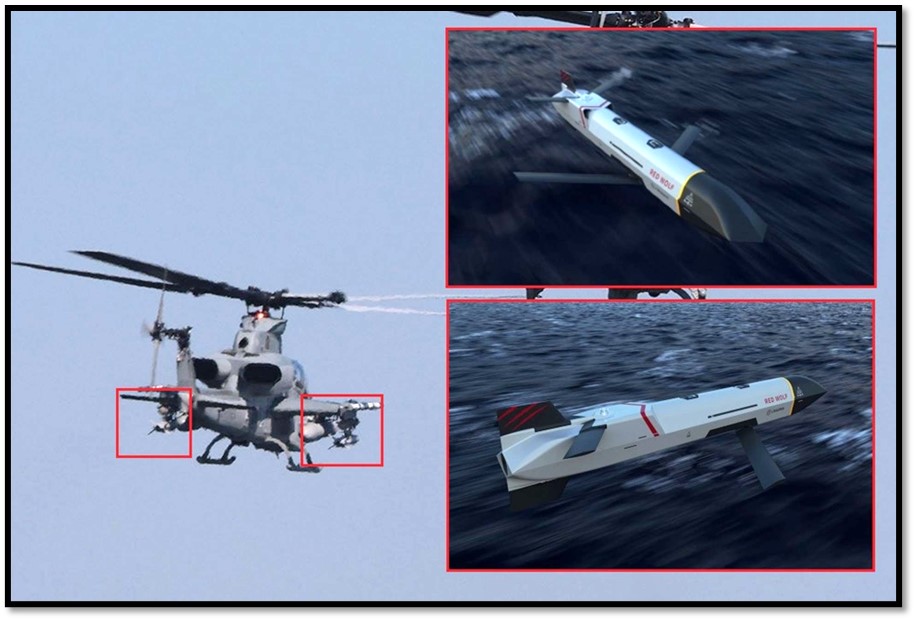
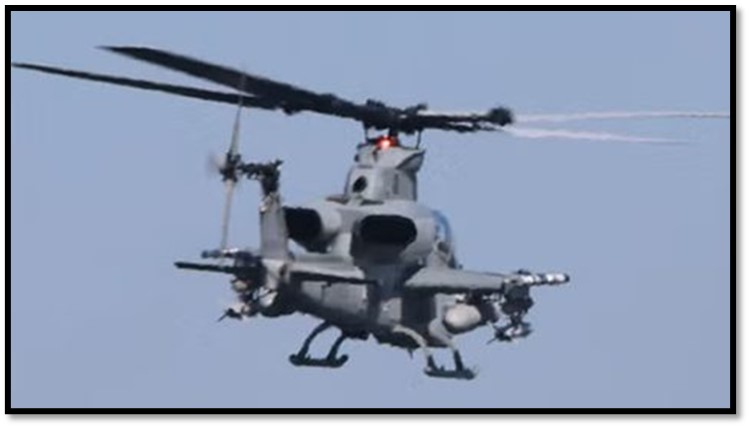
U.S. Marine Corps AH-1Z Viper helicopter gunship armed with two Red Wolf missiles for a low-altitude, below-radar-horizon test launch in September 2025.Photo Credits: U.S. Marine Corps and L3Harris Technologies.
The AH-1Z Viper may be armed with as many as eight (normally) to 16 (maximum load) AGM-114K2A Hellfire II laser-guided missiles, or newer, AGM-179A JAGM (Joint Air-to-Ground Missile; $319,000 each), which are very similar in size and weight, at 64 to 70 inches long, seven inches in diameter, and 100 to 108 pounds overall, with a range of five to 6.8 miles, depending upon the variant.
But the Marine Corps wanted a longer-range missile, able to reach out as far as 170 miles or more, yet much smaller and less expensive than the AGM-158C Long-Range, Anti-Ship Missile (LRASM), at $700,000 to $1 million per copy.
Advertisement
Red Wolf fits into exactly the same size and weight category as a Hellfire II or JAGM missile, at exactly 72 inches (six feet) long, with a 25-pound payload (warhead and seeker), and the same price range as a JAGM missile, at $300,000 (possibly as high as $500k initially), but instead of being rocket-boosted and supersonic in flight, the Red Wolf is a subsonic, turbojet-powered (German-made engine), mini-cruise missile with fold-out fins and wings for long-distance flight, and can fly as far as 230 miles, at very low altitude!
This long range is the Red Wolf’s principal advantage, making it the longest-range weapon for the Marine Corps helicopters. Ed Zoiss, the president of L3Harris’ Space and Airborne Systems, has stated that, “The Red Wolf…(is) lethal, modular, affordable, and ready to hunt…with a significant advantage in closing long-range kill chains, defeating adversarial threats in challenging environments, and protecting assets.” This long reach allows it to operate outside the engagement zones of modern, shipborne, surface-to-air missile systems and coastal missile networks. L3 Harris Technologies is fully prepared to produce up to 1,000 Red Wolf missiles per year, beginning in 2026. In addition to the AH-1Z Viper helicopter, it may be tailored to be launched from drones or ground vehicles.
Advertisement
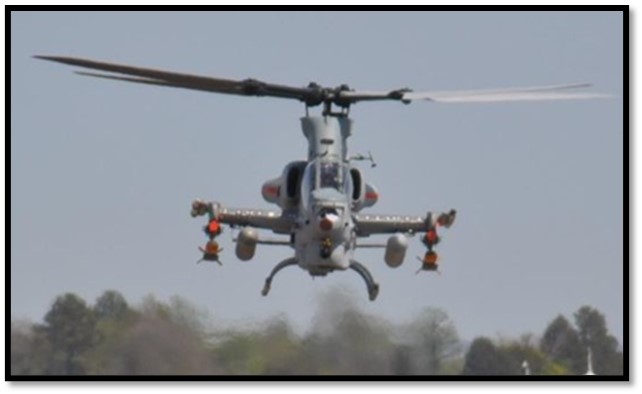
AH-1Z Viper gunship carrying two Red Wolf missiles on a November 2024 test flight. Photo credit: NAVAIR.
With a modular and scalable payload section, the Red Wolf missile is able to accept different warhead types and seeker combinations, although based upon its very long range, and the images provided by L3 Harris Technologies, it likely employs some type of GPS mid-course guidance toward the target, and possibly imaging-infrared (IIR) terminal guidance, for a very precise impact point on the selected target.
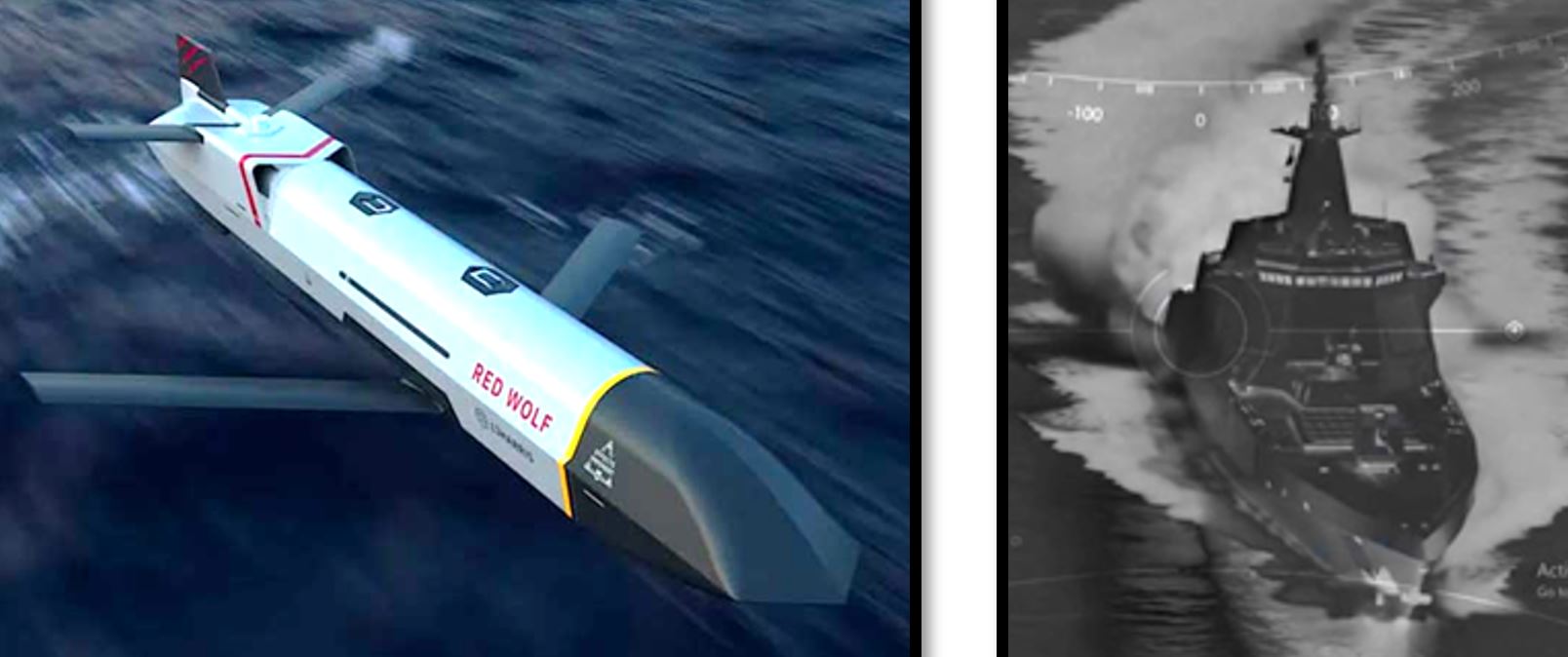
Red Wolf missile depicted at ultra-low, sea-skimming altitude, and striking a simulated Chinese Navy Type 52D destroyer. Photo credits: L3 Harris Technologies.
The Red Wolf cruise missile is ideal for striking enemy naval vessels, particularly their radar masts and sensor systems, to blind them to additional, incoming threats, such as U.S. Navy or Marine Corps F/A-18E/F Super Hornet jet fighters with more expensive, anti-ship missiles or Joint Strike Missiles (JSMs). Launched from AH-1Z Vipers operating from aircraft carriers, assault ships, austere locations on islands, or expeditionary bases, they could also attack enemy missile sites, radar sites, command posts, or other vital targets in greater volume and at lower cost than some of the larger, high-end missiles available.
Christopher Kubasik, the chairman and CEO of L3Harris Technologies, said that, “Recent conflicts and incursions over NATO airspace, particularly with the increased use of mass-produced drones, demonstrate the urgent need for cost-effective alternatives to exquisite munitions. Our proven, Red Wolf system can bring affordable mass to the Marines’ arsenal of advanced munitions…to support the most-lethal, fighting force in the world.”
Advertisement
Red Wolf missile depicted at ultra-low, sea-skimming altitude, and striking a simulated Chinese Navy Type 52D destroyer. Photo credits: L3 Harris Technologies.
The Red Wolf cruise missile is ideal for striking enemy naval vessels, particularly their radar masts and sensor systems, to blind them to additional, incoming threats, such as U.S. Navy or Marine Corps F/A-18E/F Super Hornet jet fighters with more expensive, anti-ship missiles or Joint Strike Missiles (JSMs). Launched from AH-1Z Vipers operating from aircraft carriers, assault ships, austere locations on islands, or expeditionary bases, they could also attack enemy missile sites, radar sites, command posts, or other vital targets in greater volume and at lower cost than some of the larger, high-end missiles available.
Christopher Kubasik, the chairman and CEO of L3Harris Technologies, said that, “Recent conflicts and incursions over NATO airspace, particularly with the increased use of mass-produced drones, demonstrate the urgent need for cost-effective alternatives to exquisite munitions. Our proven, Red Wolf system can bring affordable mass to the Marines’ arsenal of advanced munitions…to support the most-lethal, fighting force in the world.”
Red Wolf missile depicted at ultra-low, sea-skimming altitude, and striking a simulated Chinese Navy Type 52D destroyer. Photo credits: L3 Harris Technologies.
Advertisement
What readers are saying
Generating a quick summary of the conversation...
This summary is AI-generated. AI can make mistakes and this summary is not a replacement for reading the comments.










COMMENTS