

That same year, Olds jumped into the fray at the Cleveland National Air Races, entering the first closed-course jet race in history. He flew a P-80 like a man possessed and finished second in the Jet Division—proving he had the guts and skill to race jets just as hard as he fought with them. But the thrill came with heartbreak. In July 1946, during an airshow on the Fourth of July, his friend and flying partner Herbst crashed and died in front of the crowd. The tragedy drove home just how thin the line was between showmanship and sacrifice in those early, unforgiving days of jet-powered aviation.
Olds didn’t slow down. In 1948, his jet credentials and leadership earned him a spot in the U.S. Air Force/Royal Air Force Exchange Program. He took command of No. 1 Squadron at RAF Tangmere, flying the British Gloster Meteor. This was more than a diplomatic exchange—it was Olds bringing American fighter pilot grit into the postwar NATO alliance and learning the strengths and weaknesses of our closest allies firsthand.
These postwar years with the Shooting Star were about more than personal thrills or headlines. They marked Olds’ evolution from a World War II fighter ace into a visionary of jet-age combat pilot who didn’t merely fly the next generation of aircraft but helped shape what air warfare would become.
Vietnam War: Operation Bolo and the Wolfpack
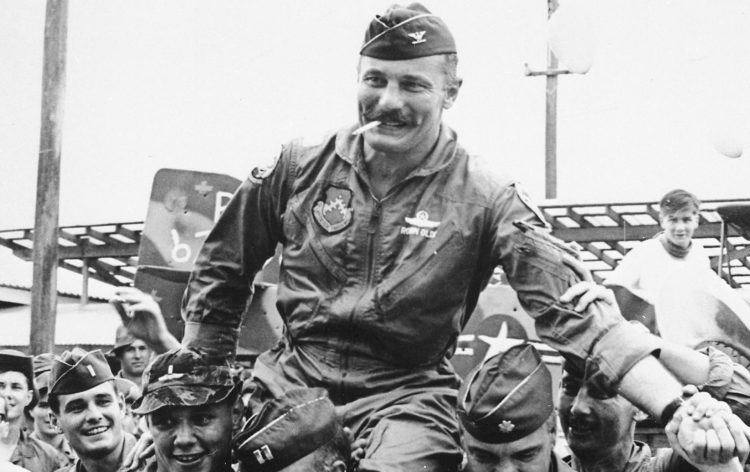
By the time the Vietnam War came knocking, Robin Olds was already a legend—but he wasn’t done yet. In October 1966, he took over command of the 8th Tactical Fighter Wing at Ubon Royal Thai Air Force Base, a ragtag bunch known as the “Wolfpack.” Flying the F-4 Phantom II, Olds jumped right into the fight, logging 152 combat missions—105 of them straight into the teeth of North Vietnamese air defenses. This wasn’t a desk jockey with brass on his collar. Olds led from the front, routinely putting his own tail in the danger zone alongside the men he commanded.
One of his boldest moves came on January 2, 1967, with Operation Bolo. Olds cooked up a plan so clever it should’ve come with a laugh track and a warning label. The idea was simple but deadly: make his F-4s fly like slow, vulnerable F-105 bombers to bait the enemy into a fight. The North Vietnamese MiG-21 pilots took the bait, and the Wolfpack sprang the trap. Seven MiGs were blown out of the sky without a single American loss. It was one of the most successful air-to-air ambushes of the war and proof that Olds wasn’t only brave—he was tactically brilliant.
Olds didn’t stop there. He scored four confirmed MiG kills during his tour, pushing his career total to 17 and making him a “triple ace.” His Phantom, Scat XXVII, wore those kills like medals, each one a reminder that this old-school pilot could still go toe-to-toe with the best—and usually win. But it wasn’t just about racking up kills. Olds had a leadership style that bordered on mythic. He was all swagger and steel, the kind of man who’d strap in for the same high-risk missions as his youngest pilots. He didn’t believe in sending others into danger he wasn’t willing to face himself.
He was also loud and clear about his disdain for the bureaucratic red tape that choked the life out of effective combat. Olds hated the restrictive rules of engagement that handcuffed U.S. pilots and wasn’t shy about saying so, even if it ruffled feathers at the Pentagon. His honesty, bravery, and flat-out refusal to play politics made him a hero to his men—and a thorn in the side of career-minded brass.
For his actions, Olds was awarded the Air Force Cross after leading a treacherous strike against the heavily defended Paul Doumer Bridge in August 1967. But ask anyone who flew with him, and they’ll tell you the medals were just window dressing. What really mattered to the man was the way he led, the way he fought, and the way he made his people believe they were invincible.
Oh, and that mustache. The thick, rebellious mustache that he grew in open defiance of Air Force grooming standards became a legend of its own. It was more than facial hair—it was a battle flag, a middle finger to conformity, and a rallying symbol for every pilot who followed him into the fight.
When the war ended, Olds didn’t fade quietly into retirement. He was promoted to brigadier general and took the helm as Commandant of Cadets at the U.S. Air Force Academy, where he passed on his warrior spirit to the next generation. To this day, Robin Olds is remembered not only as a war hero, but as one of the greatest fighter leaders in American history—fearless, brilliant, and completely unafraid to break a few rules when the mission called for it.
Legacy of a Maverick
During his tenure as Commandant of Cadets at the U.S. Air Force Academy, he influenced yet another generation of aviators. He retired in 1973 as a brigadier general, leaving behind a legacy of courage, innovation, and defiance against bureaucratic constraints.
Olds passed away on June 14, 2007, but his spirit endures. His mustache inspired the Air Force tradition of “Mustache March,” a testament to his enduring impact on military culture. Robin Olds remains a symbol of the fearless, unorthodox pilot who dared to challenge the status quo in pursuit of excellence.








COMMENTS