

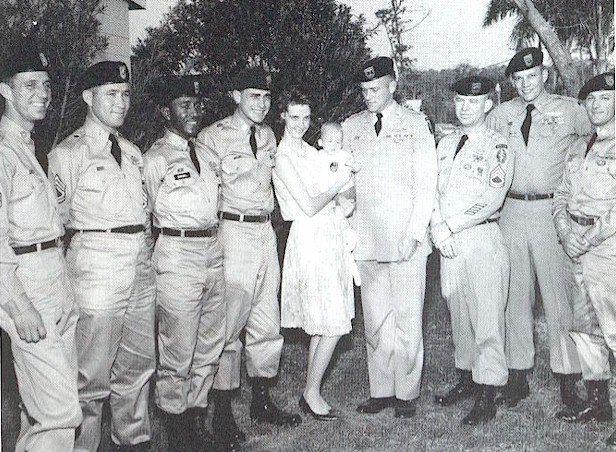

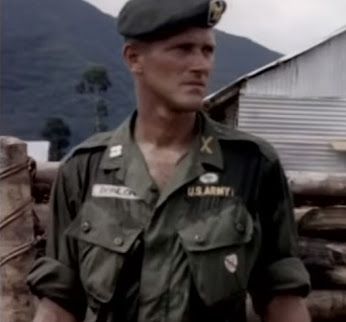
The team’s radio operator, SSG Keith Daniels was on the radio with Da Nang when the Commo Bunker was hit. “They had superb planning,” Donlon said after the battle. Machinegun fire and grenades raked the camp as 800 VC of a reinforced battalion were beginning to assault the camp.
Donlon and MSG Gabriel “Pop” Alamo were trying to douse the fires while retrieving weapons and ammo from the command post. Alamo was burned badly but quickly joined SSG Ray Whitsell and SGT Michael Disser at their 81mm mortar pit near the main gate. It was one of three mortar positions, along with two 60mm mortar pits, ringing the inner perimeter. Disser was firing illuminating rounds that revealed hundreds of VC swarming through the outer perimeter.
“It was the most frightening sight of my life,” Disser was quoted in the book “Vietnam Medal of Honor Heroes.”
That is when Conway was killed. He was bounding down the steps of the mortar pit slowly in an effort to bolster the confidence of the young SF troops when he took a shot between the eyes. He lingered for a half-hour unconscious but died despite being given what little first aid was available. He was the first Australian soldier to die in Vietnam.
SGT John Houston saw more Viet Cong inside the inner perimeter and rushed to meet them headlong. He was behind a berm where a new command post was to be put in. The SF troops called it “The Pool.” Donlon was going to help him when he was hit by shrapnel from a mortar round. The blast took off all of his equipment, leaving him with no boots and just his AR-15. He was wounded in three places.
The youngest member of the team, Houston dueled with VC troops lobbing grenades at him for over two hours before his ammunition began to run out. He still refused to leave his position telling other soldiers to throw him ammo. He was then mortally wounded by the enemy that continued to advance.
In the mortar pit, the tube was glowing red-hot from the constant use of shells and illumination rounds that were being fired. Pop Alamo with an AR-15 and 1LT Jay Olejniczak, the XO of the team with an M-79 grenade launcher also kept up a steady rate of fire.
Alamo saw the VC attempting to breach the main gate. He rushed from the pit under heavy automatic weapons fire and bolstered the defense there, despite suffering a serious wound. The team’s situation was rapidly becoming untenable.

Donlon and Alamo covered the rest of the men in the pit as Donlon ordered them back to a safer position in a ditch. When it was their turn to leave, Donlon helped Alamo to his feet just as a VC mortar round hit the edge of the pit. The blast killed Alamo and wounded Donlon a fourth time. He had wounds to his face, arm, leg, and a quarter-sized hole in his stomach. His fingers were numb but it didn’t stop him from carrying the 60mm mortar and ammunition back to the men in the ditch.
He made three trips while treating the Nungs who were badly wounded and distributing ammunition and rallying the men. Donlon was seemingly everywhere. He made his way to SSG Woods who manned the other 81mm mortar pit. Woods was nearly knee-deep in brass and empty ammunition tubes. He was wounded in his feet and had a perforated eardrum.
At just after 0400, Donlon heard the drone of an approaching aircraft which would drop flares and then the airstrikes would follow. He expected the VC to make a final all-out attempt to take the camp. Then the unexpected happened.
The team heard a voice shouting something in Vietnamese over a megaphone. The sound echoed in the darkness, and for a moment both sides stopped firing. “What’s he saying?” the Americans asked their interpreters.
The Vietnamese interpreter was visibly shaken by the words that the voice was shouting. “He say lay down weapons. V.C. going to take camp and we all be killed.”
After a pause, the voice shouted over the loudspeaker again, this time in English. “Lay down your weapons! We are going to annihilate your camp, you will all be killed!”
In the mortar pit, SGT Brown feverishly started dialing the knobs of the mortar tube trying to pinpoint where the sound of the loudspeaker came from. He dropped 10 rounds in succession. Enemy machine guns answered, but the loudspeaker had been silenced.
“In my mind’s eye, I see Brownie’s mortar rounds dropping directly down that megaphone,” Donlon said in an interview in 2003.
The arrival of air support turned the tide. VC fire began to dwindle. At 0600 Donlon finally was able to reach SSG Beeson’s position. He’d been firing his mortar all night long with his Nungs keeping him supplied with ammo. No one else on the team had been able to reach him. But the sight of his commander, now wounded all over his body, shocked the NCO. It was then, only because Beeson had to threaten Donlon that he’d knock him down, that the Captain allowed his own wounds to be treated.
By 0700, the VC withdrew. They left behind 154 dead and probably carried many more away. Then the wounded were treated and withdrawn from the shattered camp. Two Americans, Alamo and Houston were killed as was their Australian counterpart Conway. Nine more were wounded.
Both Alamo and Houston had pregnant wives waiting at home in Ft. Bragg. Upon hearing about his death, Alamo’s wife had a miscarriage. Houston’s wife gave birth to twins. One died at birth. The other, Houston’s son has stayed in close contact with Donlon thru the years.
On December 5, 1964, all ten surviving members of Detachment A-726 were in attendance at the White House where President Lyndon Johnson presented Captain Roger H.C. Donlon with the Medal of Honor. It was the first of 248 such awards to be presented for heroism during the War in Vietnam. And one of 18 Medals of Honor bestowed upon the Green Berets during the war.
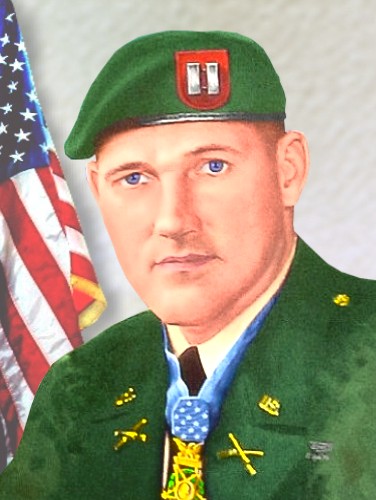
Alamo and Houston were awarded the Distinguished Service Cross posthumously for their bravery, while Olejniczak, Brown, Disser and Terrin received Silver Stars. Bronze Stars for Valor were awarded to Beeson, Daniels, Gregg, Whitsell, and Woods. Nine of the twelve A-Team members received Purple Hearts.
Donlon later commanded the 3rd Bn. 7th Special Forces Group in Panama and retired as a Colonel. He and his wife live in Kansas.
Photos courtesy US Army
This article was originally published on SpecialOperations.com and written by








COMMENTS