

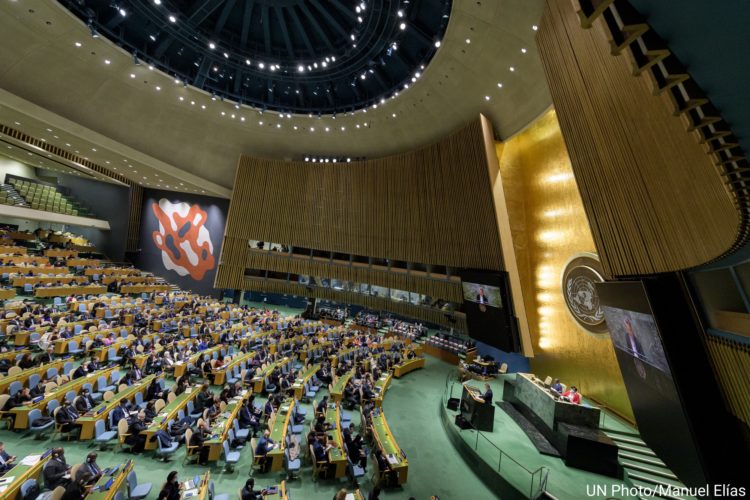
“Today is not the time nor the place for theatrics, or these kinds of extremely theatrical performances like the one presented by Ukraine. In fact, the draft resolution we are considering today has no relationship to the actual human rights situation on the ground,” the Russian Deputy Representative of the Russian Federation to the UN, Gennady Kuzmin, said before the vote was made.
Chinese Ambassador Zhang Jun warned that Thursday’s result will “set a new dangerous precedent, further intensify confrontation in the field of human rights, bringing a greater impact on the UN governance system, and produce serious consequences.”
He also said they “firmly oppose the politicization of human rights issues” and “double standards.” Note that China faces its own human rights crisis with its alleged treatment and massacre of the Uyghurs, which the United States declared genocide last year.
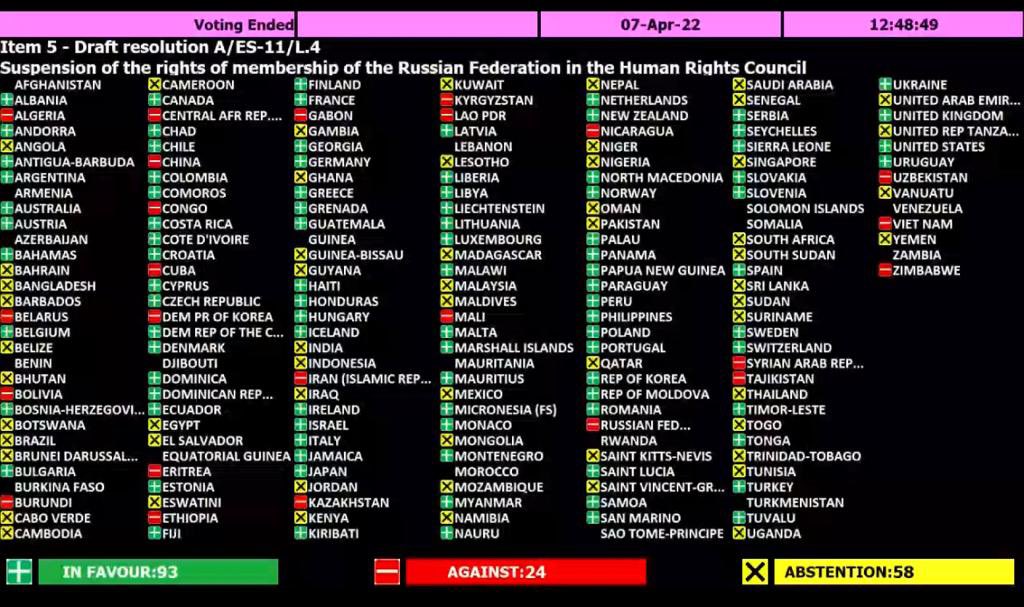
However, Thursday’s most striking figure was the 58 UN member states who opted to abstain from voting on the resolution. These include countries in Africa, the Middle East, and Asia.
Some abstainers, such as Singapore, explained that their decision was in support of the “independent, international commission of inquiry” launched by the Human Rights Council to investigate alleged human rights violations.
However, there are those like Saudi Arabia that fear that the suspension is an escalatory move and “a form of politicization of the work of the council… that gives certain [countries] more rights than others.”
Russia Leaves the Council
Kuzmin spoke after the suspension was adopted and suddenly announced that his country had already decided to leave the Council. The Russian representative claimed that the Council was being monopolized by a select group of states for their personal goals.
Some Russians made clumsy attempt to twist today’s stripping Moscow of HRC membership rights as if decision to leave Council was taken before the vote. Yet putin’s Geneva envoy’s letter of April 7 clearly reads “just adopted UNGA resolution”. Gatilov’s truth hits the wall of lies pic.twitter.com/wYMMJHGIkk
— Sergiy Kyslytsya 🇺🇦 (@SergiyKyslytsya) April 8, 2022
“These States for many years have directly been involved in blatant and massive violations of human rights or abetted those violations,” he said, speaking through an interpreter.
“In spite of their membership as members of the Council, they are not ready to sacrifice their short-term political and economic interests in favor of true cooperation and stabilizing the human rights situation in certain countries.”
The UN Human Rights Council
The Council, established in 2006, served as a replacement for the Commission on Human Rights that was founded in the aftermath of World War II. The commission fell into disarray as accusations of bias, abuse of power, and constant disagreements plagued the group.
The Human Rights Council was formed to address the issues of the commission. It has 47 members chosen by a regional collective of nations. Members of the Council are given a term of three years through the General Assembly. No member may serve more than two terms in a row.
Several meetings are held throughout the year to discuss matters on human rights and humanitarian law in coordination with the UN High Commissioner for Human Rights.
The last time a member was suspended from the Council was in 2011, when Libya and its then-leader
Muammar al-Qaddafi violently cracked down on anti-government sentiment in the country. The same provision was used in the resolution last Thursday.
Currently, Russia faces more human rights violations, war crimes, and crimes against humanity due to their recent bombing of the Kramatorsk Train Station in Donetsk. The attack has reportedly killed at least 50 people (and counting) who were evacuating the city due to fears of Russian bombardment in the coming days.








COMMENTS