

It took just five minutes to kill all terrorists inside the hall, and 10 minutes more to finish off those who managed to hide in nearby rooms. All terrorists, including female suicide bombers, were eliminated, but 67 civilians were killed during the assault, many from the Russian nerve gas, and 63 more died later in hospitals. Still, the fierce assault resulted in freeing more than 750 hostages.
The Beslan School Siege in North Ossetia, Russia, on September 1, 2004, was one of the most heroic and tragic incidents in the history of Alfa Group. On that day, 32 Chechen terrorists seized 1,128 hostages, mostly school children. On the third day of the siege, Alfa assaulted the school with explosives, and the terrorists began shooting at the hostages fleeing through holes blown in the walls.
The attack was bold and bloody, resulting in 314 civilians killed, including 186 innocent children. 31 terrorists were killed, and one was taken alive. Alfa lost 10 commandos, their largest casualty number in any one battle to date. They were later criticized for their reckless use of force, but President Putin defended them, stating that they had not planned on storming the school, and attacked only after the terrorists had begun executing children inside.
In the summer of 2006, the FSB, and accordingly Alfa Group, was given the legal power to engage in targeted killing of “terrorism suspects” overseas if ordered by the president, but since the FSB answers directly to Putin, only he decides who the “terrorism suspects” are. This is blanket authority kill anyone he deems a threat, anywhere.
Over the past 47 years, FSB Alfa troops have seen extensive, combat action in Afghanistan (1979 to 1989), the North Caucasus region (Chechnya, Dagestan, Ingushetia, Kabardino-Balkaria, North and South Ossetia, and other areas, from 1994 to 2017), Georgia (2008), Crimea (2014), Syria (2014 to 2025), and Ukraine (2014 to present).
An FSB source stated that the primary mission of their special units in Ukraine is to detect and neutralize enemy reconnaissance and sabotage groups. During August and September 2024, the FSB’s elite, Alfa and Vympel (“Pennant”) units, numbered at only 500 to 600 men combined, reportedly sustained, combat losses in the embattled, Kursk region, estimated at 100 men killed, wounded, or missing, so they are certainly seeing direct action, and taking substantial casualties as a result.

Alfa is an elite, counterterrorism force, with candidates aged 22 to 27, mostly college graduates. University education, physical and mental fitness, and high moral qualities are prerequisites for consideration. The selection process takes over a year, and once selected, the candidates undergo a rigorous, three-year training program that includes infantry training, parachuting, SCUBA diving, sniper operations, practical shooting, foreign language acquisition, martial arts, and studying terrorism in Russia and around the world. Operators are organized into groups of 12 specialists, divided into four teams.
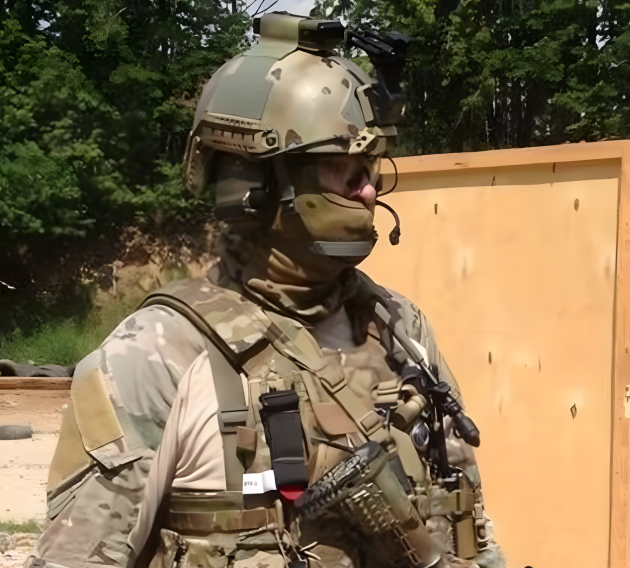
Alfa commandos have been seen wearing civilian clothes, black assault uniforms with black berets, or military camouflage uniforms, most recently the MultiCam pattern, with either black or brown boots. Now, let’s take a look at their primary weapons:
Assault rifles and carbines:
Alfa’s standard, assault carbine has been the compact, highly-customized, AK-105 series, with 12.4-inch barrel, in 5.45x39mm, often with Aimpoint (American) CompM4 optical sight, Armasight (American) Drakos laser aiming device, and Vector 5.45 VR-DTL flash hider. Newer options, since 2021, may include the AK-12K (11.4-inch barrel), especially in the brand-new, MultiCam finish, or the shorter, AK-12SC compact model (8.9-inch barrel.)
Special, integrally-suppressed AS or ASM Val (“Shaft”), or SR-3M Vikhr (“Whirlwind”) carbines in 9x39mm are in use for quieter operations. Some H&K (German) MR762 (HK417 version) rifles in .308 Winchester and Bushmaster (American) M4A3 carbines in 5.56x45mm NATO have seen limited use.


Service pistols:
The primary handgun of Alfa operators is the unlicensed, Russian copy of the Glock-17 or Glock-19, produced since 2012 by the Orsis factory in Moscow for half the price. These are clearly marked “Assembled in Russia” on the right side of the frame in English. Special-purpose pistols include the Stechkin APS (also issued to Russian fighter pilots) and OTs-33 Pernach (“Mace”) machine pistols, both in 9x18mm.
The brand-new, TochMash SR-2 Udav (“Boa”) is likely to become the next standard pistol. This advanced, polymer-framed handgun holds 18 rounds of 9x21mm ammunition, equivalent in power to a hot-loaded, 9x19mm +P cartridge at 1,300 feet-per-second velocity. SP-10 armor-piercing loads are the preferred, military round, and a spiral-pattern, carbon-fiber suppressor is optional.

Submachine guns (SMGs):
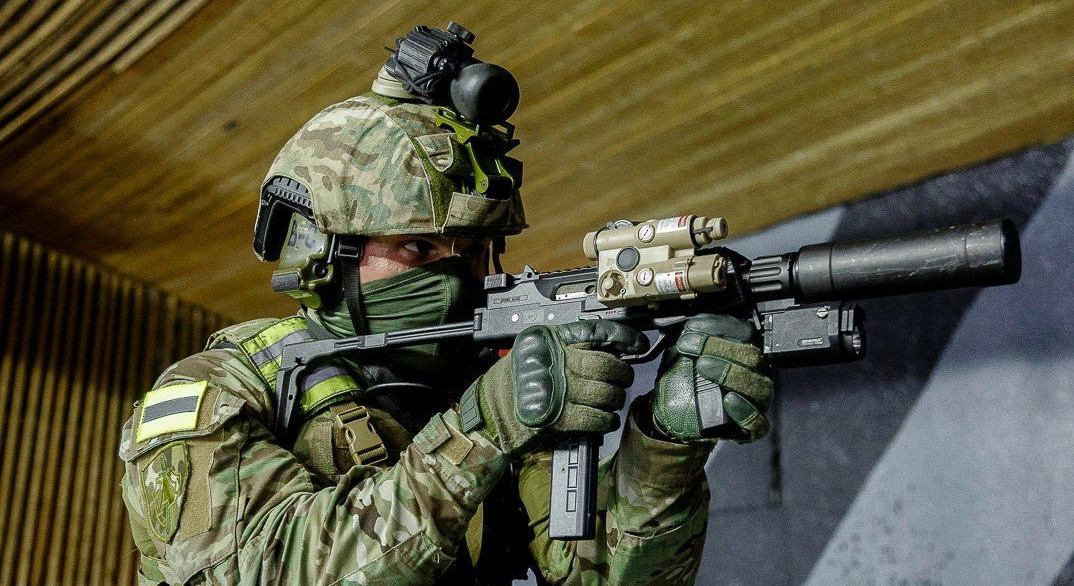
These include the PP-19-01 Vityaz-SN (“Knight-SN”), H&K MP5A3 variants, and suppressed, Brügger and Thomet (Swiss) MP9-Ns, with other accessories.
Infantry machine guns:
The PKP Pecheneg (named for an ancient, indigenous people of central Asia, living near the Black Sea) is the most-common, medium machine gun. These are often suppressed.
Sniper rifles:
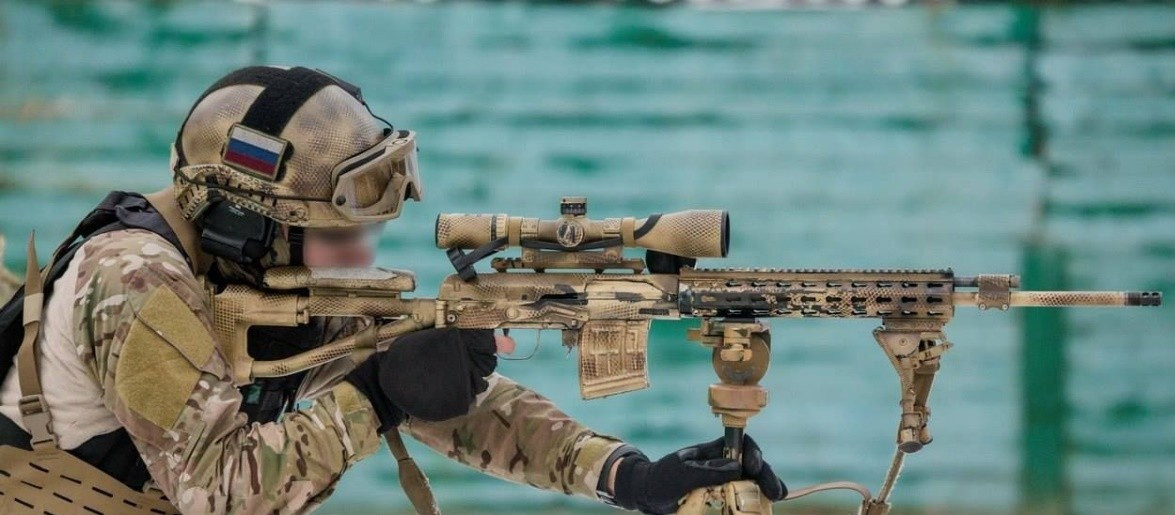
The classic, Dragunov SVDM (often camouflaged, in 7.62x54mmR) has been used until recently, possibly replaced by the new, semiautomatic Chukavin SVCh-7.62 in the same caliber, although other versions are also produced. The SV-98M in 7.62x54mmR, with suppressor, is also employed. The suppressed VSS Vintorez (from the Russian acronym for “Special Sniper Rifle”) is used for quiet operations. Other sniper weapons include the Accuracy International (British) AWM in .338 Lapua Magnum, and some H&K MR308 (civilian version of the HK417) rifles in .308 Winchester.
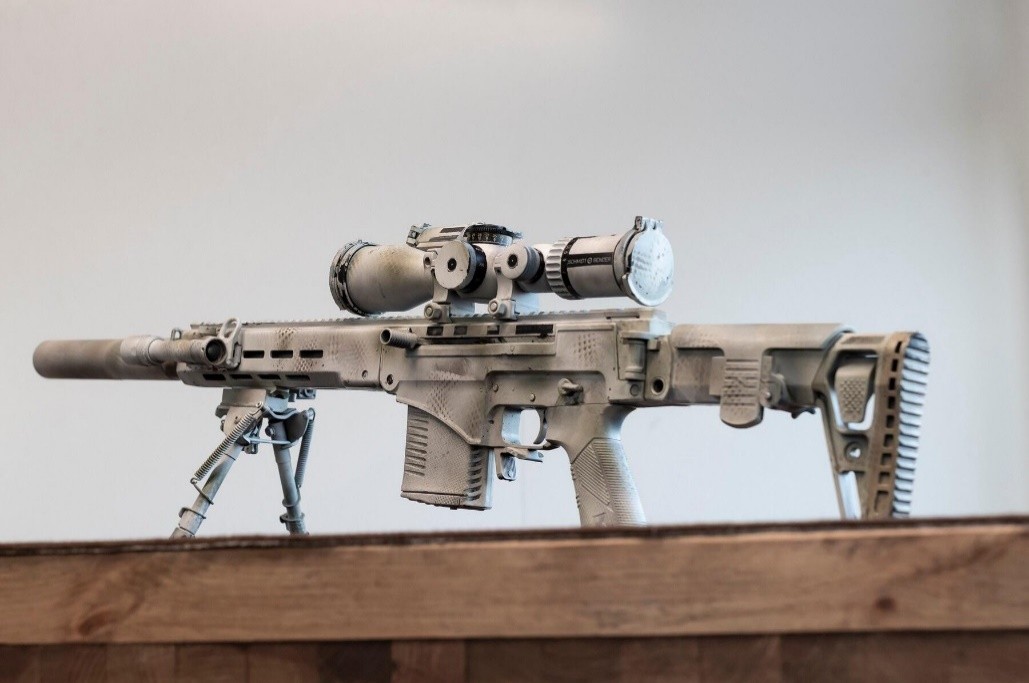
More-recent, Russian selections for Alfa are the highly-accurate, bolt-action, Orsis T-5000M “Terminator,” and the all-new, Lobaev SVL-1 Urbana-L in .308 Winchester, or the integrally-suppressed, Lobaev SVL-2 Antimatter-L in .300 Winchester Magnum or .338 Lapua Magnum.
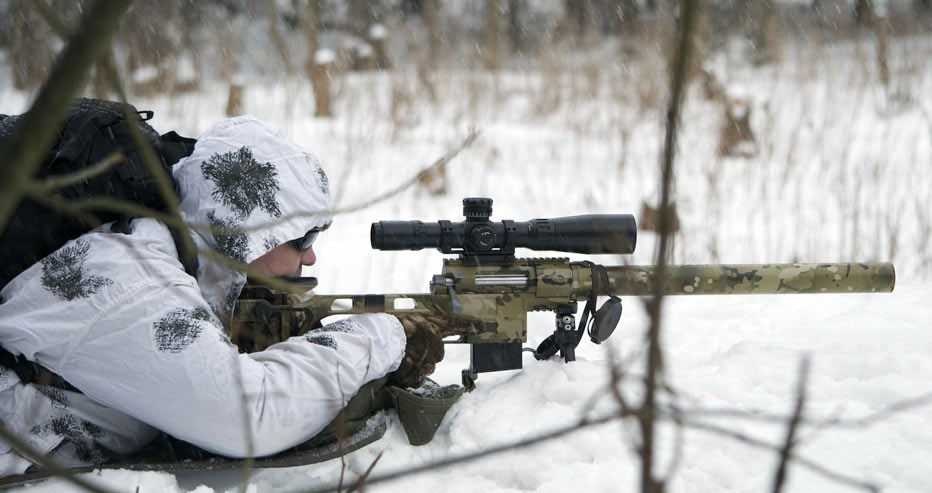
Combat knives:
Many Russian Special Forces men and Alfa commandos privately purchase fighting knives from Kizlyar Supreme, handcrafted in the Russian Republic of Dagestan, which was a war-torn region in 1999. Favorite knives include the Kizlyar DV-2 (an abbreviation for “Far East-2,” $270) Bowie-style, Voron-3 (“Raven-3,” $89), Korshun (“Kite,” the bird, $210), and the Kizlyar Alpha Knife ($142).
The superb, high-quality, American-designed, German-produced, Böker Applegate-Fairbairn combat dagger ($340) with six-inch blade has also been observed and photographed among the personal weapons of Alfa commandos.

Other equipment:
In October 2014, FSB Alfa operators were photographed at a shooting championship match wearing RBR (British) Mk. II helmets with Armytex helmet covers, Peltor ComTac XP communication headsets, Fort Gladiator (Russian) ballistic vests with pouches, Slavyanka (Russian) Gen. 3 MultiCam uniforms, Blackhawk (American) tactical holsters for Glock-17 pistols, and HWI (American) HKTG tactical gloves.
They use Arbalet-2 (“Crossbow-2”) or Malva-24 freefall parachutes. The latest field equipment includes the LPR-3 laser rangefinder, Garmin (American) GPS units, R-187-P1E Azart (“Excitement”) handheld, combat radio, and KRUS Strelets (“Shooter”) tactical field computers.
Combat vehicles:
The unofficial, standard vehicle of Russian Special Forces and Alfa is probably the GAZ Tigr-M (“Tiger-M”) utility vehicle, very much like an American Humvee. They’ve also been seen driving a Russian-made copy of the high-quality, Iveco (Italian) LMV “Lynx.” The UAMZ Toros (“Hummock”) 4×4 vehicle and Eskadron (“Squadron”) fast-attack vehicle were recently offered to Russian Special Forces.

The ongoing war in Ukraine currently serves as a testing-and-development opportunity for modern, Russian weapons designs, which will certainly guarantee that the rapid pace of arms development continues. Meanwhile, elite, FSB Alfa commandos continue to operate wherever President Vladimir Putin perceives a threat to Russian national security, which certainly includes embattled Ukraine at the present time.








COMMENTS