
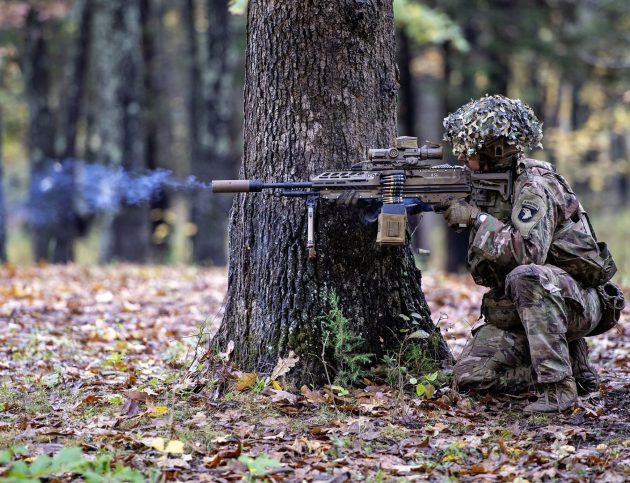
Somewhere between the clack of disintegrating links and the sharp bite of spent powder hanging in the air, the Army ran into a reality every grunt learns the hard way. “Good enough” dies fast when the other guy is armored, dug in, and shooting from a distance you used to call long range. The squad automatic weapon (SAW) has to do more than make noise and throw brass. It has to reach farther, hit harder, and keep the enemy pinned down long enough for the squad to move and finish the fight.
That reality is the backdrop for the M250, SIG Sauer’s new(ish) belt-fed automatic rifle, fielded to initial units under the Army’s Next Generation Squad Weapon (NGSW) program. NGSW is not about incremental tweaks. It is about changing what a squad carries, how far it reaches, and how hard it hits bad guys.
Recognizing a Need
The M249 Squad Automatic Weapon has been the squad’s mechanical insurance policy for decades. It is a Portable base of fire, with controllable bursts, and enough sustained output to let maneuvers happen. Officially, it fills the automatic rifle role in infantry squads, with effective fire out to 600 meters on point targets, 800 meters on area targets, and suppressive fire to 1,000 meters.
The problem is not that the M249 stopped working. The problem is that the battlefield shifted.
Modern peer and near-peer threats operate at longer distances and increasingly assume body armor as a baseline. The Army’s own language around NGSW makes this clear.
The system is designed to defeat protected and unprotected targets at the squad level, improving hit probability and lethality against dismounted personnel and small units, including those wearing modern armor.
That is the “why.” Now comes the “what.”
The M250 Program Context: NGSW Is a System, Not a Lone Weapon
It is tempting to talk about the M250 as if it arrived from the heavens fully formed, divorced from the rest of the Army’s numerous modernization efforts. It did not.
In April 2022, the Army awarded SIG Sauer a 10-year production contract covering the rifle, originally announced as the XM5, later redesignated XM7, and now type-classified as the M7, along with the XM250, now the M250, and a common 6.8×51mm cartridge family. That contract followed more than two years of prototyping, testing, and evaluation.
NGSW was always conceived as a system. It pairs the M7 rifle and M250 automatic rifle with common ammunition and the XM157 fire control optic, mounted on both weapons. The optic integrates variable magnification, a laser rangefinder, a ballistic calculator, atmospheric sensors, a compass, visible- and infrared-aiming lasers, and a digital display overlay. Some really high-speed stuff.
This matters. The M250 is not a stand-alone replacement you drop into yesterday’s tactics and call it progress.
It is the squad’s belt-fed sledgehammer, anchored to a modern kill chain where the gun, the optic, and the ammo all work as one.
Meet the M250
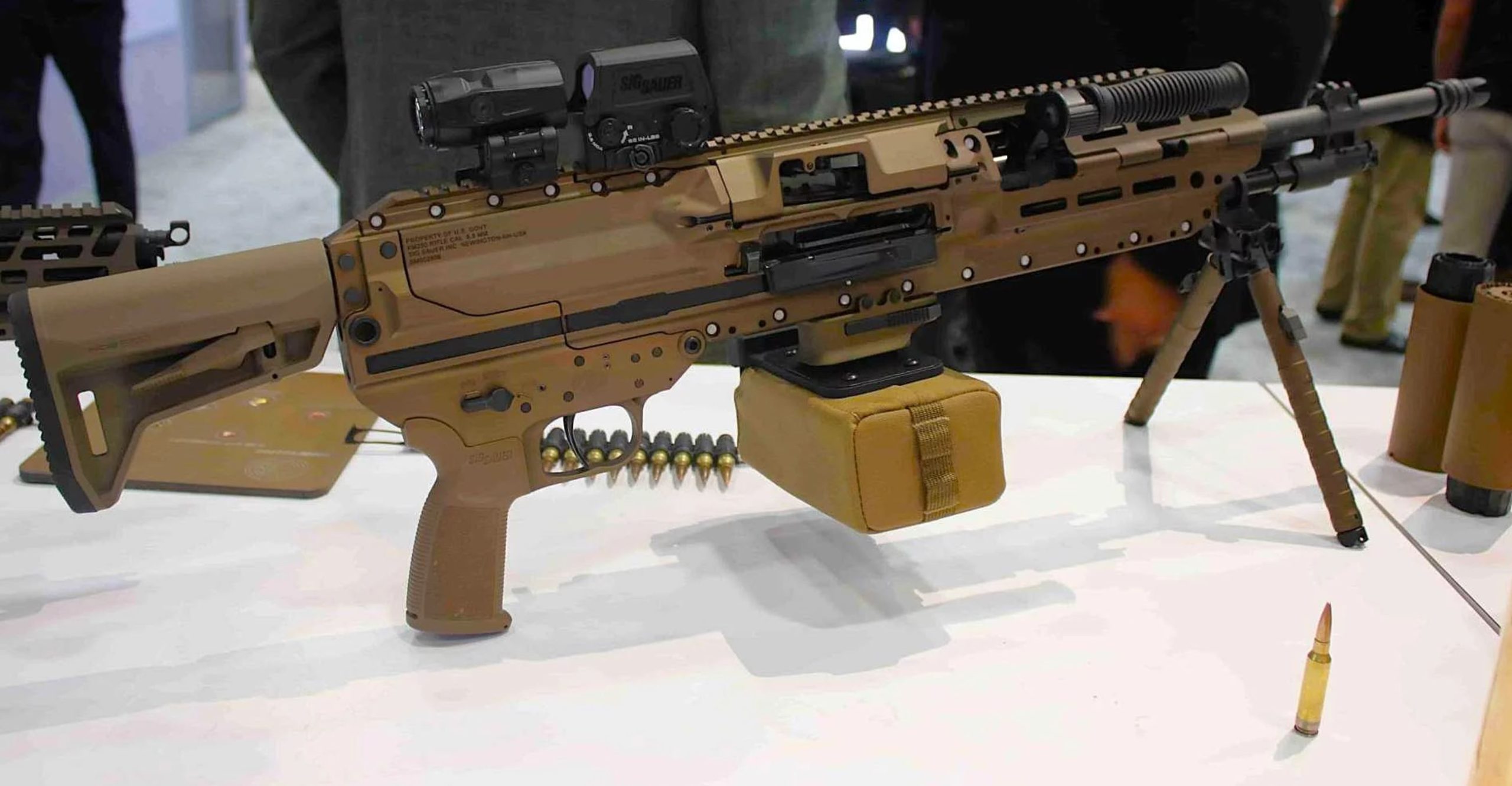
According to the Army’s Program Executive Office Soldier (or PEO Soldier), the M250 is a lightweight, belt-fed, select-fire 6.8mm light machine gun (LMG). It features fully ambidextrous controls, a collapsible buttstock, M-LOK mounting points, and an internal recoil mitigation system.
One design choice stands out, and it reflects deliberate engineering priorities. The M250 was built from the start to be run suppressed. It is issued with a quick-detach suppressor optimized to reduce sound and visible flash while also cutting gas flow back into the receiver. That is not marketing copy. It is lifted directly from the Army’s own program description.
Published specifications list the M250 at roughly 13 pounds, or 14.5 pounds with suppressor, with a 17.5-inch barrel and overall length just under 37 inches unsuppressed. Official effective range figures are still listed as to be determined, which tells you the Army is still refining doctrine and employment rather than rushing to print tidy numbers.
M250 vs. M249: The Differences That Matter
The real comparison is not about nostalgia or internet arguments. It is about capability.
First, this is a different cartridge class, not a minor tweak. The M249 fires 5.56mm. The M250 fires 6.8×51mm, the round the Army is betting on for modern overmatch. This cartridge family occupies the same performance space as the .277 SIG FURY, which was standardized at extremely high pressures to deliver velocity and energy well beyond legacy small-arms rounds.
Second, weight savings count. A standard M249 weighs about 18 pounds. The M250 sheds roughly five pounds even with its suppressor attached. That difference becomes real halfway through a patrol, after the first sprint, or on the second climb of the day when your legs are burning and you just want to take a knee.
Third, the M250 is designed around signature management. Suppression is not an add-on. It is a baseline assumption, paired with reduced flash and better gas handling from the get-go.
Fourth, modern ergonomics are baked in. Fully ambidextrous controls and recoil mitigation are not marketing checkboxes. They reflect a weapon intended to be run hard, by tired people, in unforgiving environments.
From “X” to “M”: Where the M250 Stands Now
The Army does not hand out full “M” designations lightly. In 2025, the NGSW rifle and automatic rifle officially became the M7 and M250, reflecting that the system met Army standards tied to performance and safety. That milestone came after the program worked through early challenges, including fume mitigation issues, on its path to type classification.
This is not vaporware. In 2024, a brigade from the 101st Airborne Division became the first unit to receive the NGSW set, including the M250, marking the beginning of initial operational fielding.
The takeaway is simple. The SIG M250 is not a nostalgia piece, nor is it a cosmetic update.
It is a purpose-built answer to the same brutal question the SAW has always tried to solve: how to give a squad enough controlled violence to move and win.
This time, it was engineered for the next fight, not the last one.








COMMENTS