
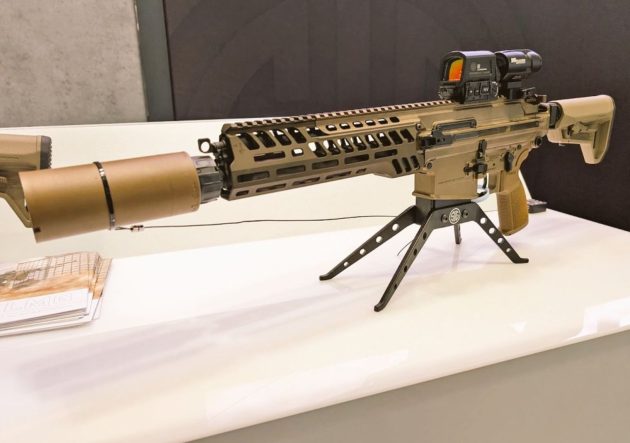
When the M7 first hit troop hands, it carried the swagger of a next-generation weapon system (NGWS) backed by a powerful new cartridge and purpose-built fire control. What soldiers noticed first, though, was something simpler. The rifle felt heavier than expected. Early configurations sat at about 8.38 pounds unloaded and roughly 9.84 pounds with its suppressor installed, and that was before adding an optic, laser, and a loaded magazine. For infantry already working at the edge of their load capacity, the M7 arrived with potential and a few rough edges.
Those early complaints opened the door to a redesign. What followed is a case study in a service rifle treated as a living system, shaped by real conversations between the soldiers who carry it and the engineers who build it.
A New Rifle Meets the Real World
The M7 grew out of the Army’s Next Generation Squad Weapon program, a multi-year effort to push range, energy on target, and visual and thermal signature reduction forward in a single package. The weapon delivered the power of the 6.8 by 51 round and worked well in Army testing with the XM157 fire control system designed for modern close combat. None of that erased the practical truth that soldiers were hauling a heavier rifle through buildings, onto aircraft, and across long approaches in full kit.
Some soldiers felt the rifle was nose-heavy. Others raised endurance concerns after hours of holding it at the ready. A detailed officer report from within the 101st Airborne documented accelerated barrel wear and some component issues in early test rifles under heavy use. These were not program-ending flaws. They were symptoms of an ambitious system stepping into the unforgiving rhythms of daily infantry work.
More importantly, they provided SIG Sauer and Army program managers with a clear set of opportunities to refine the weapon.
The Value of Touch Points
Central to the NGSW effort were structured Soldier Touch Points. These were not some polite product demonstrations set up for the public. Infantry, cavalry scouts, and special operations soldiers were encouraged to run the weapon hard, break parts if necessary, and provide direct feedback to engineers and program officials. Soldiers highlighted areas where the rifle excelled and pinpointed where it needed refinement. That information flowed back into the design cycle in a way that mirrored how earlier service rifles matured under real-world pressure.
In its early days, the M16 struggled in the jungles of Vietnam before later iterations solved reliability shortcomings. The M4 family improved incrementally for decades, shaped by input from soldiers deploying to Iraq and Afghanistan. The M7 followed that same lineage. It was never treated as a fixed object but as something that would earn its final form after enough hands had carried it, shot it, and pushed back on its weak points.
Enter the Lighter M7
The result was a focused Product Improvement Effort aimed at the rifle’s most consistent point of criticism. Weight reduction became the priority. SIG’s engineering team reprofiled the barrel, lightened internal components, and introduced a revised upper receiver. A compact carbine version with a barrel in the 10 to 10.5-inch range showed how far the platform could shrink while preserving performance. Soldiers had noted that the folding stock hinge added weight without meaningful benefit in most roles, so SIG produced versions without it. The suppressor was updated to manage heat and signature more effectively while trimming mass.
In the carbine configuration SIG displayed at the latest Defense and Security Equipment International show, these changes dropped the rifle to roughly 7.5 pounds unloaded with suppressor and no optic. Official specifications from recent Army briefings list around 7.6 pounds for the enhanced rifle with a 13.5-inch barrel and about 7.3 pounds for the carbine version, both unloaded and without suppressors. Those numbers mark a substantial improvement over the original suppressor-equipped weapon.
The point is not only that the rifle became lighter. It is that the weapon evolved in direct response to field use and that SIG treated soldier input as a design requirement rather than a problem to be dismissed.
What Two Pounds Mean in the Field
Two pounds on a packing list looks like nothing. Two pounds on a rifle that a soldier carries for a twelve-hour patrol is a different reality. Weight closer to the muzzle affects how quickly a shooter can transition between targets. It shapes how steady they remain in unsupported positions. It determines how quickly fatigue sets in while navigating obstacles, climbing into a vehicle, or clearing a multi-story structure in full kit.
A lighter weapon also offsets the heavier 6.8 ammunition and the smaller 20-round magazines required for it. Combine those factors, and you get a rifle that feels more responsive in the hands of the people who rely on it for survival. The improved M7 preserves the extended reach and punch that drove its adoption, but today it handles more like a rifle tailored for the day-to-day tempo of modern dismounted operations.
A System That Learns
The M7’s evolution shows what can happen when feedback loops remain open. Soldiers raised honest concerns. Engineers addressed them. The weapon that emerges is stronger because it went through that process.
The SIG Sauer M7 is no longer the problem child some early users described. It has become a more balanced instrument shaped by thousands of hours of real-world use and a willingness from its designers to refine the rifle without ego.
What comes next will depend on that ongoing cycle of use, critique, and iteration carried out by the people who know the rifle best.








COMMENTS