

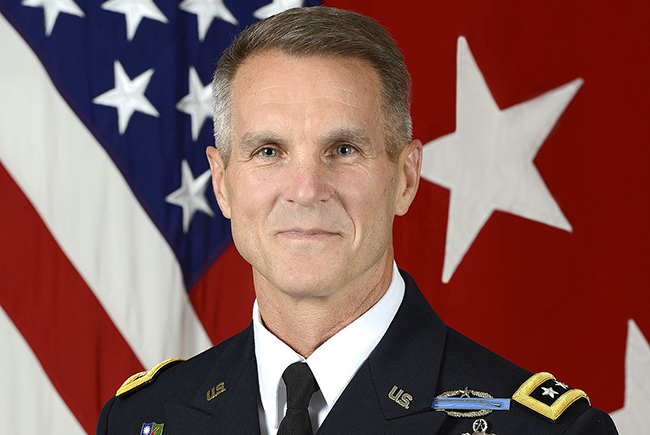
Clarke was also asked about the situation within the SOCOM community. Last year, a stand-down was ordered to conduct a comprehensive review of what causes reports of violence, drug use, other criminal behavior, and misconduct within the SOCOM community. Clarke said the review produced 16 recommendations that “focus on over-employment” which led to a “detriment of leadership and accountability.”
He added that the high operating tempo, reduction of training and assessment time, and fewer opportunities for leadership development contributed to the breakdown of behavior and ethics.
“It’s about engaged leadership,” Clarke said.
As a result, deployments among U.S. Special Operations Forces are down to their lowest levels since 2001 before the 9/11 attacks. Clarke said that about 5,000 SOCOM personnel are deployed today in 62 countries, down about 15 percent from last year and the smallest number since 2001.
Clarke touched on other issues, including the “Armed Overwatch” aircraft for SOCOM operations in austere environments. Currently, the command looks to replace the U-28 Draco unarmed aircraft with an airframe to provide sustainable support to activities fighting terrorist organizations. SOCOM is seeking 75 armed overwatch aircraft to support special operators.
“In many remote areas, intelligence, surveillance, reconnaissance, and close air support assets are stretched thin and come at a high cost,” he said. “We continue to work with DoD to address this issue.”
Clarke told lawmakers that SOCOM has shifted 40 percent of its manpower to address the great power competition with Russia and China. He added that SOCOM is standing up a Special Operations task force to counter Chinese disinformation operations in the Indo-Pacific. “China works very well in that space,” he said. The idea behind the task force “is to tamp down some of the disinformation.”
He stressed that the command needs to modernize its precision strike, ISR, data collection, and analysis capabilities “to see and sense the battlefield.” Electronic warfare efforts need to better protect U.S. SOF operators, he added.
Acting Assistant Defense Secretary for Special Operations Christopher Maier told lawmakers that the Biden administration is reviewing the new special operations and low-intensity conflict stand-alone organization. Under the new structure, SOCOM’s service-like secretary reports directly to the secretary of defense. This was implemented by the Trump administration’s Acting Secretary of Defense Christopher Miller following Congress’s directive as part of the 2017 NDAA.
Maier added that there are now 40 persons assigned to the proposed SOCOM secretariat, but “at this point, it is not at the point of irreversible momentum.” His comments fall in line with reports that the administration is considering reversing the move.








COMMENTS