

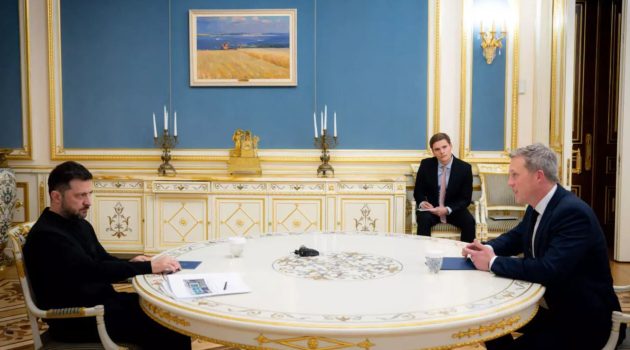
The plan itself has ignited a firestorm across Europe and inside Ukraine. It reportedly requires Kyiv to surrender sovereignty over Crimea and parts of the Donbas and to freeze the current contact lines everywhere else. It also calls for a major reduction in Ukraine’s military capability and a permanent rejection of NATO membership. In return, Ukraine would receive security guarantees from the United States and key European powers, demilitarized zones, the lifting of sanctions on Russia, and vague promises of renewed European integration.
The proposal also includes amnesty for Russian personnel accused of war crimes and official status for the Russian language inside Ukraine.
Secretary of State Marco Rubio headed the American delegation. German, French, and British envoys added their voices as partners and critics. Russia stayed out of the Geneva round but will re-enter the process in follow-up sessions. European leaders offered cautious support, describing the plan as a possible starting point while warning that it echoes too many Russian demands. The European Union reminded participants that borders cannot be changed through force. Leaders in Berlin, Paris, and London emphasized that significant revisions and stronger guarantees would be required before they could urge Ukraine to accept the deal.
Inside the negotiating rooms, the pressure is unmistakable. Ukraine faces a choice between continued total war and a peace that carries political and moral risks. Zelensky warned that any agreement must protect the dignity and independence of the nation. He understands the exhaustion felt across Ukraine, but he also sees the long shadow cast by concessions that could fracture the country’s political landscape.
The next several days will determine whether this proposal becomes a turning point or another failed attempt to end the war. Trump and Zelensky are set to see the final version before Thursday. The path to peace remains open, but it is narrow, and every step carries consequences that will shape Europe for years to come.
European leaders push back on US plan to end war in Ukraine, hope to amend it at a Sunday meeting in Geneva https://t.co/60M5QQK77K pic.twitter.com/Ps8MeTvKnn
— New York Post (@nypost) November 22, 2025
A Grizzly in the Trees: Bella Coola Teachers Stand Between Children and a Charging Bear
Bella Coola, British Columbia, woke up on November 20 to a nightmare that no parent or teacher ever wants to imagine. A grizzly bear charged a group of fourth and fifth-graders from Acwsalcta School during a field trip, turning a quiet moment on a forest trail into a sudden fight for survival. The school, operated by the Nuxalk Nation, had taken roughly twenty students into a valley near town when the bear crashed out of the treeline and ran straight at them.
The attack left eleven people injured, including teachers and students, and two of those victims were in critical condition by nightfall. What kept this from becoming a mass casualty event were the teachers who instantly placed themselves between the children and a several-hundred-pound predator. They hit the bear with spray and set off bear bangers, desperately trying to push the animal back. One male teacher took the brunt of the attack. He was mauled so severely that he had to be airlifted out, and two others suffered major injuries while refusing to abandon the kids in their care.
A parent later said her ten-year-old son, Alvarez, was close enough to feel the bear’s fur brush his body as it surged past him. The bear wasn’t targeting him, but that detail only adds weight to how fast and chaotic the attack unfolded. During the melee, several children were accidentally hit with bear spray themselves, but those painful moments were collateral damage in an effort that likely saved lives.
Authorities described the bear’s behavior as highly unusual, possibly triggered by an old injury. What made the situation worse was that the bear slipped back into the forest and vanished. Conservation officers and police mobilized with rifles, dogs, and tracking teams while residents were warned to stay inside and avoid a nearby highway. The British Columbia Conservation Officer Service made it clear: this bear remained a serious threat.
The attack renewed debate about how communities in the province manage the uneasy balance between people and wildlife. Some officials drew a line back to the 2017 ban on grizzly hunting, arguing that more bears have become comfortable around humans and more willing to test boundaries. The Nuxalk Nation called for better safety planning and deeper cooperation to prevent anything like this from happening again.
Acwsalcta School closed the next day as families and staff tried to absorb what happened. In a place where the community runs deep, there is no doubt the teachers’ actions prevented a tragedy on a far larger scale. Their courage turned the tide in a moment when the only thing standing between children and a charging grizzly was them.
⚠️WARNING: This post describes a violent animal attack involving children.
A “devastated” grandmother has shared photos of her granddaughter, who required 100 stitches after being mauled by a grizzly bear during a school trip in Bella Coola, British Columbia.
The attack… pic.twitter.com/Ij7mIqdHhq
— True Crime Updates (@TrueCrimeUpdat) November 21, 2025








COMMENTS