

The price cuts, part of a Medicare negotiation program established under the 2022 Inflation Reduction Act, are projected to save the government about $8.5 billion annually once they take effect in 2027.
US Health Secretary Robert F. Kennedy Jr. said the deals reflect the administration’s effort to make health care more affordable for seniors.
🚨 𝐌𝐞𝐝𝐢𝐜𝐚𝐫𝐞 𝐒𝐥𝐚𝐬𝐡𝐞𝐬 𝐏𝐫𝐢𝐜𝐞𝐬 𝐟𝐨𝐫 𝟏𝟓 𝐏𝐫𝐞𝐬𝐜𝐫𝐢𝐩𝐭𝐢𝐨𝐧 𝐃𝐫𝐮𝐠𝐬
The latest price cuts amount to $12 billion in savings, according to the Centers for Medicare & Medicaid Services.
Read here:https://t.co/7qgpsVpihO pic.twitter.com/uQZ6YyTn9V
— The Epoch Times (@EpochTimes) November 26, 2025
The latest round covers drugs treating diabetes, asthma, arthritis, and cancer, including popular GLP-1 medications Ozempic, Rybelsus, and Wegovy. The combined total of negotiated drugs now stands at 25. Medicare beneficiaries’ out-of-pocket costs will vary by plan, though new rules cap annual expenses at $2,000.
Officials said the program’s second year achieved deeper discounts than the initial round launched under the Biden administration. Pharmaceutical companies continue to challenge the law in court, arguing it stifles innovation.
Meanwhile, the Trump administration is piloting expanded Medicare coverage for obesity-related GLP-1 drugs and plans to negotiate prices for another 15 medications next year.
US Forces Japan Halts Solo Military Police Patrols After Viral Video Shows Civilian Detained in Okinawa
US Forces Japan (USFJ) has suspended unilateral military police patrols in Okinawa pending an investigation into a viral video showing US officers forcefully detaining an American civilian outside a bar near Kadena Air Base.
The footage, shared on social media Sunday, shows officers slamming Kareem Farrakhan El, a former Marine captain visiting Okinaw, to the ground and attempting to handcuff him as he protested their actions.
USFJ spokesman Colonel John Severns said Wednesday that Lieutenant General Stephen Jost, the USFJ commander, ordered the investigation and retraining of patrol members. He confirmed the civilian was not affiliated with the US military.

The incident occurred during one of the patrols, which had been operating independently since September to enforce an off-base alcohol curfew.
Under the US-Japan Status of Forces Agreement, US military police have no jurisdiction over Japanese civilians or residents unaffiliated with the military.
The incident has sparked widespread criticism online and renewed scrutiny of US policing practices in Okinawa, where public sensitivity to American military conduct remains high.
House Panel Calls Anthropic CEO to Testify on Chinese AI-Driven Cyberattack Using Claude Code
The House Homeland Security Committee has invited Anthropic CEO Dario Amodei to testify on December 17 about how Chinese state actors allegedly used the company’s Claude Code AI model in a major cyber-espionage campaign—the first known instance of an artificial intelligence (AI)-orchestrated cyberattack.
Committee Chair Andrew Garbarino (R-N.Y.) also called on Google Cloud CEO Thomas Kurian and Quantum Xchange CEO Eddy Zervigon to appear at the same hearing on the future of AI and cybersecurity.
Lawmakers say the hearing will explore how adversaries could use AI tools for autonomous cyber operations and how industry and government can respond at “machine speed.”
Garbarino warned that foreign adversaries’ use of commercial AI for near-fully automated hacking “should concern every sector of critical infrastructure.”
We disrupted a highly sophisticated AI-led espionage campaign.
The attack targeted large tech companies, financial institutions, chemical manufacturing companies, and government agencies. We assess with high confidence that the threat actor was a Chinese state-sponsored group.
— Anthropic (@AnthropicAI) November 13, 2025
The panel also plans to examine how cloud providers and quantum-security firms are adapting to defend against emerging AI-enabled threats.
Executives have until December 3 to confirm their participation.
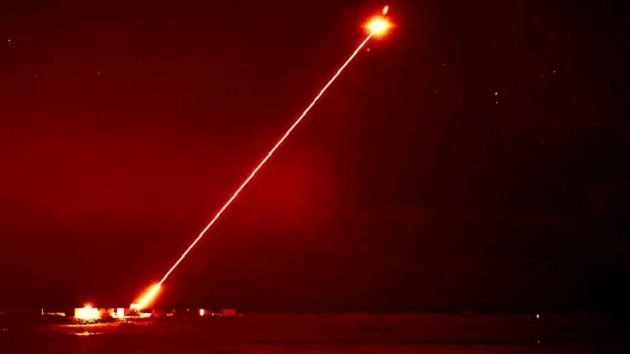
UK Tests DragonFire Laser Weapon, Shoots Down High-Speed Drones in Breakthrough Trial
The United Kingdom Ministry of Defence successfully tested its DragonFire laser weapon in Scotland, destroying drones flying at 650 kilometers per hour (403 mph) in what officials called a major step toward integrating directed-energy systems into the military.
The test at the MOD Hebrides range marked one of Europe’s most advanced demonstrations of laser-based air defense technology.
The ministry also awarded a £316 million ($413 million) contract to MBDA to install DragonFire on Royal Navy Type 45 destroyers. Each shot from the system costs about £10 and can hit a target the size of a £1 coin from a kilometer away, offering a cheaper and faster alternative to missile-based interceptors.
DragonFire is a laser directed energy weapon designed and built entirely in the UK.
It can hit a target the size of a £1 coin from a kilometre away, costs only £10 a shot, and just successfully took down a high-speed drone during testing.
Read more ➡️ https://t.co/Am3bp03VYq pic.twitter.com/Edc0lFnCKG
— Ministry of Defence 🇬🇧 (@DefenceHQ) November 20, 2025
Developed as part of NATO’s push into directed-energy defense, DragonFire uses concentrated light to burn through targets at the speed of light.
The UK joins countries such as Israel, Germany, and China in deploying or developing similar systems as drone and missile threats rise globally. The US continues to invest heavily in the technology, with more than $1 billion in annual funding for laser and microwave defense programs.
Kremlin Confirms Upcoming US Envoy Visit as Ukraine Peace Talks Gain Momentum
The Kremlin confirmed Wednesday that US special envoy Steve Witkoff will visit Moscow next week as diplomatic efforts accelerate to end the nearly four-year war between Russia and Ukraine.
Russian President Vladimir Putin’s foreign policy adviser, Yuri Ushakov, said Moscow has not officially received Washington’s peace proposal but has reviewed a version obtained through informal channels. Talks involving US, Russian, and Ukrainian representatives were held earlier this week in the United Arab Emirates.
Ushakov and Kremlin spokesman Dmitry Peskov both cautioned against overstating progress, with Peskov saying it is “too early” to suggest a peace deal is near.
Russian presidential aide confirms expected US visit next week:
◼️ ‘I can say a preliminary agreement has been reached that (US presidential envoy Steve Witkoff) will come to Moscow next week’
◼️ ‘He and a number of other representatives of the (US) administration who are… pic.twitter.com/62lsPG08a0
— Anadolu English (@anadoluagency) November 26, 2025
The proposal, initially seen as favorable to Russia, has been revised following US-Ukrainian discussions in Geneva.
Ukrainian President Volodymyr Zelenskyy described the plan as potentially “workable” and hopes to meet with US President Donald Trump soon.
Meanwhile, Russian drones struck the Ukrainian city of Zaporizhzhia overnight, wounding at least 19 people, while Ukraine claimed a successful strike on a Russian missile equipment plant.
At least 19 people were injured and residents evacuated homes after Russian drone strikes hit Zaporizhzhia, Ukraine, damaging shops and dozens of buildings https://t.co/HNwixjrP7o pic.twitter.com/SpvS9TwE3S
— Reuters (@Reuters) November 26, 2025
In Europe, leaders voiced growing unease over being sidelined in peace negotiations, with German Chancellor Friedrich Merz and European Commission President Ursula von der Leyen insisting that any deal must secure Ukraine’s independence and defense capabilities.
European Union foreign policy chief Kaja Kallas added that Russia has shown “zero indication” it is ready for a genuine ceasefire.
Israel Returns 15 Palestinian Bodies as Ceasefire Holds Amid Fresh Violence in Gaza and West Bank
Israel handed over the bodies of 15 Palestinians on Wednesday, a day after Hamas returned the remains of Israeli hostage Dror Or, as part of a US-brokered ceasefire that remains fragile amid continued clashes in Gaza and the West Bank.
Two hostages, including one Israeli and one Thai national, remain unreturned.
Mediators from Turkey, Qatar, and Egypt met in Cairo to plan the next phase of the ceasefire, which includes forming an international stabilization force to disarm Hamas and a UN-mandated authority to oversee Gaza’s reconstruction.
🚨 Israel returns remains of 15 more Palestinian prisoners to Gaza, bringing total handed over since Oct. 10 ceasefire to 345, Health Ministry says
⚰️ Many bodies show signs of abuse and were transferred without documentation https://t.co/CDH9CbJPsC pic.twitter.com/5ZeeTKwV4H
— Anadolu English (@anadoluagency) November 26, 2025
In Gaza, Israeli forces carried out airstrikes and raids that killed several suspected militants, while local hospitals reported at least one civilian death from Israeli fire in central Gaza. The Gaza Health Ministry said 69,775 Palestinians have been killed since the war began, including 345 since the truce took effect.
Meanwhile, Israeli forces launched a large-scale counterterrorism operation in the West Bank’s Tubas governorate, using helicopters and airstrikes to target what they called “terror infrastructures.”
The Israel Defense Forces and Shin Bet stated that the operation involved airstrikes, ground troops, and Border Police units to dismantle terror infrastructure seeking to gain a presence in the area.
Palestinian officials condemned the action as a step toward annexation.
Israeli forces launched a major operation in the occupied West Bank, hitting Tubas and nearby towns with helicopters, bulldozers and heavy troop deployments ⤵️
Israel has escalated West Bank violence since October 2023, killing more than 1,082 Palestinians and injuring nearly… pic.twitter.com/9mo58f0NJN
— Anadolu English (@anadoluagency) November 26, 2025
Rising settler violence and recent deadly attacks have fueled fears that the unrest could undermine the ceasefire.
As regional diplomacy continues, Indonesia confirmed preparations to deploy peacekeepers to Gaza under the proposed international force, and Pope Leo XIV announced his first foreign trip to Turkey and Lebanon following renewed Israeli strikes on Hezbollah targets in Beirut.
Military Seizes Power in Guinea-Bissau After Contested Election, President Arrested
Soldiers in Guinea-Bissau announced on state television Wednesday that they had overthrown President Umaro Sissoco Embaló, suspended all government institutions, and closed the country’s borders.
The declaration followed heavy gunfire near the presidential palace and came three days after national elections in which both Embaló and opposition candidate Fernando Dias da Costa claimed victory before results were released.
A military spokesperson, Dinis N’Tchama, said the coup was triggered by an alleged plot to manipulate election results involving politicians, a drug trafficker, and foreign nationals.
Embaló told French media he had been deposed and detained by the army chief of staff but was not mistreated.
⚡️ Ousted Guinea-Bissau president was plotting to ‘DESTABILIZE’ the country — military
President Embalo’s plan supposedly involved ‘a well-known national and foreign DRUG BARON’
Brigadier General Denis N’Canha decided to ‘immediately depose’ him https://t.co/I2BNpPvr0G pic.twitter.com/xaFr4nPSeQ
— RT (@RT_com) November 26, 2025
The military also halted media operations and suspended the electoral process.
The coup adds to a series of recent military takeovers across West Africa.
Guinea-Bissau, long a hub for drug trafficking, has faced chronic instability since independence, with four previous coups and multiple failed attempts.
Embaló, who came to power in 2020, had faced a legitimacy dispute after opposition groups claimed his term expired earlier this year.
Myanmar Junta Grants Amnesty to Thousands Ahead of Election, Unclear if Suu Kyi Included
Myanmar’s military government announced Wednesday that it has granted amnesty to more than 3,000 political prisoners and dropped charges against over 5,500 others ahead of next month’s national election.
State media said the move aims to ensure “eligible voters” can participate freely in the December 28 vote.
Authorities said the amnesty covers prisoners convicted under the incitement law, often used to jail critics for spreading so-called false or fear-inducing information. It was unclear if former leader Aung San Suu Kyi, serving a 27-year sentence following what her supporters call politically motivated prosecutions, is among those freed.
Myanmar’s military rulers grant a mass amnesty ahead of election https://t.co/Ty1oNpowQu
— Nikkei Asia (@NikkeiAsia) November 26, 2025
The military’s announcement follows years of violent suppression and mass arrests since its 2021 coup. Rights groups estimate more than 22,000 political prisoners remain in detention.
Critics say the upcoming election will not be free or fair, as Suu Kyi’s National League for Democracy has been disbanded and independent media silenced.
South Korea Successfully Launches Largest Satellite Yet on Homegrown Nuri Rocket
South Korea launched its largest satellite to date early Thursday aboard the domestically developed Nuri rocket, marking the country’s fourth successful launch and a milestone in its expanding space program.
The three-stage rocket lifted off from the Naro Space Center in Goheung and placed a 516-kilogram (1,137-pound) science satellite and 12 microsatellites into orbit about 600 kilometers (372 miles) above Earth.
Officials confirmed the main satellite established contact with a ground station in Antarctica about 40 minutes after launch, verifying that it was operating normally.
NOW – South Korea launches its homegrown Nuri rocket, deploying 13 satellites into orbit. pic.twitter.com/r0rV8ttYI9
— Disclose.tv (@disclosetv) November 26, 2025
The launch was the first to be assembled by private firm Hanwha Aerospace under a technology transfer from the Korea Aerospace Research Institute, signaling growing commercial participation in South Korea’s space sector.
Science Minister Kyunghoon Bae called the launch a “turning point” for the nation’s space ambitions, which include next-generation rockets, lunar exploration, and deep-space missions.
The Nuri program, which began in 2021, aims for two more launches by 2027 to strengthen South Korea’s independent space capabilities and narrow the gap with regional powers China, Japan, and India.
Sources: News Agencies








COMMENTS