

Bodies Exchanged as Gaza Toll Passes 69,000
Gaza’s death toll climbed past 69,000, health officials said Saturday, as Israel and Hamas completed another exchange of remains under the fragile ceasefire. The rise reflects bodies recovered from rubble and newly identified victims since the truce began on October 10. Officials said the latest figures include those killed in Israeli strikes targeting remaining militants.
Israel returned the remains of 15 Palestinians a day after Hamas handed back the body of Israeli hostage Lior Rudaeff, an Argentine-born citizen. The exchange follows the ceasefire’s terms: for every Israeli hostage returned, Israel releases the remains of 15 Palestinians. Families and supporters gathered in Tel Aviv, demanding the return of all hostages.
The truce, now in its first phase, aims to wind down the war that began on October 7, 2023, when Hamas-led militants killed about 1,200 people in southern Israel and took 251 hostages.
The body of a deceased hostage that was returned last night to Israel by Hamas and the Palestinian Islamic Jihad has been identified as 61-year-old Lior Rudaeff, who was the Deputy Security Coordinator at Kibbutz Nir Yitzhak on the morning of October 7, 2023, with him being… pic.twitter.com/Mbx1bplzh4
— OSINTdefender (@sentdefender) November 8, 2025
Gaza’s Health Ministry, part of the Hamas-run government, said 69,169 Palestinians have been confirmed dead, with 284 names added after verification between October 31 and November 7. It said 241 people have died since the ceasefire began, including nine recovered from the rubble this week.
In Khan Younis, Dr. Ahmed Dheir, head of forensic medicine at Nasser Hospital, said 300 bodies have been returned, with 89 identified.
The ceasefire has not halted violence elsewhere. Palestinian officials reported new settler attacks in the West Bank. Eleven people, including journalists and medics, were injured in Beita after masked settlers armed with clubs descended on olive harvesters. A Reuters team was attacked despite identifying themselves as the press.
The moment a mob of Israeli settlers began striking Reuters journalist Raneen Sawafta and the aftermath. pic.twitter.com/LyloRWVK8T
— Drop Site (@DropSiteNews) November 8, 2025
The United Nations said October saw more than 260 settler assaults, the highest monthly total since records began in 2006.
Israel’s military said it intervened to disperse a “confrontation” during an uncoordinated harvest in a restricted zone. Rights groups note that arrests for settler violence remain rare, with prosecutions in less than four percent of cases. On Saturday, another attack in Burin left five more injured.
The ceasefire holds in name. Underneath, the war’s toll keeps surfacing—one body, one story, at a time.
El-Fasher’s Fall Triggers Mass Exodus to Tawila
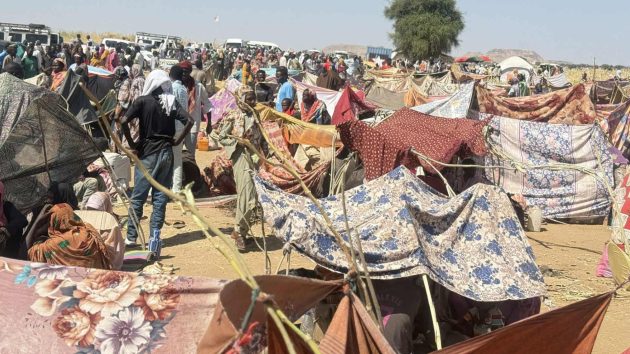
Tens of thousands of Sudanese are fleeing west Darfur’s capital after the Rapid Support Forces (RSF) seized El-Fasher, turning the city into another front of mass displacement and reported atrocities. Aid groups said Saturday that more than 16,000 people have reached Tawila, 70 kilometers (43 miles) away, since the city’s fall on October 26. Many arrive with nothing but what they carried, joining crowds already displaced by earlier battles.
The camp in Tawila is overwhelmed. Shelters are made from patched tarps and sheets. Food lines stretch through the dust. Videos from Sudan’s IDPs and Refugee Camps group show children running between tents and adults sharing a single pot of food. The International Organization for Migration estimates 82,000 people have fled the El-Fasher area overall, some walking for days to reach safety.
At Tawila Hospital, Doctors Without Borders reports at least 1,500 recent arrivals with fractures and other injuries.
When Rashid, @UNICEF’s WASH Specialist, returned to Tawila, he stood in silence.
The quiet town he once knew now shelters tens of thousands fleeing violence in #AlFasher.
🎥 Listen to Rashid share what he saw & how UNICEF is helping families reclaim a sense of safety and hope. pic.twitter.com/IZCEFbQui6
— UNICEF Sudan – اليونيسف في السودان (@UNICEFSudan) November 8, 2025
The RSF’s assault on El-Fasher followed an 18-month siege that left the city starved of aid. Witnesses describe mass killings, sexual assaults, and executions. The World Health Organization says more than 450 people were killed inside the Saudi Hospital alone. Satellite images and survivor accounts show homes torched and bodies in the streets. The RSF denies the accusations.
UN Human Rights Chief Volker Türk said many civilians remain trapped.
“Traumatised civilians are still trapped inside El Fasher and are being prevented from leaving,” Türk warned Friday in Geneva. “The exit routes themselves have been the scenes of unimaginable cruelty.”
Fighting continues despite a US-brokered ceasefire proposal from the Quad mediators. The RSF said it accepted the plan, while the army insists any truce must begin with RSF withdrawal from civilian areas and disarmament. The war, which began in April 2023, has killed at least 40,000 people and displaced 12 million. Nearly half of Sudan’s population faces acute hunger.
The conflict is spreading beyond Darfur. In North Kordofan, a drone strike on El-Obeid killed at least 40 this week. The army said it intercepted two more drones on Saturday morning.
Analysts say the fall of El-Fasher and new strikes in Kordofan mark both a battlefield win for the RSF and a deepening humanitarian collapse.
NEW | The Rapid Support Forces (RSF) and Sudanese Armed Forces (SAF) are setting conditions to launch new offensives across central Sudan.
These preparations signal that neither side is genuinely interested in peace, which will undermine US-led peace efforts to secure a… pic.twitter.com/Pf9PVOreaR
— Critical Threats (@criticalthreats) November 7, 2025
Sudan’s war has no front line left—only roads of flight, lined with the displaced and the dead.
Sources: News Agencies








COMMENTS