

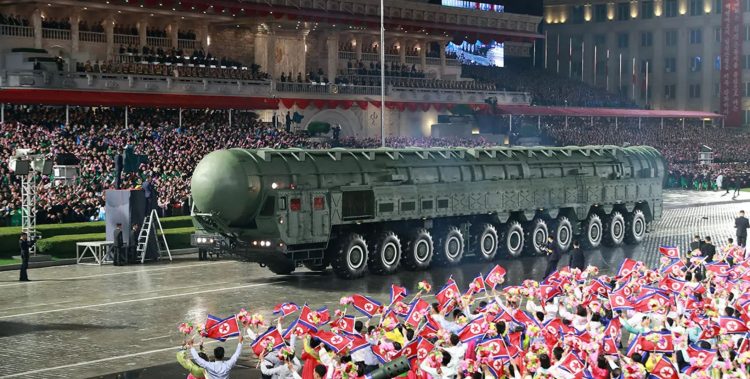
Pyongyang Rolls Out the Hwasong 20. The Message Is Aimed Far Beyond the Parade Ground
North Korea turned its anniversary party into a weapons expo. On Friday night in Pyongyang, the Workers’ Party of Korea (WPK) marked its 80th year with a military parade that put a new intercontinental ballistic missile (ICBM) named Hwasong 20 at center stage. Kim Jong Un presided. Chinese Premier Li Qiang, Russia’s former President Dmitry Medvedev, and Vietnam’s Communist Party chief To Lam watched from the stands, a guest list chosen to signal alignment.
State media billed Hwasong 20 as the most powerful nuclear strategic system in the arsenal. Analysts who spoke to international outlets say the design likely uses solid fuel and may be built for multiple reentry vehicles, a path meant to stress missile defenses and speed launch timelines. The missile rode an 11-axle transporter erector, a clue about weight and size, but there has been no public flight test yet. The practical questions remain the hard ones. Can the payload survive reentry? Can guidance stay precise end-to-end? Skeptics are not short of material there.
Hypersonic glide vehicles (HGVs) also rolled by. North Korea portrays them as maneuverable warheads designed to complicate interception. That tracks with the broader playbook we have watched for years, which is to push variety and saturation to dilute the advantages of U.S. and allied missile defense.
The politics mattered as much as the hardware. Kim used the moment to cast the force as an unstoppable shield against outside pressure and to celebrate deepening ties with Moscow and Beijing. Reporting from the scene noted Medvedev’s remarks about North Korean personnel aiding Russia, and separate coverage captured Kim’s praise for troops abroad. Those claims are politically loaded, so file them as assertions by Russian and North Korean leaders rather than independently verified facts. The optics are clear either way. The Democratic People’s Republic of Korea (DPRK) wanted the world to see that it is not isolated in its neighborhood.
What happens next? Western analysts expect test activity to follow the parade, potentially to validate the Hwasong 20 and the hypersonic systems. Until a flight profile and reentry are proven, range and accuracy claims stay in the theoretical bucket. But procurement and doctrine are built on signals, and tonight’s signal was unambiguous. The DPRK is moving toward faster-firing solid-fuel ICBMs and maneuvering warheads while tightening diplomatic links with China, Russia, and Vietnam. Watch for launch notices and for any new sanctions talk that tries to crowd that effort. The parade told us what they want us to believe. The tests, if they come, will tell us what they can do.
❗️🇰🇵🤝🇷🇺 – North Korea held a military parade to mark the 80th anniversary of the Workers’ Party of Korea’s founding.
On the podium beside Kim Jong Un were China’s State Council Premier Li Qiang, Vietnam’s leader To Lam, and Russia’s Deputy Chairman of the Security Council,… pic.twitter.com/Y8y3TLfsRA
— 🔥🗞The Informant (@theinformant_x) October 11, 2025
India Upgrades Its Kabul Outpost To A Full Embassy. The Message To The Region Is Clear.
New Delhi just moved from cautious engagement to active presence in Afghanistan. During a rare visit by Taliban Foreign Minister Amir Khan Muttaqi, External Affairs Minister S. Jaishankar announced that India will upgrade its technical mission in Kabul to a full embassy. That is the strongest signal of re-entry since India pulled staff in 2021 and returned a small team in 2022.
This shift matches the regional chessboard. Pakistan and China already talk directly with the Taliban government. India is done watching from the sidelines. Jaishankar framed the decision as support for Afghan development and regional stability, while keeping recognition off the table for now. The line is pragmatic. Engage for security and influence. Hold judgment on formal recognition.
The visit carried a hard security edge. Both sides condemned terrorism from “regional countries,” a phrase that lands where you think it does. New Delhi has made cross-border militancy a constant theme in talks with Kabul. That theme was present again this week.
Economics followed the security brief. Kabul invited Indian firms to look at mining and trade routes. Jaishankar said the offer would be explored, which tracks with India’s interest in critical minerals and connectivity through Chabahar and, if it ever opens, overland corridors. None of this is easy. It does show where both capitals want the conversation to go.
Aid and access matter on the ground. India paired the embassy upgrade with development and humanitarian steps that keep its brand visible in Afghan clinics, classrooms, and projects. That is classic Indian statecraft in Afghanistan. Build durable ties through services people use every day.
The optics were not all positive. A press event in New Delhi barred women journalists. The backlash was fast and loud. India’s foreign ministry said it had no role in the presser, which took place at the Afghan embassy. The incident is a reminder that rights concerns remain a central obstacle to wider international acceptance of Taliban rule.
Bottom line. Upgrading to a full embassy gives India more eyes, more access, and more leverage in Kabul. It does not equal recognition, and it does not erase the risks. Expect steady coordination on counterterrorism. Expect Indian companies to kick tires on mining and logistics. Watch the rights file because that is where the politics get hot quickly. For now, India is back in Kabul with a larger footprint and a simple message. We are in the room again, and we plan to stay.
Afghanistan’s Foreign Minister, Amir Khan Muttaqi, who represents the Taliban government, arrived at Darul Uloom Deoband in India — and was received with respect and warmth by the people there.
A moment that shows how times change pic.twitter.com/1omu93bEOL
— Mazhar Khan (@Mazhar4justice) October 11, 2025








COMMENTS