

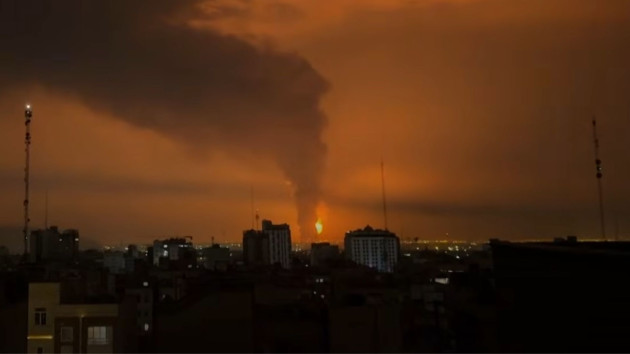
In Tehran, Israeli strikes set major oil storage facilities ablaze, marking the first confirmed attacks on civilian industrial energy infrastructure inside the capital. Multiple fuel depots and a production transfer center were reportedly hit across Tehran province and nearby Karaj, triggering large fires and localized fuel leaks. Iranian authorities said distribution networks remain functional despite damage.
Thick smoke rises over Tehran after Israeli airstrikes hit Iran’s oil facility
◾️ Strikes targeted several fuel storage sites including Shahran Oil Depot and other depots in Tehran and nearby areas
◾️ US-Israeli strikes on Iran entered ninth day as regional conflict continues… pic.twitter.com/IfvdjZfydE
— Anadolu English (@anadoluagency) March 8, 2026
Iranian officials accused the United States of striking a desalination facility on Qeshm Island, while Tehran reportedly targeted desalination infrastructure in Bahrain. The exchange places critical water supply systems inside the conflict envelope, a sensitive threshold in a region heavily dependent on desalination.
Meanwhile, casualty counts continue to rise. Iranian authorities report more than 1,200 fatalities since February 28, including hundreds of women and children. Regional tallies indicate more than 300 deaths in Lebanon and about a dozen in Israel.
Independent verification remains limited, but the trajectory points to sustained high-intensity operations.
Energy markets reacted sharply to the widening target set. According to the Associated Press report, Brent crude climbed to $92.69 per barrel while US benchmark crude reached $90.90, both the highest levels since 2023. Iranian lawmakers warned prolonged fighting could disrupt oil production and exports, amplifying strain on global supply chains already pressured by maritime security risks.
Israeli officials say the fuel facilities supported military logistics. Regional analysts assess the strikes as a dual-purpose campaign aimed at constraining operational mobility while exposing economic vulnerabilities deep inside Iranian territory.
A Tehran oil refinery is on fire pic.twitter.com/5n5VwaLTQG
— Open Source Intel (@Osint613) March 7, 2026
The conflict is moving beyond conventional force-on-force exchanges toward infrastructure disruption and economic pressure. Targeting fuel and water assets expands strategic leverage but raises environmental, humanitarian, and market risks.
If this pattern holds, operational tempo will increasingly be measured by systemic disruption rather than battlefield movement.
China Signals Thaw With US Ahead of Expected Leaders’ Summit
China struck a measured, conciliatory tone toward the United States, signaling interest in stabilizing ties ahead of a potential summit between US President Donald Trump and Chinese President Xi Jinping later this month.
Speaking on the sidelines of China’s annual legislative session on Sunday, Foreign Minister Wang Yi described the year as a potential “landmark” period for bilateral relations. He emphasized continued high-level communication between both leaders and framed it as a stabilizing force amid persistent strategic rivalry.
Chinese FM Wang Yi: major powers must act ‘in the spirit of justice and righteousness’
‘China stands ready to work with Middle Eastern countries to restore order and restore peace to the world’ pic.twitter.com/Q4pEim6k47
— RT (@RT_com) March 8, 2026
While Beijing stopped short of confirming a summit visit, officials signaled preparations are underway and called for managing disputes while reducing political friction. The messaging suggests China is seeking a more predictable relationship as economic and security tensions persist.
Relations have remained strained since the trade war was launched during Trump’s first term. A temporary tariff truce reached last year paused further escalation but left structural disputes unresolved, including market access, technology controls, and trade imbalances.
Beyond bilateral ties, Beijing used the moment to reinforce its positioning as a defender of multilateral institutions. Wang stressed support for the United Nations, where China holds a permanent Security Council seat, contrasting Beijing’s posture with Washington’s pullback from several UN initiatives.
Chinese officials also promoted the Global Governance Initiative, a framework introduced by Xi that places the United Nations at the center of international security coordination. The initiative reflects Beijing’s push to shape global governance structures as US influence fluctuates.
On regional security, Wang called for an immediate halt to military operations in Iran, urging major powers to return to negotiations. The appeal aligns Beijing with de-escalation efforts while avoiding direct confrontation with Washington.
The path of Latin American and Caribbean (LAC) countries should be chosen by their people, and the choice of friends should be made by LAC countries themselves, Chinese Foreign Minister Wang Yi said at a press conference on Sunday on the sidelines of the fourth session of the… pic.twitter.com/L3Q4S4nBdx
— Global Times (@globaltimesnews) March 8, 2026
Beijing’s messaging signals tactical restraint rather than strategic alignment. By projecting openness and backing multilateral frameworks, China is positioning itself as a stabilizing power while preserving leverage in its competition with Washington.
A leaders’ summit could pause friction, but structural rivalry remains the defining feature of the relationship.
Sources: News Agencies








COMMENTS