

The driver’s station looks less like a traditional armored vehicle and more like a racing simulator. A Fanatec controller, closer to a gaming input than a tank tiller, sits at the center of the layout. The logic is blunt and practical: younger soldiers adapt faster to familiar interfaces, and training time matters when manpower is tight.
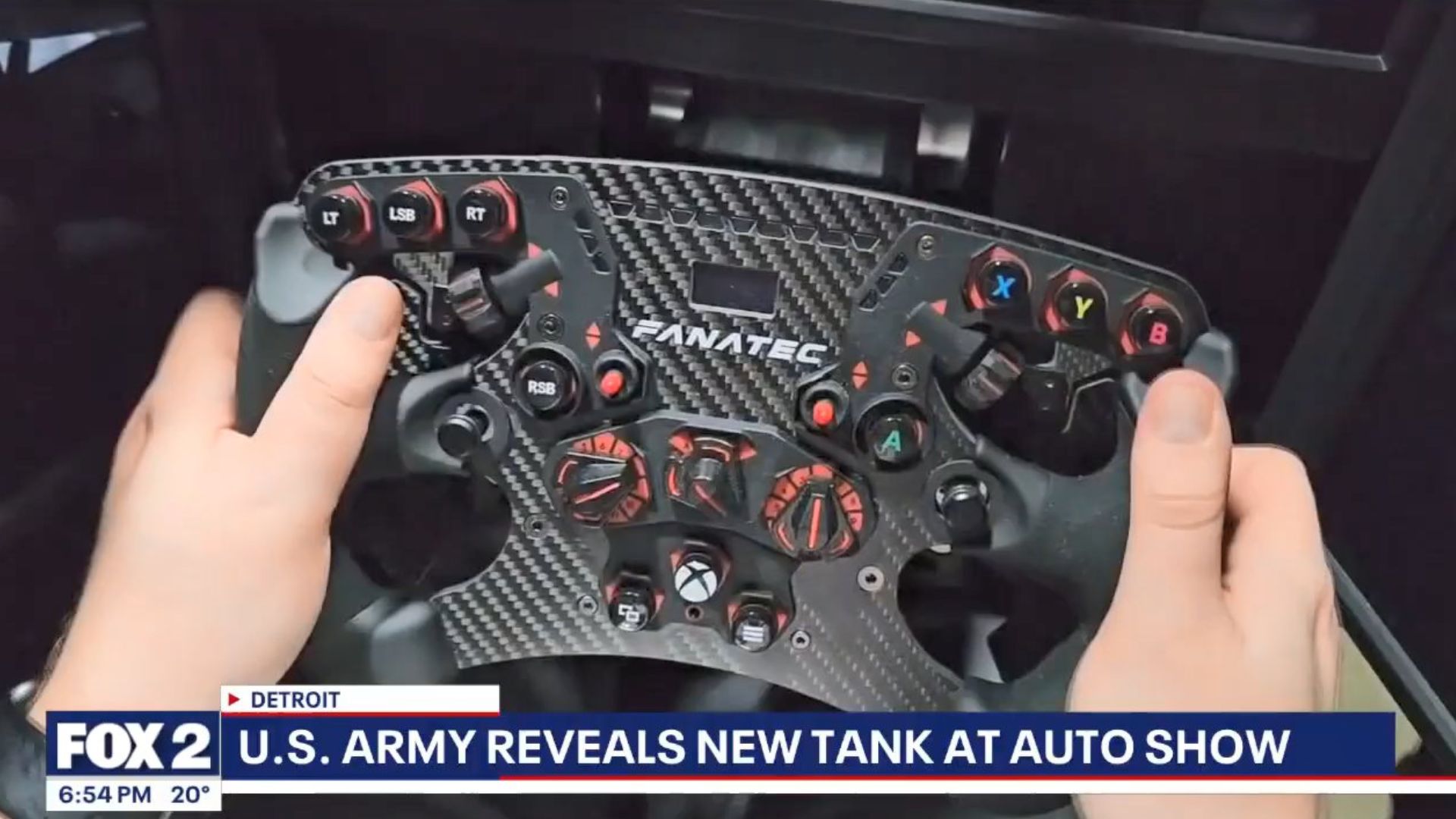
Displays are fully digital and configurable. Controls are software-defined. The Army has even acknowledged that the prototype can move and fire with a single crew member onboard—not as doctrine, but as proof of how far automation has advanced.
This is not about comfort. It is about reducing cognitive load in a fight that now arrives faster and from more directions than ever before.
Mobility as Strategy
Under the armor, the M1E3 points toward another break from tradition.
The prototype unveiled in Detroit represents a transition toward a hybrid-electric future, built around commercial automotive components and a Caterpillar engine. The goal here is to cut fuel consumption by roughly half, shrink the logistical tail, and make the tank easier to move globally.
Weight matters again. The Army believes the final design could be as much as 25 percent lighter than current Abrams variants, making air and sea transport faster and cheaper.
The U.S. Army’s first M1E3 Abrams prototype features:
Reduced weight: ~60 tons for better mobility.
Hybrid-electric propulsion: Quieter, more fuel-efficient, extended range.
Unmanned turret with autoloader: Smaller crew, faster firing.
Active Protection System: Intercepts… https://t.co/BRNTACNQ0p pic.twitter.com/8sqnZEVbn7
— Open Source Intel (@Osint613) December 15, 2025
Speed here is not about racing across terrain, but rather about arriving at the fight at all.
Built Fast, Tested Early
What makes the M1E3 notable is not just what it is, but how quickly it arrived.
Originally envisioned on a timeline stretching toward 2030, development was compressed dramatically.
The first prototype was delivered in December 2025, just months before its public unveiling. Four prototypes are scheduled to enter soldier testing in 2026, cutting the original development schedule by roughly two-thirds.
US Army Chief of Staff General Randy George has been explicit: lessons from Ukraine and other modern battlefields cannot wait for perfect designs. Feedback from real units will shape the tank as much as engineers will.
This is acquisition as iteration, not perfection.
Gen. Randy George, @USArmy Chief of Staff, paid a visit to the 2026 #detroitautoshow — we’re honored to have you, General! 🇺🇸 The #USArmy unveiled an M1E3 Abrams early prototype last week at the Detroit Auto Show, showcasing cutting-edge advancements in firepower & mobility. pic.twitter.com/9c01T8gIxe
— Detroit Auto Show (@detautoshow) January 21, 2026
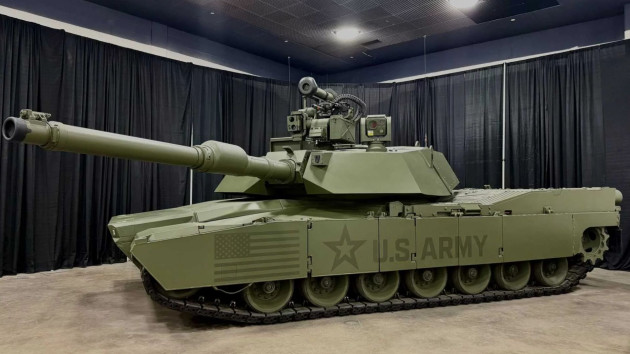
What the Photo Captures
This image from Detroit is not about spectacle. It is about transition.
The M1E3 Abrams is not the end of the Abrams story. It is a hinge point. A moment where the Army openly accepts that survivability now comes from networks as much as armor, and that adaptability may matter more than mass.
The final M1A3 will look different. Systems will change. Designs will evolve. But in this moment, under auto show lights far from any battlefield, the Abrams lineage takes a clear step into the future.
Not heavier.
Not slower.
Just built for the war that is already here.








COMMENTS