The faceted black jet was dragged across a Saudi ramp like contraband in broad daylight, and if you listen closely you can hear the old rules of air war cracking in half.
Read the full article for more on:
Important insights and detailed analysis
Expert commentary on current events
Breaking developments and updates
Updating summary...
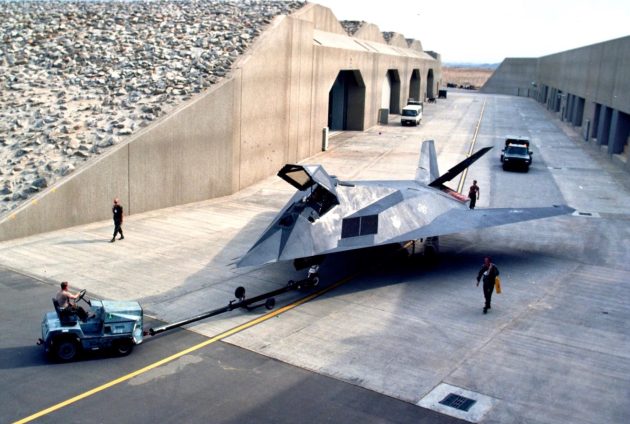
SOFREP Pic of the Day: An F117A Nighthawk at King Khalid Air Base During Operation Desert Shield
Guy D. McCardle
Speed
1x
Listen
COMMENTS
The faceted black jet was dragged across a Saudi ramp like contraband in broad daylight, and if you listen closely you can hear the old rules of air war cracking in half.
The F-117A Nighthawk rolls quietly across a Saudi air base in Desert Shield, a faceted ghost in broad daylight waiting for night to make it lethal. Image credit: Reddit.
The Black Jet in the Saudi Sun
From our 21st-century perspective, there is nothing glamorous about this photograph at first glance. A jet shaped like a bad idea ripped straight from an eighth grader’s geometry textbook is being towed across a sun-blasted ramp at King Khalid Air Base in Saudi Arabia.
Advertisement
There is no afterburner roar. No takeoff roll. No crowds eyballing the alien-looking aircraft. And yet this moment sits right at the hinge of modern air warfare. It’s a snapshot of history.
By January 1991, the world knew the F-117A Nighthawk existed, but only barely. The U.S. Air Force had acknowledged it publicly in November 1988, ending years of outright denial, while revealing almost nothing that mattered. It was stealthy. It flew at night. That was the menu, and everything else stayed locked up in the kitchen. When Iraq invaded Kuwait on August 2, 1990, and Operation Desert Shield began, the Nighthawk arrived in theater with that same attitude. Present, quiet, and profoundly misunderstood.
King Khalid Air Base, near Khamis Mushait in southwest Saudi Arabia, was an unlikely stage for history. Sitting more than 6,700 feet above sea level, with a long concrete runway built for Cold War survivability, the base offered space, altitude, and distance. During Desert Shield and the transition to Desert Storm, it became one of the forward homes of the 37th Tactical Fighter Wing and its black jets. This was not a test range anymore. This was the waiting room before the opening night of a war that would be broadcast live to the world.
Advertisement
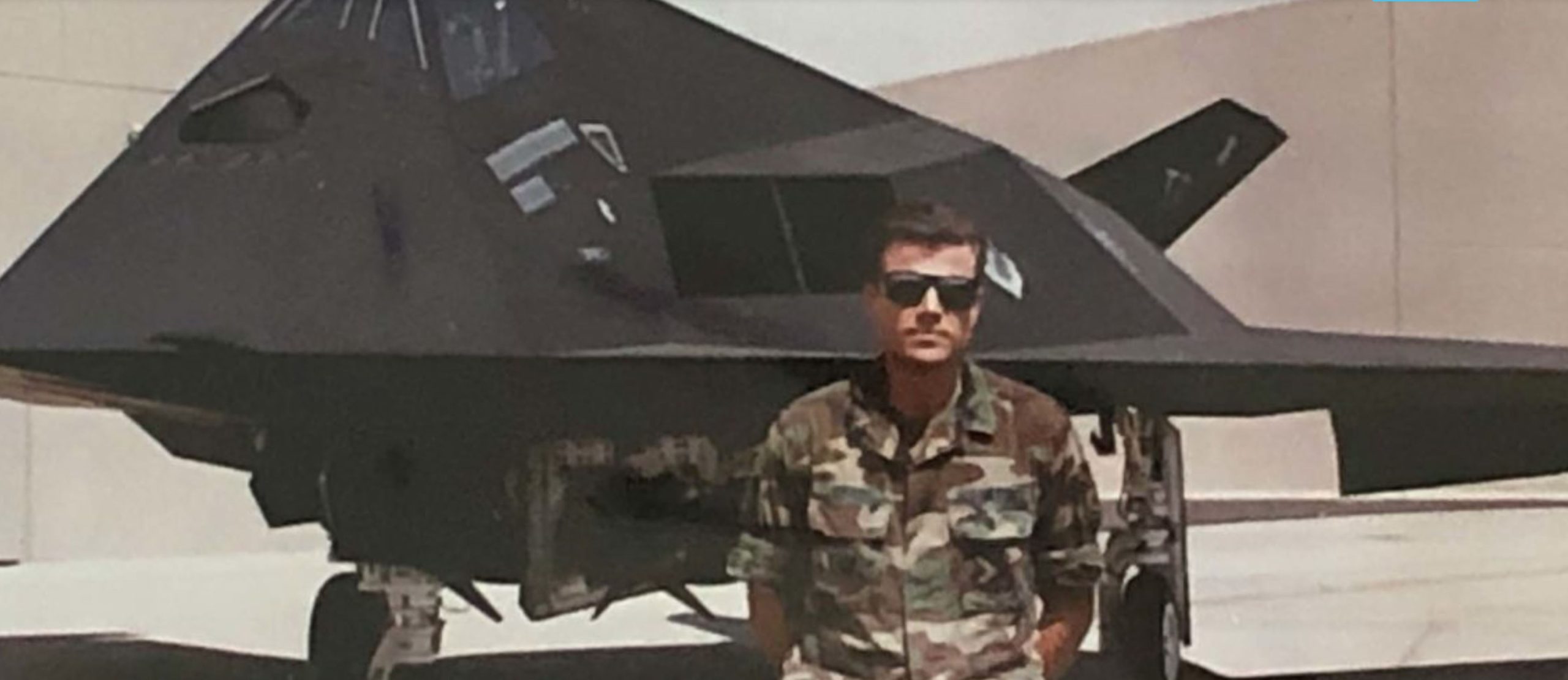
One of the aforementioned black jets. Could that be duct tape up there by the cockpit? Image Credit: Diane Simard
A Machine Built by Math, Not Romance
The F-117A was never meant to be loved. It was born from slide rule equations, radar cross-section charts, and the cold logic of survivability. Developed at Lockheed’s Skunk Works from the Have Blue demonstrator under the Senior Trend program, it first flew in 1981 and became the world’s first operational stealth aircraft. Fifty-nine production aircraft were built between 1981 and 1990, each one a painful compromise between what engineers wanted and what physics would tolerate.
Its faceted shape was not a design flourish. Early computers could not model smooth curves effectively, so engineers broke the aircraft into flat panels that scattered radar energy away from the source. The result looked like it had been assembled with a ruler and a grudge, but it worked.
Advertisement
The jet was aerodynamically unstable and entirely dependent on fly-by-wire flight controls to stay airborne. There was no onboard radar. No air-to-air armament. Its job was singular and unapologetic: carry laser-guided bombs inside internal bays, slip through dense air defenses at night, hit targets others could not touch, and leave without being invited to stay.
Officially, the U.S. Air Force labeled the F-117 a “fighter,” which is why it carried the “F” in its designation, but in practical terms, it flew like a precision bomber. The naming was largely bureaucratic because fighters drew funding, priority, and less doctrinal friction than anything branded a bomber, which mattered for a program that lived in the shadows.
Once airborne, the aircraft did nothing that resembled a classic fighter mission: it had no air-to-air radar, no air-to-air weapons, and no business mixing it up for air superiority. Its entire purpose was to slip into defended airspace at night, drop laser-guided bombs from internal bays, and leave before anyone could put a finger on what hit them. It wore a fighter’s letter, flew a bomber’s mission, and helped make the old labels start to crack.
Quiet Power and Hot Air Tamed
Power came from two non-afterburning General Electric F404-GE-F1D2 engines, closely related to those used in the F/A-18. Without afterburners, the F-117 avoided the infrared signature and fuel penalties that would have betrayed its presence. Even the exhaust was engineered for discretion, flattened and routed to mix hot gases with cooler air, reducing its heat signature before it ever met the night sky.
This was stealth as a system, not a coating. Radar shaping, materials, mission planning, and disciplined operations all worked together. Taxiing was often minimized. Ground time was controlled. Even on a crowded coalition base, the Nighthawk lived by different rules.
Opening the Door in Desert Storm
When Desert Storm began on January 17, 1991, the F-117A went straight to work. It flew 1,271 sorties during the conflict, striking heavily defended targets in Baghdad and beyond. Air defense nodes, command and control centers, leadership bunkers. The places that mattered most, early, and at night. Published Air Force figures credit the aircraft with a high mission success rate and no combat losses during the war, though later government reviews questioned how some effectiveness claims were measured and reported.
What is not in dispute is its impact. The Nighthawk helped collapse Iraq’s integrated air defenses and command structure in the opening hours of the war. It was the high-tech aviation equivalent of a door kicker.
After the Spotlight Faded
The F-117 continued flying combat missions after the Gulf War, seeing action in Panama, the Balkans, Afghanistan, and Iraq. In 1999, one was shot down over Serbia, a reminder that stealth reduced risk but never eliminated it. It is easy to forget that the aircraft was officially retired in 2008, its mission absorbed by newer platforms with broader capabilities.
Today, the F-35 Lightning II carries forward the tactical stealth strike role, while aircraft like the B-2 Spirit and the incoming B-21 Raider handle deep-penetration missions at the strategic level. They are sleeker, faster, more connected. None of them looks quite as honest about what they cost to build.
Today’s featured photograph captures the F-117 in its element, uncelebrated and unbothered. Just a machine built to do one thing well, waiting patiently in the desert heat for the moment when the lights would go out, and all at once the future would arrive on schedule.
Advertisement
What readers are saying
Generating a quick summary of the conversation...
This summary is AI-generated. AI can make mistakes and this summary is not a replacement for reading the comments.










COMMENTS